
A tracking tag on a young whale shark in Australia’s Coral Sea recorded a dive to at least 1,978 meters (6,490 feet). Even that conservative figure beats the previous record of 1,928 meters (6,325 feet), set in the Gulf of Mexico in 2010.
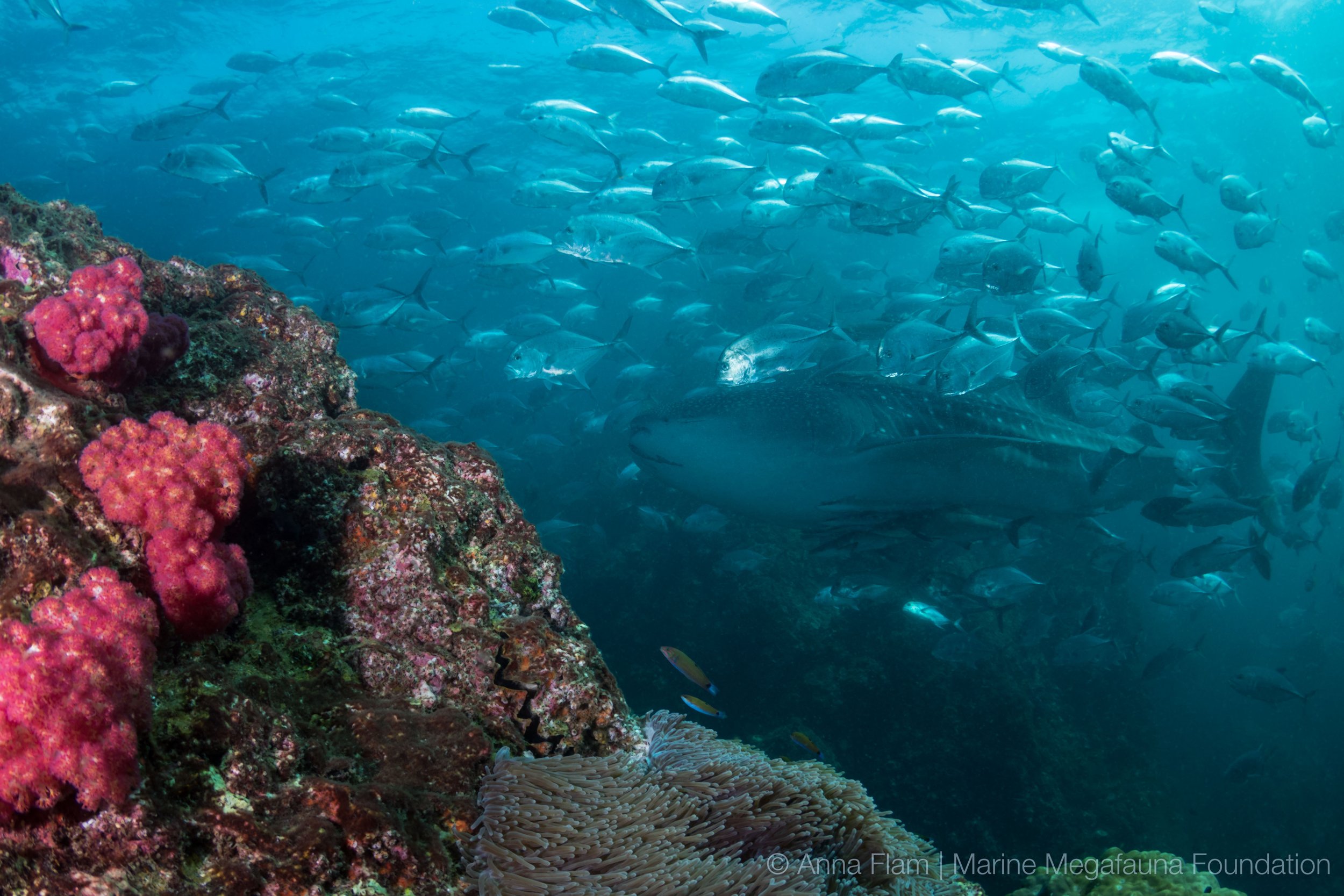
A whale shark swims through a school of trevally at Richelieu Rock, Thailand.
A record from a tagged shark
Whale sharks (Rhincodon typus) spend much of their time near the ocean’s surface. Their deepest dives are much harder to follow, because many tracking tags reach the limit of what they can measure before the sharks reach theirs.
In a new Hydrobiology study, lead author Dr. Ingo Miller of Biopixel Oceans Foundation and colleagues report the deepest dive yet recorded for the species. MMF’s Dr. Simon Pierce is a co-author. On November 26, 2024, the team attached a tag to the fin of a young male whale shark known as Francky. The tag sends its data by satellite and was set up to measure deeper than standard tags. Francky was about 7 meters (23 feet) long and was tagged at Wreck Bay, a recently discovered whale shark gathering site in the far northern Great Barrier Reef.
On October 4, 2025, the tag logged a dive somewhere between 1,978 and 2,527 meters (6,490 and 8,291 feet). The tag reported the dive as falling within a depth range rather than as an exact reading, and the stated range also allows for the sensor’s measurement uncertainty. Even the shallow end of that range is deeper than the previous whale shark record. To the authors’ knowledge, it is the deepest dive recorded for any fish that lives mainly in the ocean’s sunlit surface layer.
Why the depth matters
Francky often dived to between 10 and 500 meters (33 and 1,600 feet), and dives below 1,000 meters (3,300 feet) were less frequent. Based on the shark’s estimated position, the record dive took place over an underwater channel more than 3,000 meters (9,800 feet) deep that links Wreck Bay with the Coral Sea basin. Why whale sharks make such deep dives is still unknown. Suggested explanations include feeding, navigation, controlling body temperature, and gliding to save energy, but this tag could not show what Francky was doing at depth.
The study also shows how much the instruments shape what we know. Some earlier tags released early or failed when sharks dived too deep, and tags can’t always send all their data by satellite, which leaves gaps in the record. The authors suggest that tags built to work even deeper, with settings that send back more of the stored data, could reveal more of the deep water these endangered fish use.
The research was supported by the Queensland Government’s Threatened Species Research grant, the Sapphire Project, Blancpain Ocean Commitment, Georgia Aquarium, and Sea World Foundation. Conservation International, MAC3 Impact Philanthropies, the Slattery Family Trust, and 4planet also funded the work. Read the paper, explore our whale shark species page, or adopt a whale shark to support new research on whale sharks.