Annual report 2021
Our 2021 annual report to read on this page, section by section, beside the report's own pages. Every figure is here; the PDF has the full layout.
About the report
- Covers
- 2021
- Published
- 2022, by the Marine Megafauna Foundation
- Length
- 72 pages
- Format
- PDF, 18.2 MB
2021 in figures
283
Hectares of ocean now included in Barra’s new Locally Managed Marine Area, through a permanent net-fishing ban and a 6-month trial closure of other fisheries
10
New acoustic receivers
967
New swimmers trained by MMF from 2012–21
423
New sharks identified from 2015 to 2021 near Nosy Be in NW Madagascar
3,289
Manta rays now identified by MMF Indonesia from four areas through the country
125
Manta rays now identified by the MMF Florida team
From our co-founders
Pages 2 to 3 of the report
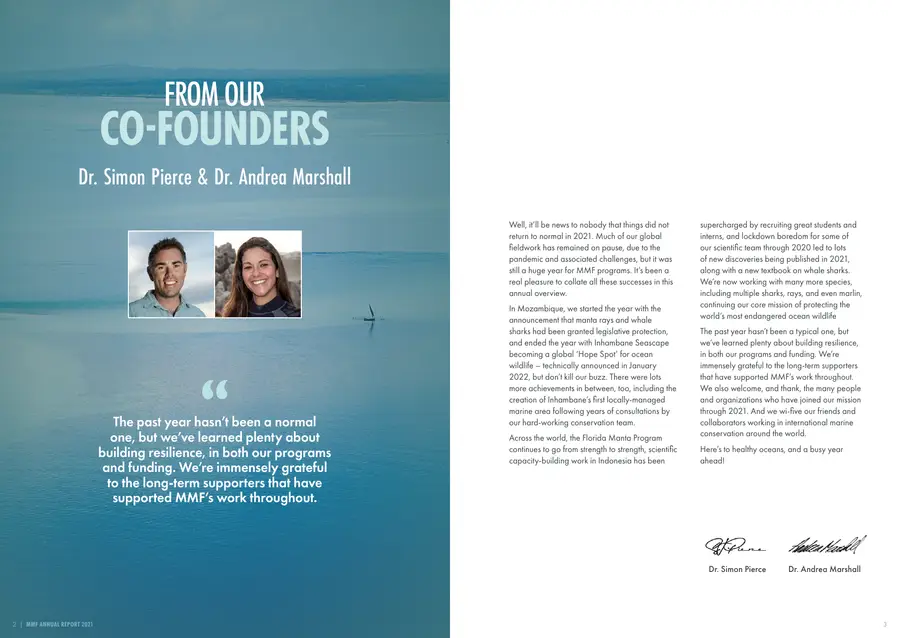
Well, it’ll be news to nobody that things did not return to normal in 2021. Much of our global fieldwork has remained on pause, due to the pandemic and associated challenges, but it was still a huge year for MMF programs. It’s been a real pleasure to collate all these successes in this annual overview.
In Mozambique, we started the year with the announcement that manta rays and whale sharks had been granted legislative protection, and ended the year with Inhambane Seascape becoming a global ‘Hope Spot’ for ocean wildlife (technically announced in January 2022, but don’t kill our buzz). There were lots more achievements in between, too, including the creation of Inhambane’s first locally-managed marine area following years of consultations by our hard-working conservation team.
Across the world, the Florida Manta Program continues to go from strength to strength, scientific capacity-building work in Indonesia has been supercharged by recruiting great students and interns, and lockdown boredom for some of our scientific team through 2020 led to lots of new discoveries being published in 2021, along with a new textbook on whale sharks. We’re now working with many more species, including multiple sharks, rays, and even marlin, continuing our core mission of protecting the world’s most endangered ocean wildlife
The past year hasn’t been a typical one, but we’ve learned plenty about building resilience, in both our programs and funding. We’re immensely grateful to the long-term supporters that have supported MMF’s work throughout. We also welcome, and thank, the many people and organizations who have joined our mission through 2021. And we wi-five our friends and collaborators working in international marine conservation around the world.
Here’s to healthy oceans, and a busy year ahead!
Dr. Simon Pierce and Dr. Andrea Marshall
2021 major impacts
Pages 4 to 13 of the report
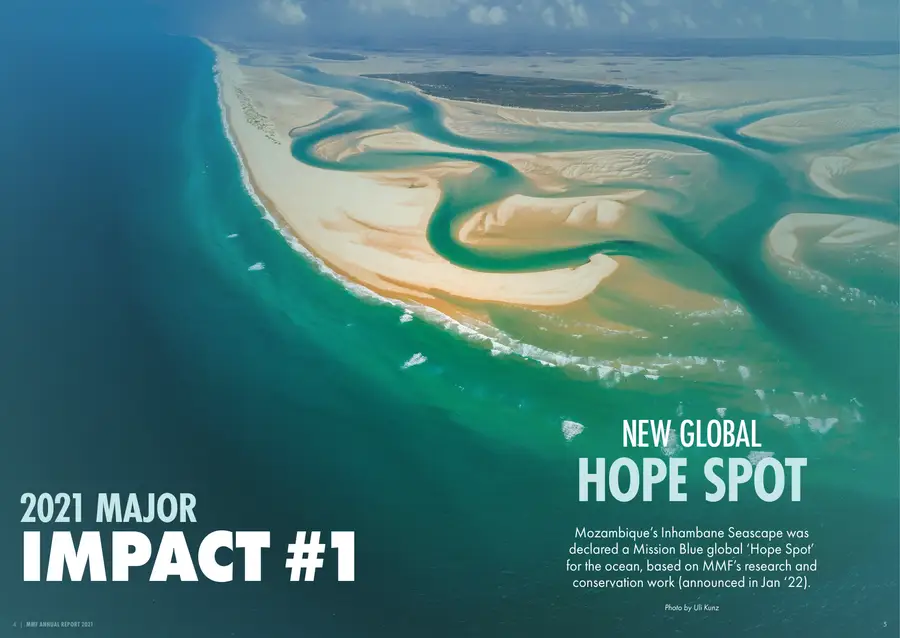
New global Hope Spot
Mozambique’s Inhambane Seascape was declared a Mission Blue global ‘Hope Spot’ for the ocean, based on MMF’s research and conservation work (announced in Jan ‘22).
Wrote the book on whale sharks
MMF Founder, Dr. Simon Pierce, co-authored the definitive book on the world’s biggest fish: Whale Sharks: Biology, Ecology, and Conservation, bringing together top researchers to collate their knowledge of these gentle giants.
Saving pelagic sharks & rays
MMF Founder, Dr. Andrea Marshall, co-authored a Nature paper documenting a global 71% decline in pelagic sharks and rays since 1970, and how we can help them recover.
Protecting Galapagos
MMF’s collaborative research informed the expansion of the Galapagos Marine Reserve protected area, and a swimway was created through to Cocos Island off Costa Rica to protect whale sharks and other endangered ocean wildlife.
Inspiring ocean guardians
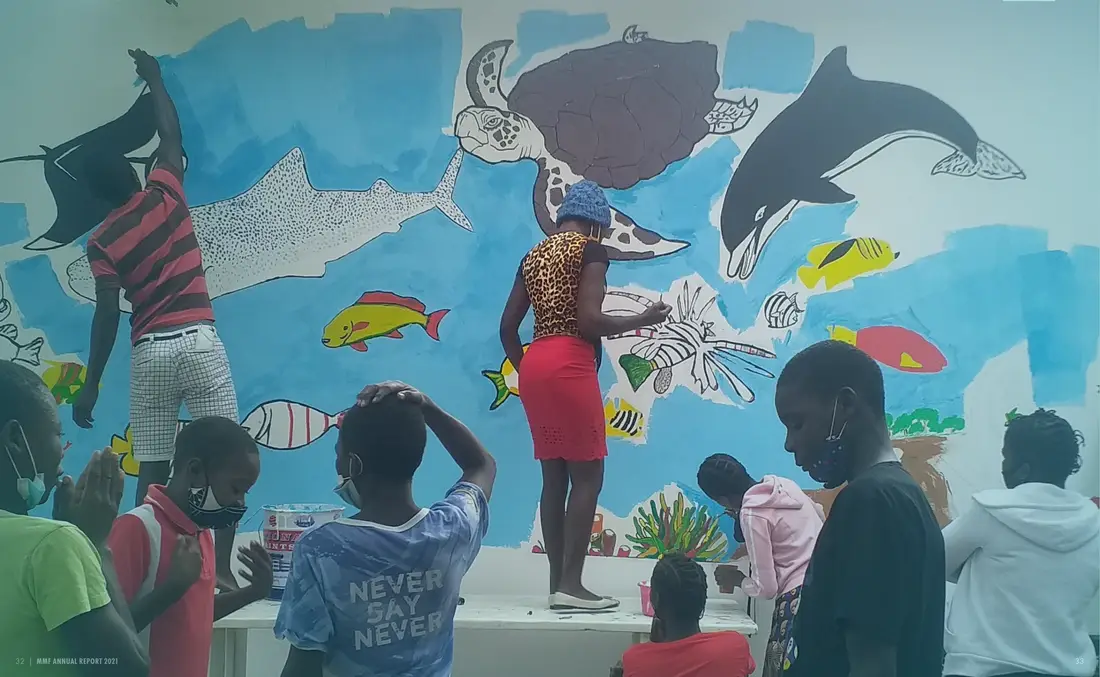
MMF built a new marine environmental education center in Tofo, Mozambique, as a permanent hub for teaching, outreach and training activities.
Our three priority regions
Pages 14 to 15 of the report
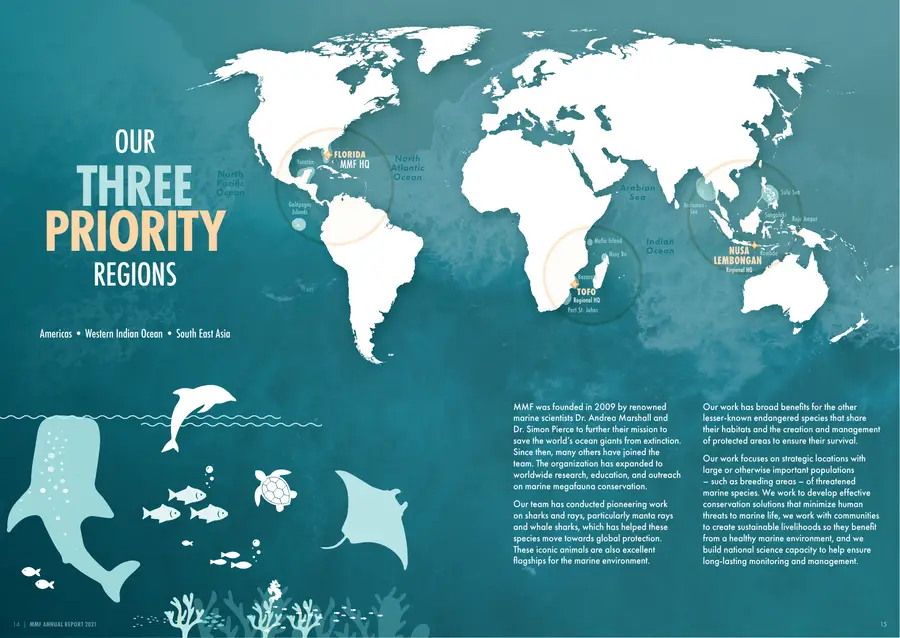
- Americas
- Western Indian Ocean
- South East Asia
- Florida (MMF HQ)
- Yucatán
- Galápagos Islands
- Mafia Island
- Nosy Be
- Bazaruto
- Tofo (Regional HQ)
- Port St. Johns
- Andaman Sea
- Sulu Sea
- Sangalaki
- Raja Ampat
- Komodo
- Nusa Lembongan (Regional HQ)
MMF was founded in 2009 by renowned marine scientists Dr. Andrea Marshall and Dr. Simon Pierce to further their mission to save the world’s ocean giants from extinction. Since then, many others have joined the team. The organization has expanded to worldwide research, education, and outreach on marine megafauna conservation.
Our team has conducted pioneering work on sharks and rays, particularly manta rays and whale sharks, which has helped these species move towards global protection. These iconic animals are also excellent flagships for the marine environment.
Our work has broad benefits for the other lesser-known endangered species that share their habitats and the creation and management of protected areas to ensure their survival.
Our work focuses on strategic locations with large or otherwise important populations (such as breeding areas) of threatened marine species. We work to develop effective conservation solutions that minimize human threats to marine life, we work with communities to create sustainable livelihoods so they benefit from a healthy marine environment, and we build national science capacity to help ensure long-lasting monitoring and management.
Mozambique conservation
Pages 16 to 21 of the report
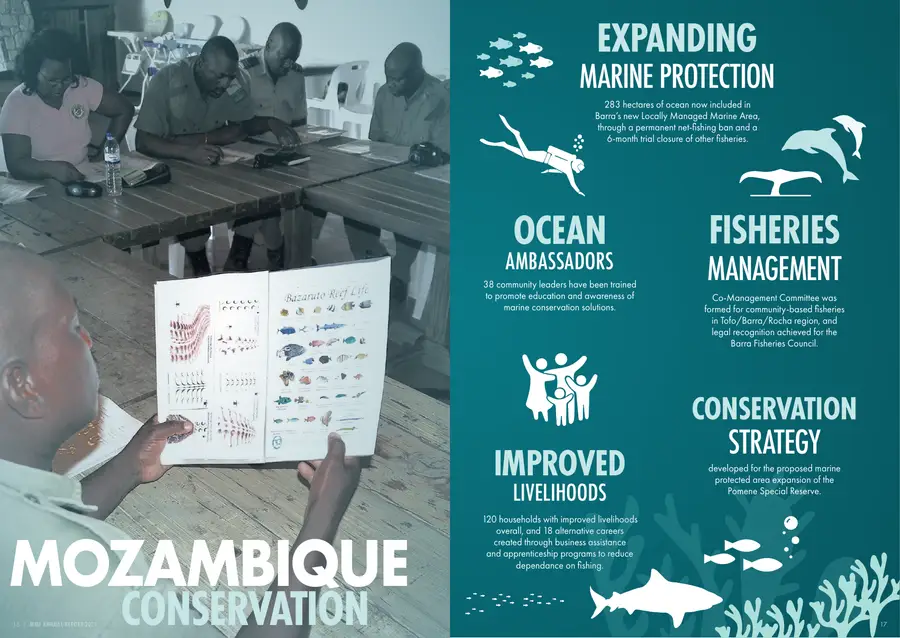
Expanding marine protection
- 283Hectares of ocean now included in Barra’s new Locally Managed Marine Area, through a permanent net-fishing ban and a 6-month trial closure of other fisheries
Ocean ambassadors
- 38Community leaders have been trained to promote education and awareness of marine conservation solutions
Fisheries management
Co-Management Committee was formed for community-based fisheries in Tofo/Barra/Rocha region, and legal recognition achieved for the Barra Fisheries Council.
Improved livelihoods
- 120Households with improved livelihoods overall
- 18Alternative careers created through business assistance and apprenticeship programs to reduce dependance on fishing
Conservation strategy
Developed for the proposed marine protected area expansion of the Pomene Special Reserve.
Mozambique research
Pages 22 to 29 of the report
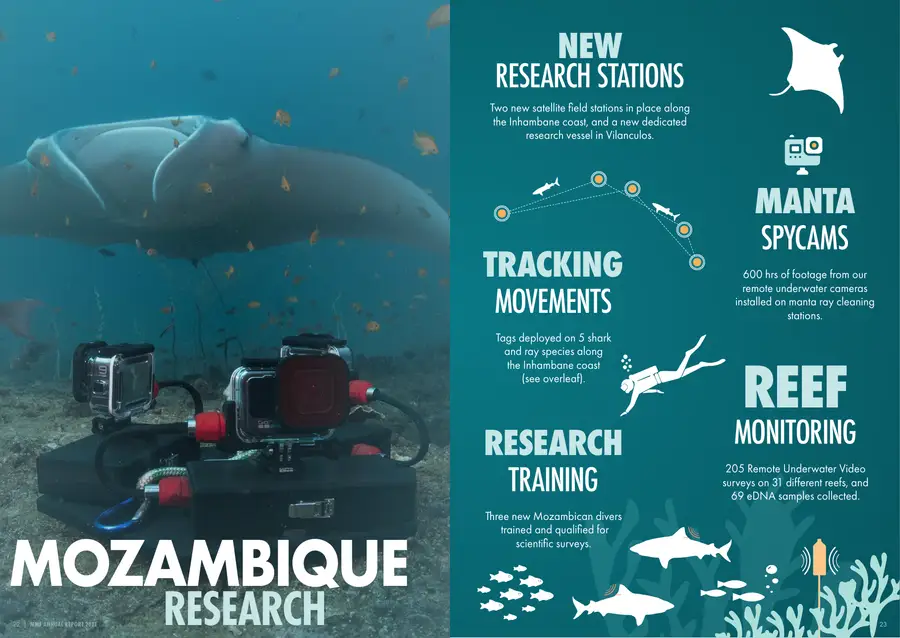
New research stations
Two new satellite field stations in place along the Inhambane coast, and a new dedicated research vessel in Vilanculos.
Manta spycams
- 600 hrsOf footage from our remote underwater cameras installed on manta ray cleaning stations
Tracking movements
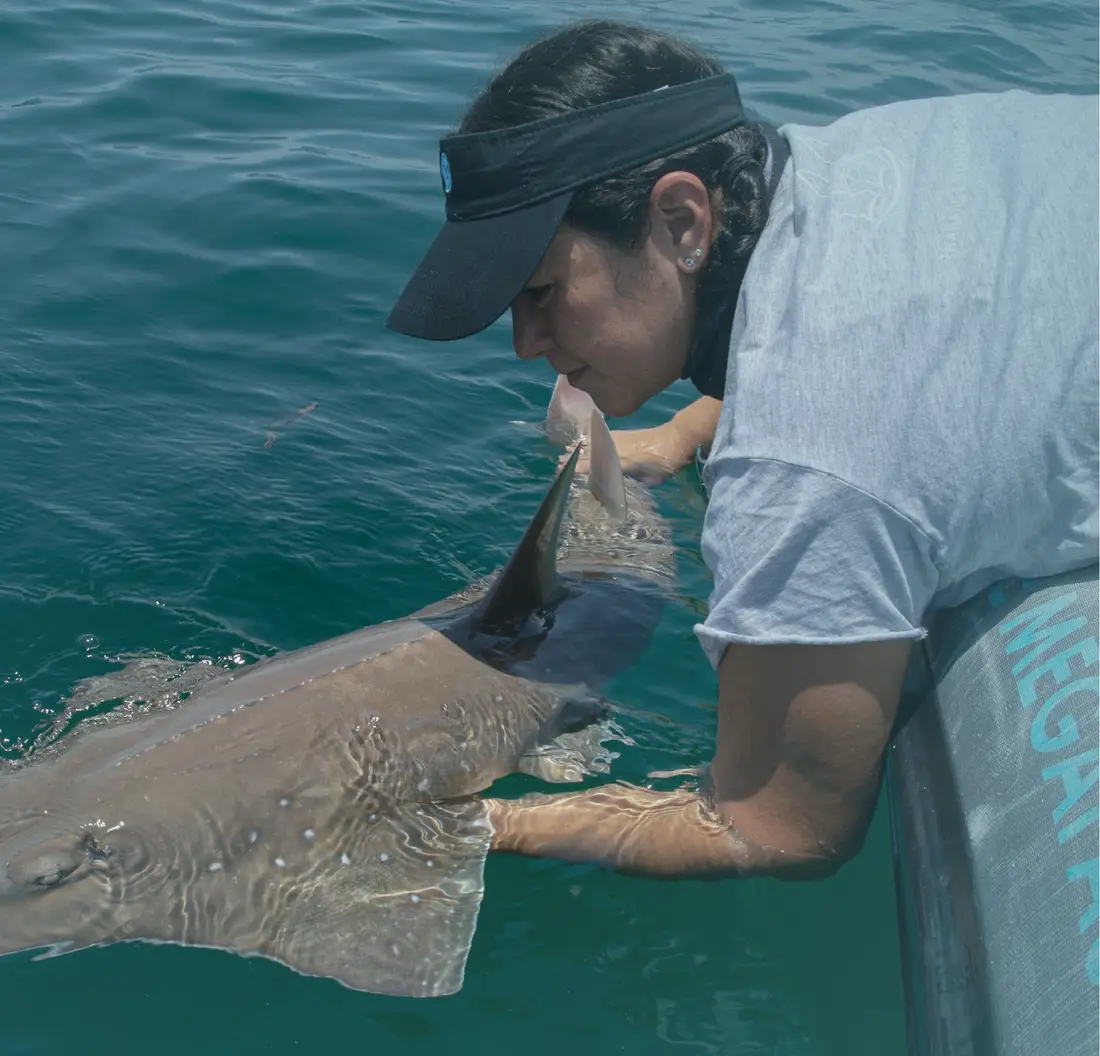
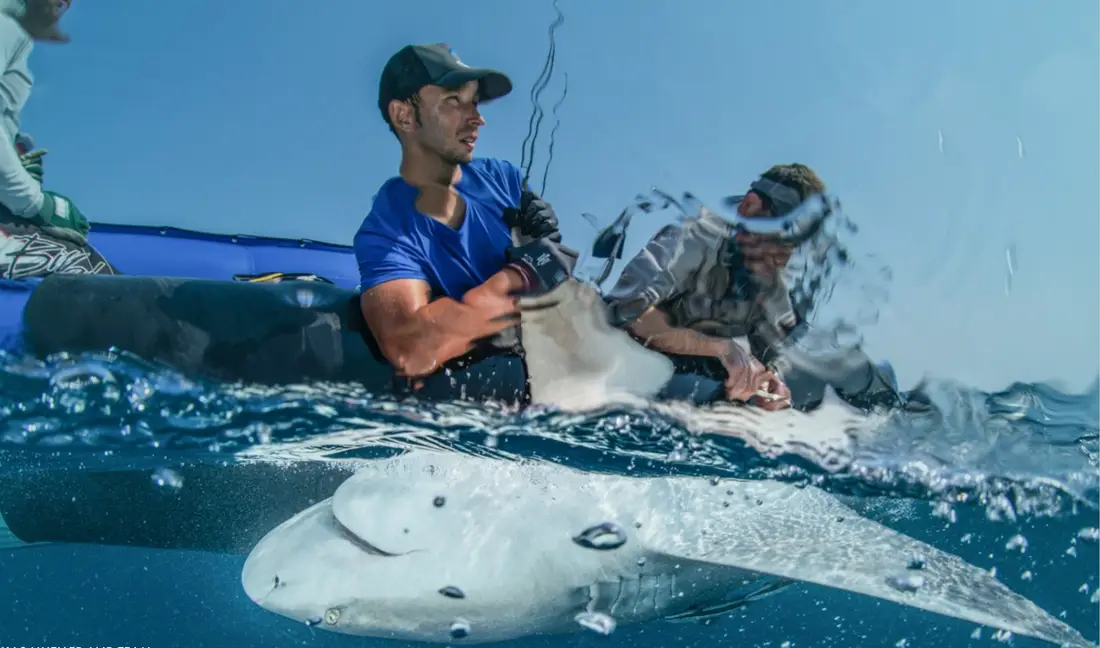
Tags deployed on 5 shark and ray species along the Inhambane coast (see overleaf).
Reef monitoring
- 205Remote Underwater Video surveys on 31 different reefs
- 69EDNA samples collected
Research training
Three new Mozambican divers trained and qualified for scientific surveys.
Expanded the Mozambique tracking network
- 10New acoustic receivers
- Bazaruto Seascape
- Vilankulos
- Pomene
- Morrumbene
- Tofo
- Zavora
We tagged:
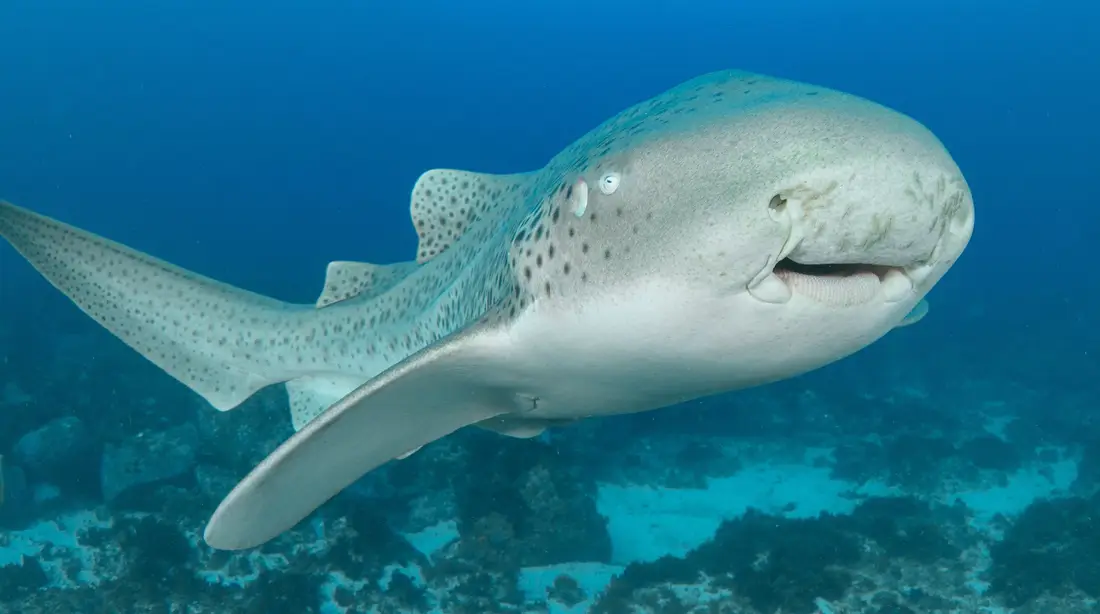
- 2Zebra sharks
- 5Bull sharks
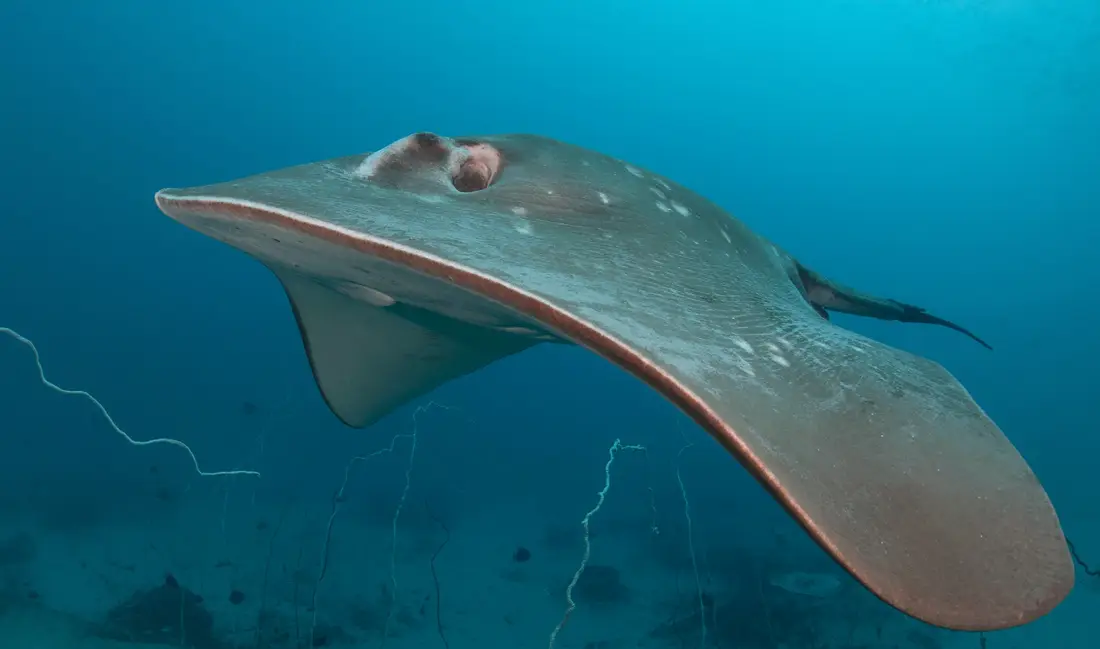
- 6Rhino rays
- 4Smalleye stingrays
Mozambique education
Pages 30 to 35 of the report
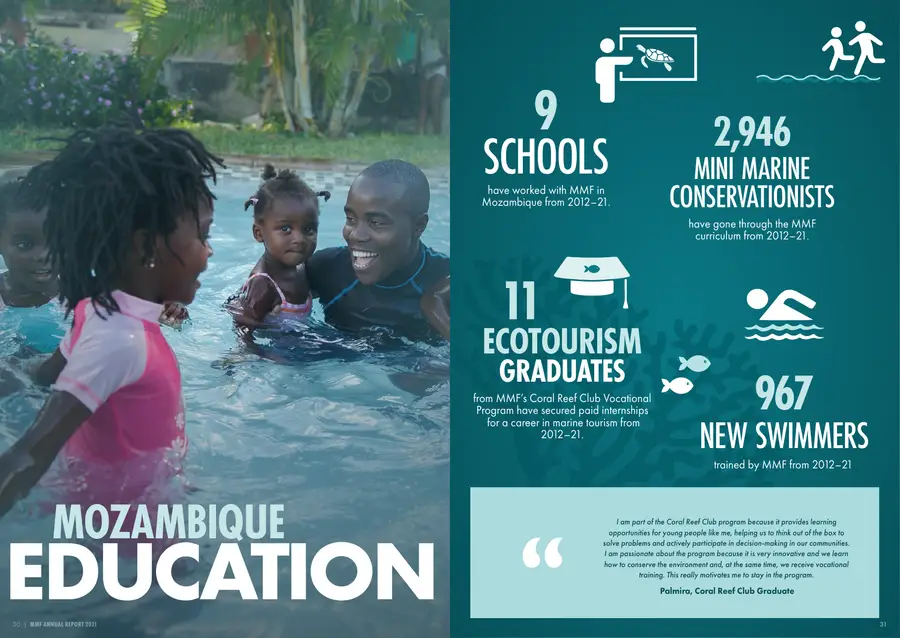
- 9Schools have worked with MMF in Mozambique from 2012–21
- 2,946Mini marine conservationists have gone through the MMF curriculum from 2012–21
- 11Ecotourism graduates from MMF’s Coral Reef Club Vocational Program have secured paid internships for a career in marine tourism from 2012–21
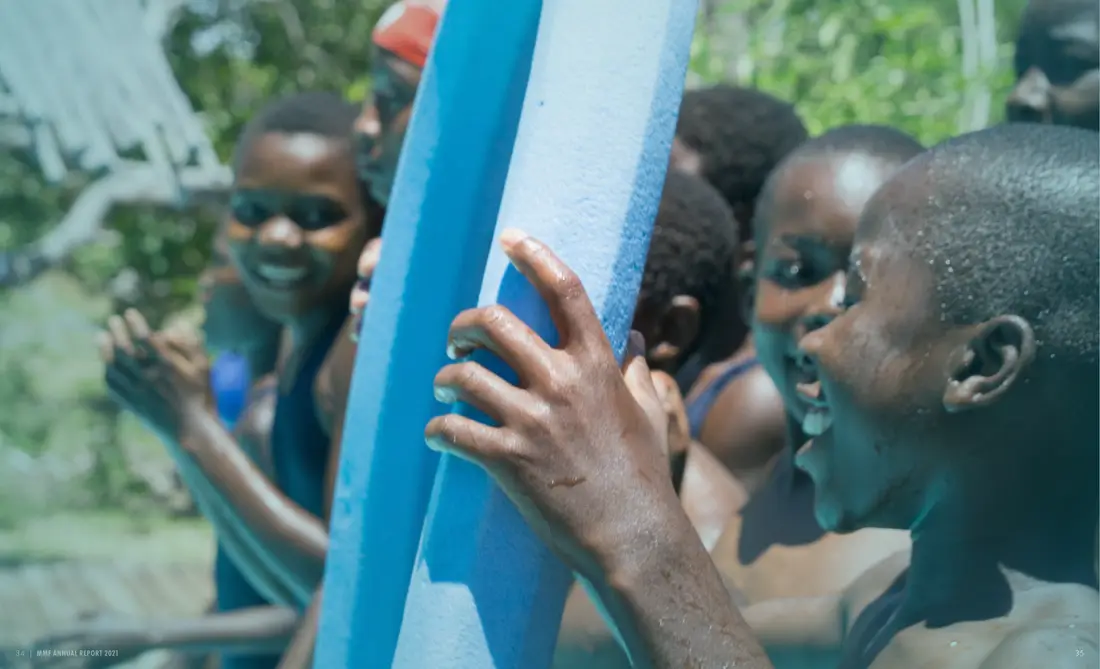
- 967New swimmers trained by MMF from 2012–21
I am part of the Coral Reef Club program because it provides learning opportunities for young people like me, helping us to think out of the box to solve problems and actively participate in decision-making in our communities. I am passionate about the program because it is very innovative and we learn how to conserve the environment and, at the same time, we receive vocational training. This really motivates me to stay in the program.
Madagascar highlights
Pages 36 to 39 of the report
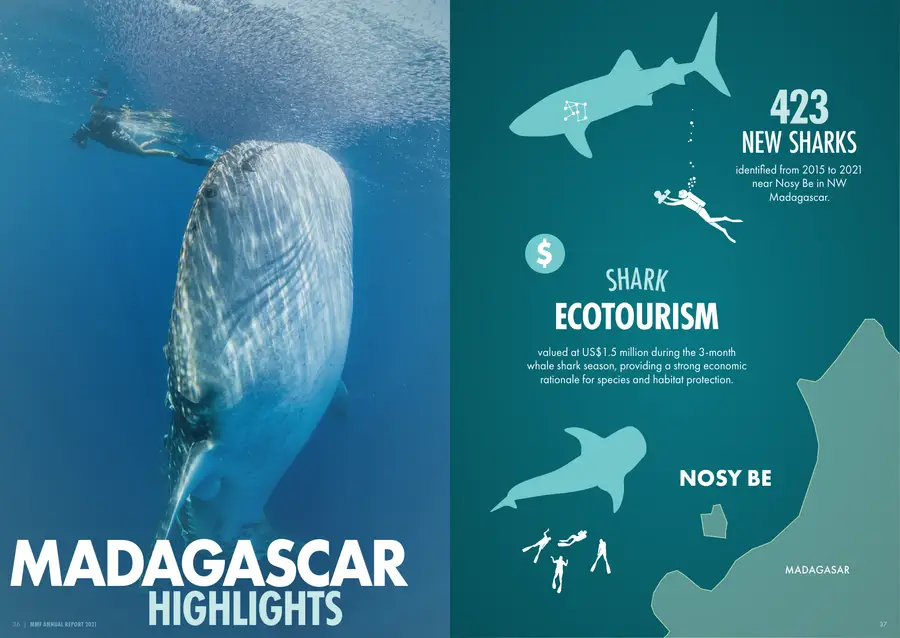
- 423New sharks identified from 2015 to 2021 near Nosy Be in NW Madagascar
Shark ecotourism
Valued at US$1.5 million during the 3-month whale shark season, providing a strong economic rationale for species and habitat protection.
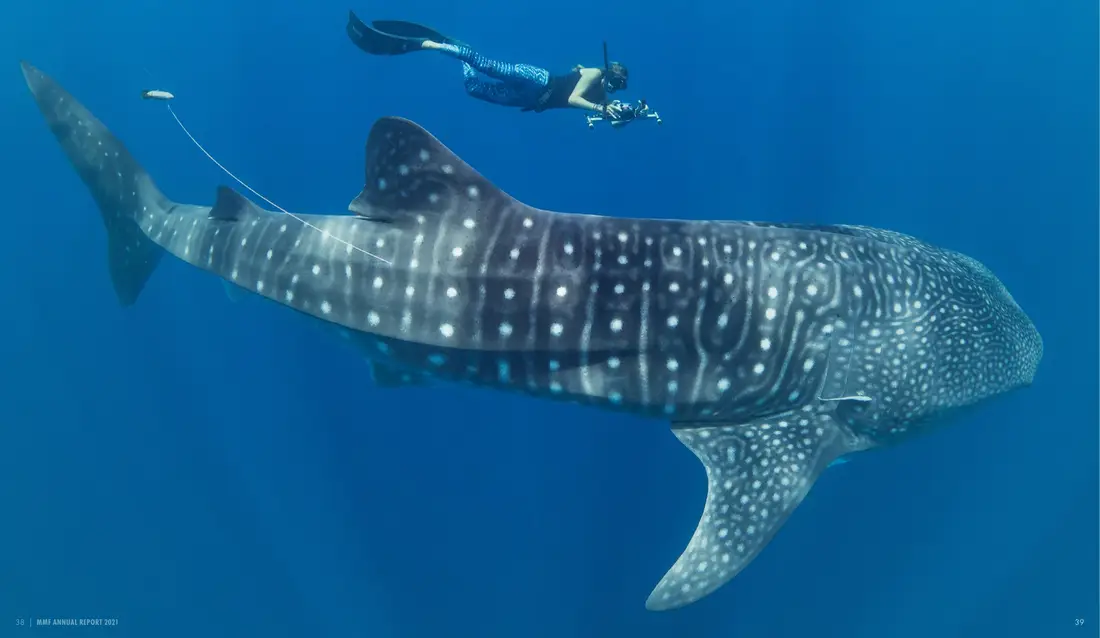
Tanzania highlights
Pages 40 to 41 of the report
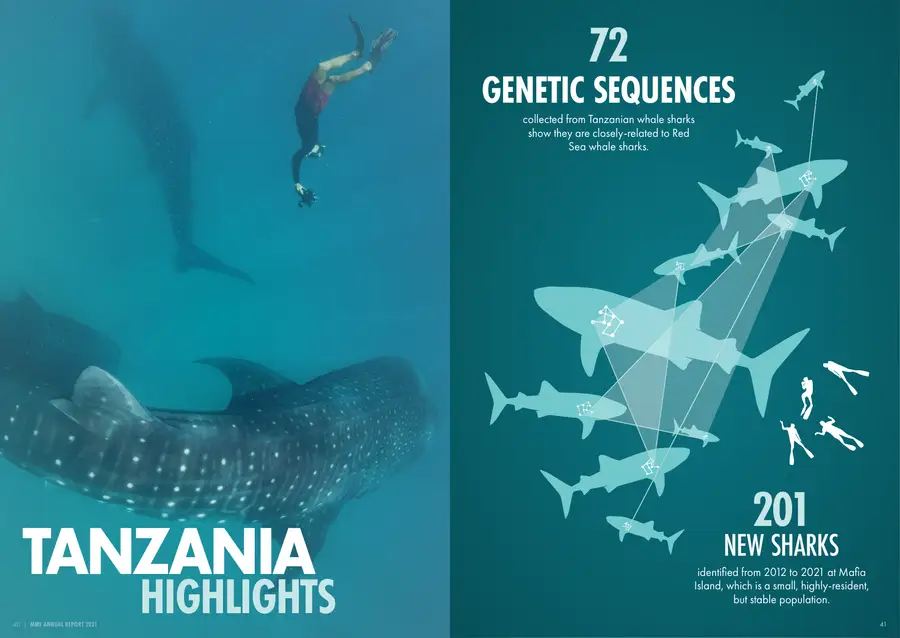
- 72Genetic sequences collected from Tanzanian whale sharks show they are closely-related to Red Sea whale sharks
- 201New sharks identified from 2012 to 2021 at Mafia Island, which is a small, highly-resident, but stable population
Kenya highlights
Pages 42 to 43 of the report
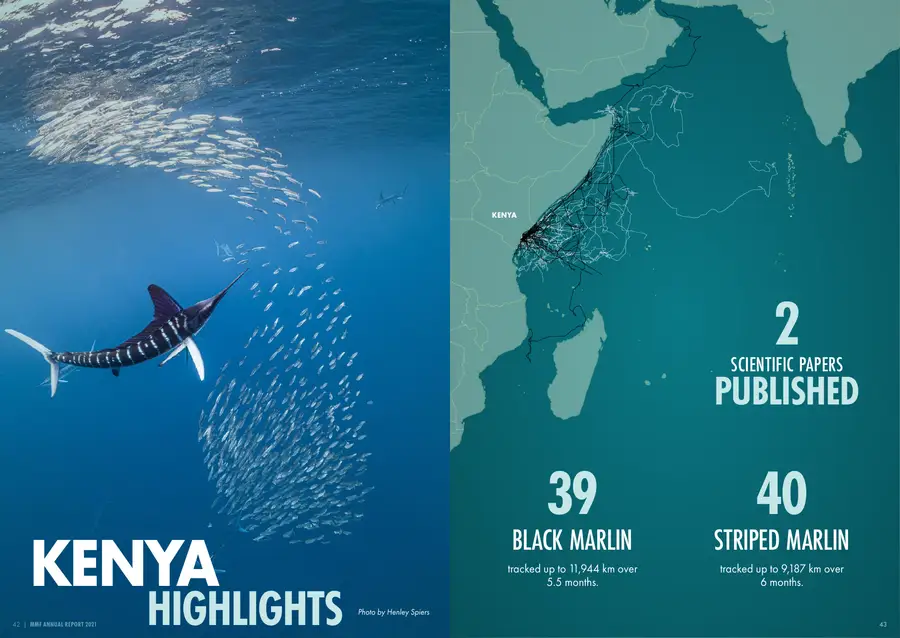
- 2Scientific papers published
- 39Black marlin tracked up to 11,944 km over 5.5 months
- 40Striped marlin tracked up to 9,187 km over 6 months
Indonesia highlights
Pages 44 to 49 of the report
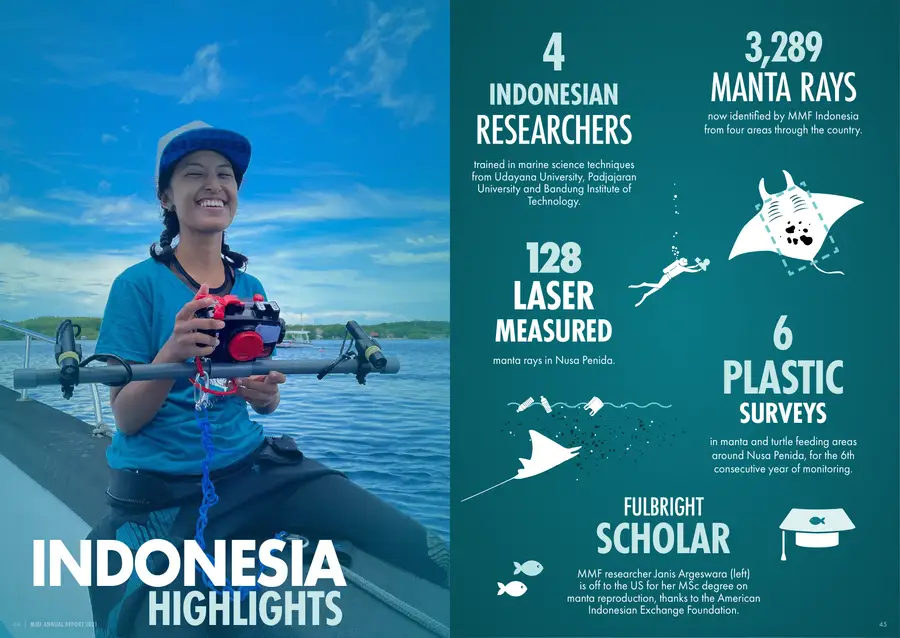
MMF senior scientist, Dr. Elitza Germanov, published two new scientific studies on the insidious threat of plastic pollution. Caption on page 49.
- 4Indonesian researchers trained in marine science techniques from Udayana University, Padjajaran University and Bandung Institute of Technology
- 3,289Manta rays now identified by MMF Indonesia from four areas through the country
- 128Laser measured manta rays in Nusa Penida
- 6Plastic surveys in manta and turtle feeding areas around Nusa Penida, for the 6th consecutive year of monitoring
Fulbright scholar
MMF researcher Janis Argeswara (left) is off to the US for her MSc degree on manta reproduction, thanks to the American Indonesian Exchange Foundation.
Florida highlights
Pages 50 to 53 of the report
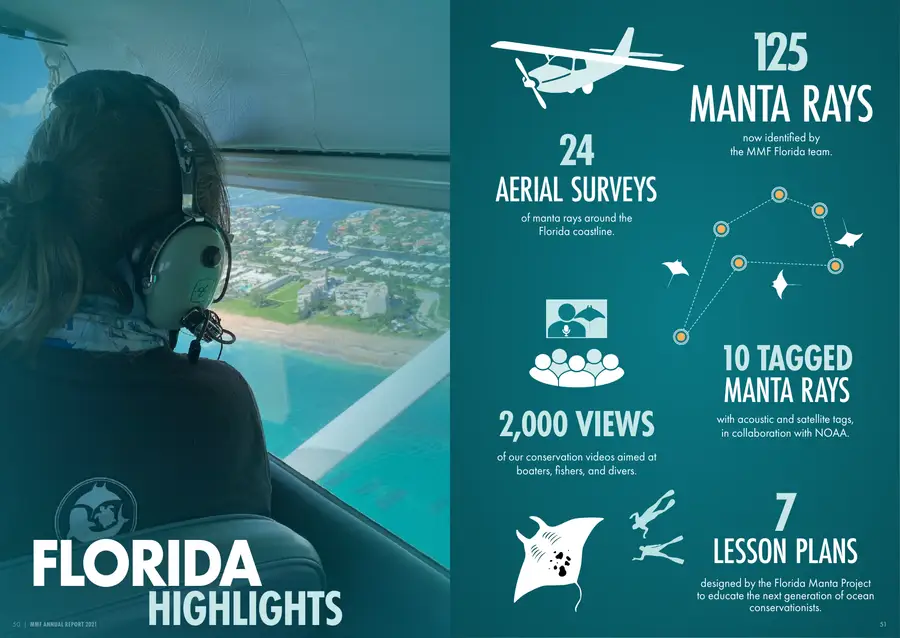
- 125Manta rays now identified by the MMF Florida team
- 24Aerial surveys of manta rays around the Florida coastline
- 10Tagged manta rays with acoustic and satellite tags, in collaboration with NOAA
- 2,000Views of our conservation videos aimed at boaters, fishers, and divers
- 7Lesson plans designed by the Florida Manta Project to educate the next generation of ocean conservationists
Research output
Pages 54 to 55 of the report
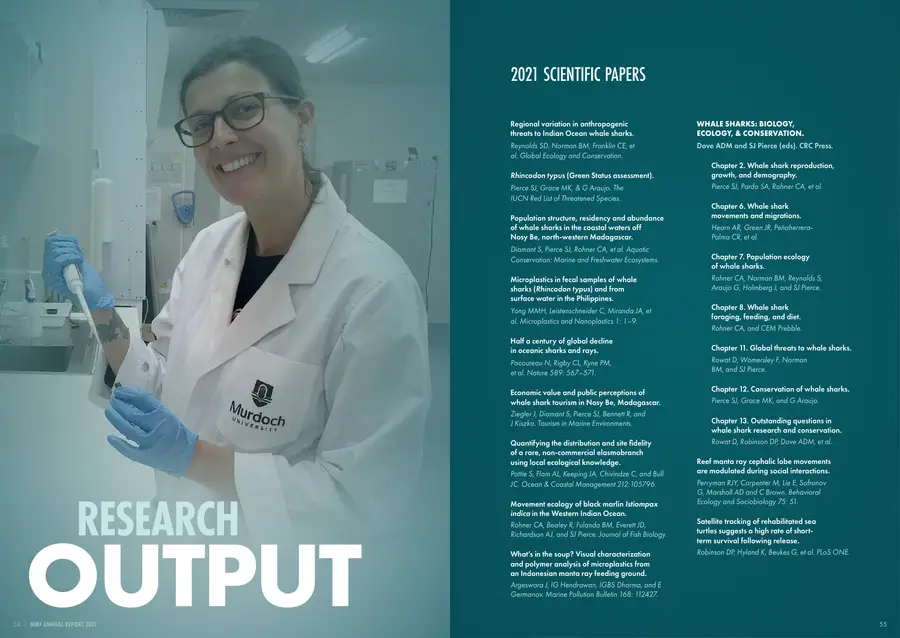
2021 scientific papers
- Regional variation in anthropogenic threats to Indian Ocean whale sharks. Reynolds SD, Norman BM, Franklin CE, et al. Global Ecology and Conservation. doi.org/10.1016/j.gecco.2021.e01961
- Rhincodon typus (Green Status assessment). Pierce SJ, Grace MK, & G Araujo. The IUCN Red List of Threatened Species.
- Population structure, residency and abundance of whale sharks in the coastal waters off Nosy Be, north-western Madagascar. Diamant S, Pierce SJ, Rohner CA, et al. Aquatic Conservation: Marine and Freshwater Ecosystems. doi.org/10.1002/aqc.3743
- Microplastics in fecal samples of whale sharks (Rhincodon typus) and from surface water in the Philippines. Yong MMH, Leistenschneider C, Miranda JA, et al. Microplastics and Nanoplastics 1: 1–9. doi.org/10.1186/s43591-021-00017-9
- Half a century of global decline in oceanic sharks and rays. Pacoureau N, Rigby CL, Kyne PM, et al. Nature 589: 567–571. doi.org/10.1038/s41586-020-03173-9
- Economic value and public perceptions of whale shark tourism in Nosy Be, Madagascar. Ziegler J, Diamant S, Pierce SJ, Bennett R, and J Kiszka. Tourism in Marine Environments. doi.org/10.3727/154427321x16223819324721
- Quantifying the distribution and site fidelity of a rare, non-commercial elasmobranch using local ecological knowledge. Pottie S, Flam AL, Keeping JA, Chivindze C, and Bull JC. Ocean & Coastal Management 212:105796. doi.org/10.1016/j.ocecoaman.2021.105796
- Movement ecology of black marlin Istiompax indica in the Western Indian Ocean. Rohner CA, Bealey R, Fulanda BM, Everett JD, Richardson AJ, and SJ Pierce. Journal of Fish Biology. doi.org/10.1111/jfb.14809
- What’s in the soup? Visual characterization and polymer analysis of microplastics from an Indonesian manta ray feeding ground. Argeswara J, IG Hendrawan, IGBS Dharma, and E Germanov. Marine Pollution Bulletin 168: 112427. doi.org/10.1016/j.marpolbul.2021.112427
- Whale Sharks: Biology, Ecology, & Conservation. Dove ADM and SJ Pierce (eds). CRC Press.
- Chapter 2. Whale shark reproduction, growth, and demography. Pierce SJ, Pardo SA, Rohner CA, et al.
- Chapter 6. Whale shark movements and migrations. Hearn AR, Green JR, Peñaherrera-Palma CR, et al.
- Chapter 7. Population ecology of whale sharks. Rohner CA, Norman BM, Reynolds S, Araujo G, Holmberg J, and SJ Pierce.
- Chapter 8. Whale shark foraging, feeding, and diet. Rohner CA, and CEM Prebble.
- Chapter 11. Global threats to whale sharks. Rowat D, Womersley F, Norman BM, and SJ Pierce.
- Chapter 12. Conservation of whale sharks. Pierce SJ, Grace MK, and G Araujo.
- Chapter 13. Outstanding questions in whale shark research and conservation. Rowat D, Robinson DP, Dove ADM, et al.
- Reef manta ray cephalic lobe movements are modulated during social interactions. Perryman RJY, Carpenter M, Lie E, Sofronov G, Marshall AD and C Brown. Behavioral Ecology and Sociobiology 75: 51. doi.org/10.1007/s00265-021-02973-x
- Satellite tracking of rehabilitated sea turtles suggests a high rate of short-term survival following release. Robinson DP, Hyland K, Beukes G, et al. PLoS ONE. doi.org/10.1371/journal.pone.0246241
Highlighting outreach
Pages 56 to 59 of the report
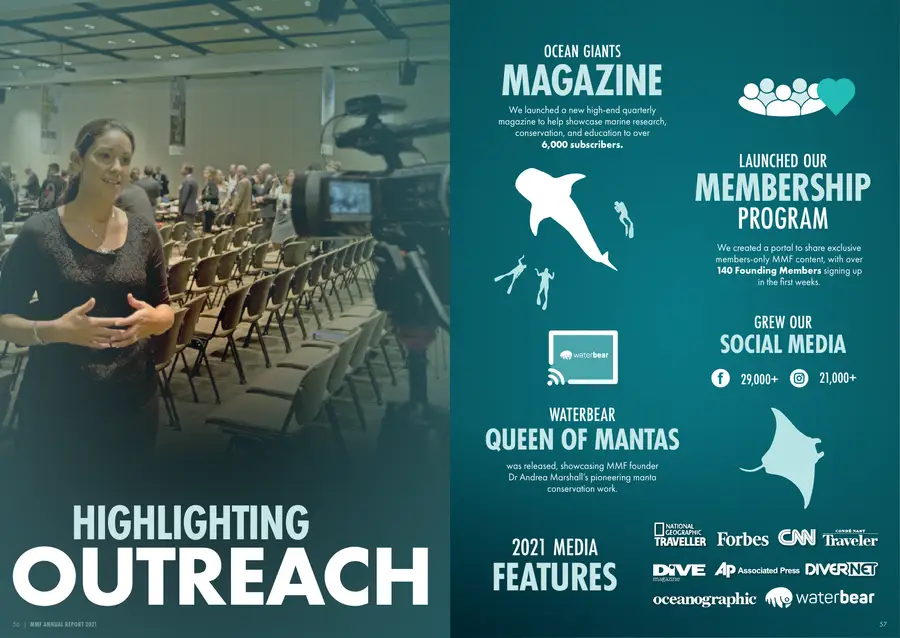
Ocean Giants magazine
We launched a new high-end quarterly magazine to help showcase marine research, conservation, and education to over 6,000 subscribers.
Launched our membership program
We created a portal to share exclusive members-only MMF content, with over 140 Founding Members signing up in the first weeks.
Grew our social media
- 29,000+Facebook
- 21,000+Instagram
WaterBear
Queen of Mantas was released, showcasing MMF founder Dr Andrea Marshall’s pioneering manta conservation work.
2021 media features
- National Geographic Traveller
- Forbes
- CNN
- Condé Nast Traveler
- DIVE magazine
- Associated Press
- DiverNet
- Oceanographic
- WaterBear
Financial summary 2021
Pages 60 to 61 of the report
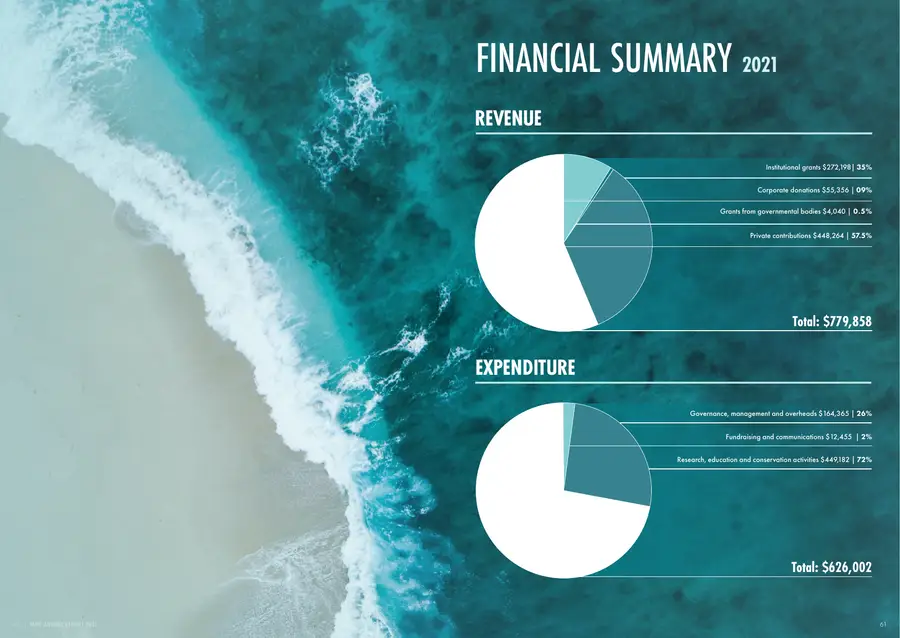
| 2021 | % | |
|---|---|---|
| Institutional grants | $272,198 | 35% |
| Corporate donations | $55,356 | 09% |
| Grants from governmental bodies | $4,040 | 0.5% |
| Private contributions | $448,264 | 57.5% |
| Total | $779,858 |
| 2021 | % | |
|---|---|---|
| Governance, management and overheads | $164,365 | 26% |
| Fundraising and communications | $12,455 | 2% |
| Research, education and conservation activities | $449,182 | 72% |
| Total | $626,002 |
Special thanks to our major project funders
Pages 62 to 65 of the report
Your help and support enables us to protect the world’s most endangered ocean wildlife, train the next generation of conservationists, and conserve marine ecosystems. These discoveries and successes would not be possible without you. Thank you, so much.
Dr. Simon Pierce and Dr. Andrea Marshall
- Angel Protocol
- Art Blocks
- Aqua-Firma
- Blue Action Fund
- Blue Corner Dive
- Big Fish Diving
- Conservation, Food & Health Foundation
- David & Carol Myers Foundation
- Disney Conservation Fund
- DSZ - International Giving Foundation For Mozambique
- Fondation Ensemble
- Fortuna Foundation
- Georgia Aquarium
- Help For Mozambique
- Izele Small Grant Scheme
- Mantahari Oceancare
- Milkywire
- Mohamed Bin Zayed Species Conservation Fund
- Ocean Wildlife Project
- Our Children’s Earth Foundation
- Peri-Peri Divers
- Planeterra
- Prince Albert II of Monaco Foundation
- ScubaPro
- Shark Conservation Fund
- Shark Foundation
- Sustainable Ocean Alliance
- Swiss Friends Of Galapagos
- The Wondrous Trust
- Turing Foundation
- Ultralight Control Systems
- UNESCO Green Citizens
- US Ambassador’s Special Self-Help Fund
- Waterlust
- Windrush Trust
- Zoomarine
If you want to help our oceans, now is the time. Join us in saving Earth’s most iconic marine wildlife.
MMF founding members
The report also thanks individual supporters by name; that list is in the PDF.
Become an MMF member
The Constellation is our MMF member community of ocean lovers, just like you, investing in the recovery of endangered marine wildlife. Includes exclusive members-only content.
Healthy ecosystems are more resilient to climate change
Pages 66 to 69 of the report
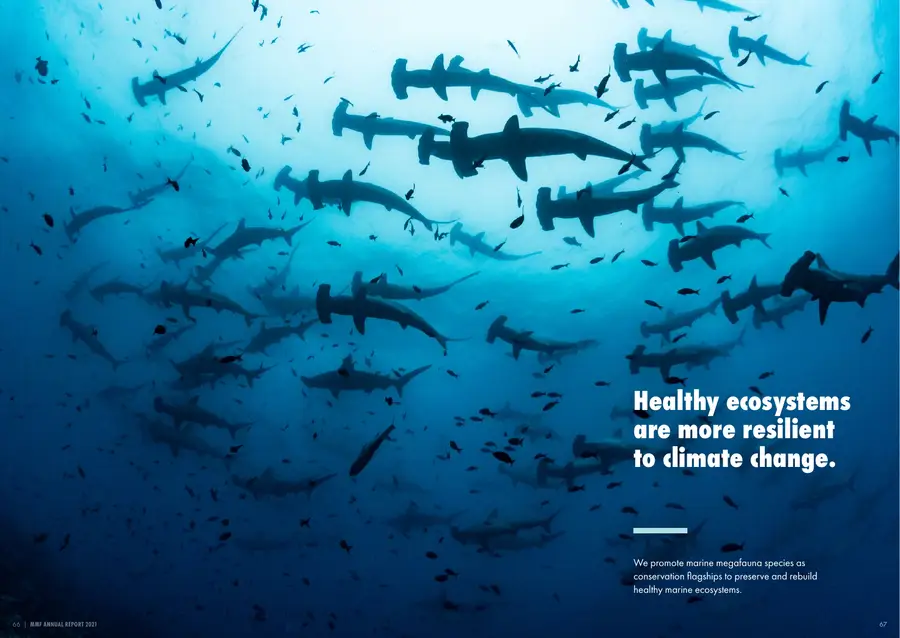
We promote marine megafauna species as conservation flagships to preserve and rebuild healthy marine ecosystems.
Explore MMF’s pioneering marine conservation work
Get our FREE Quarterly Magazine delivered straight to your inbox.
About this report
© Marine Megafauna Foundation, 2022
This report, along with other information about MMF, is available online at www.marinemegafauna.org
Marine Megafauna Foundation, 7750 Okeechobee Blvd, Ste 4-3038, West Palm Beach, FL 33411
Centro de Investigação Científica Megafauna Marinha, Associação Megafauna Marinha, Praia do Tofo, Inhambane, Mozambique
MMF is a tax-exempt non-profit charitable organization under section 501(c)(3) of the US tax code (Tax ID #46-0645082).
All contributions are tax-deductible in accordance with US tax law.
The Associação Megafauna Marinha is also a registered not-for-profit association in Mozambique.
Graphic Design: Madeleine Pierce