Annual report 2022
Our 2022 annual report to read on this page, section by section, beside the report's own pages. Every figure is here; the PDF has the full layout.
About the report
- Covers
- 2022
- Published
- 2023, by the Marine Megafauna Foundation
- Length
- 32 pages
- Format
- PDF, 8.1 MB
2022 in figures
38
New community leaders (now totaling 60) in three new villages have been trained to promote education and awareness of marine conservation solutions.
3,478
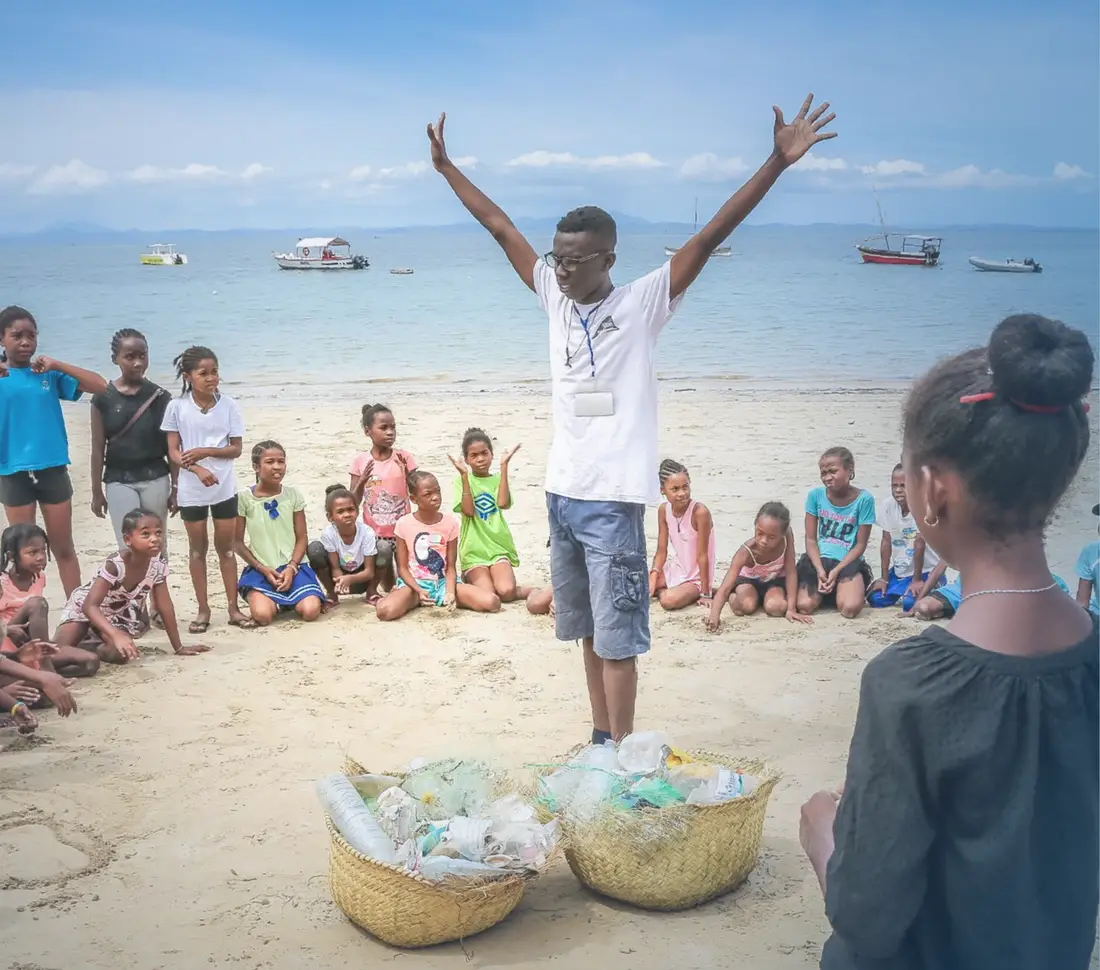
Mini marine conservationists graduated MMF’s curriculum between 2012–22.
494
New sharks identified from 2015 to 2022 near Nosy Be in NW Madagascar.
3331
Manta rays now identified throughout Indonesia.
473,300+
Reached via social media
Our three priority regions
Pages 4 to 5 of the report
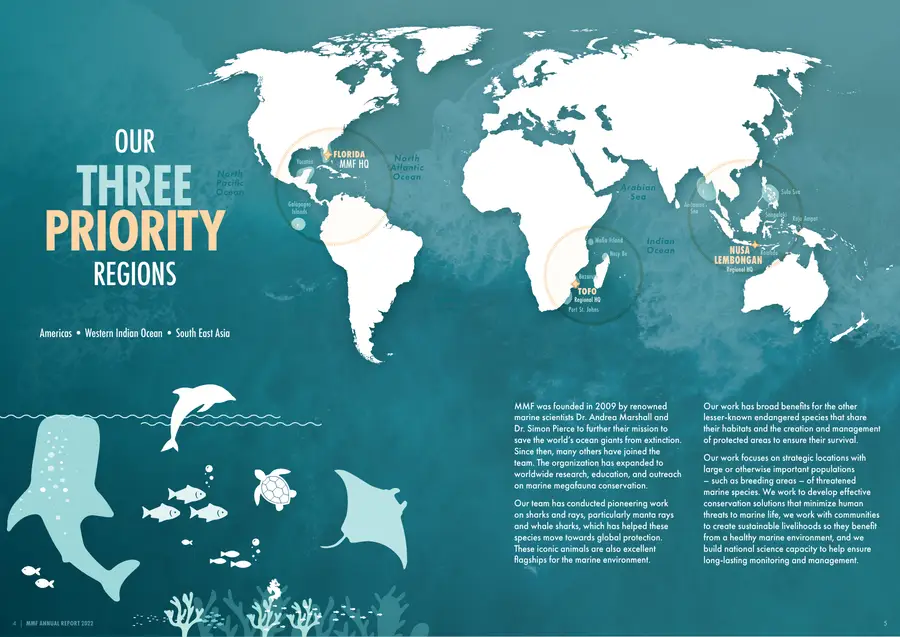
- Americas
- Western Indian Ocean
- South East Asia
- Florida: MMF HQ
- Tofo: Regional HQ
- Nusa Lembongan: Regional HQ
- Yucatán
- Galápagos Islands
- Mafia Island
- Nosy Be
- Bazaruto
- Port St. Johns
- Andaman Sea
- Sulu Sea
- Sangalaki
- Raja Ampat
- Komodo
MMF was founded in 2009 by renowned marine scientists Dr. Andrea Marshall and Dr. Simon Pierce to further their mission to save the world’s ocean giants from extinction. Since then, many others have joined the team. The organization has expanded to worldwide research, education, and outreach on marine megafauna conservation.
Our team has conducted pioneering work on sharks and rays, particularly manta rays and whale sharks, which has helped these species move towards global protection. These iconic animals are also excellent flagships for the marine environment.
Our work has broad benefits for the other lesser-known endangered species that share their habitats and the creation and management of protected areas to ensure their survival.
Our work focuses on strategic locations with large or otherwise important populations (such as breeding areas) of threatened marine species. We work to develop effective conservation solutions that minimize human threats to marine life, we work with communities to create sustainable livelihoods so they benefit from a healthy marine environment, and we build national science capacity to help ensure long-lasting monitoring and management.
Mozambique conservation
Pages 6 to 11 of the report
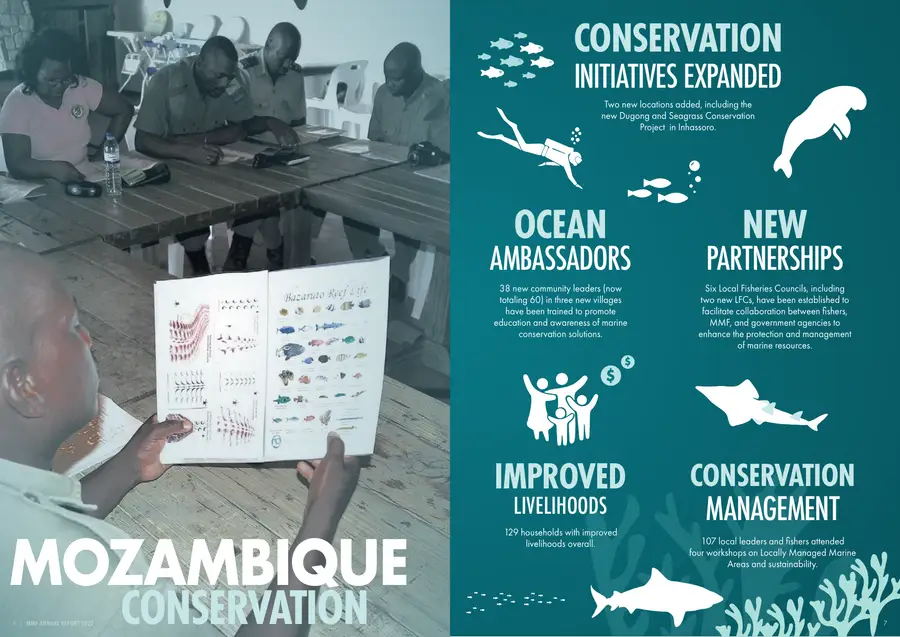
Conservation initiatives expanded
Two new locations added, including the new Dugong and Seagrass Conservation Project in Inhassoro.
Ocean ambassadors
- 38New community leaders (now totaling 60) in three new villages have been trained to promote education and awareness of marine conservation solutions.
New partnerships
Six Local Fisheries Councils, including two new LFCs, have been established to facilitate collaboration between fishers, MMF, and government agencies to enhance the protection and management of marine resources.
Improved livelihoods
- 129Households with improved livelihoods overall.
Conservation management
- 107Local leaders and fishers attended four workshops on Locally Managed Marine Areas and sustainability.
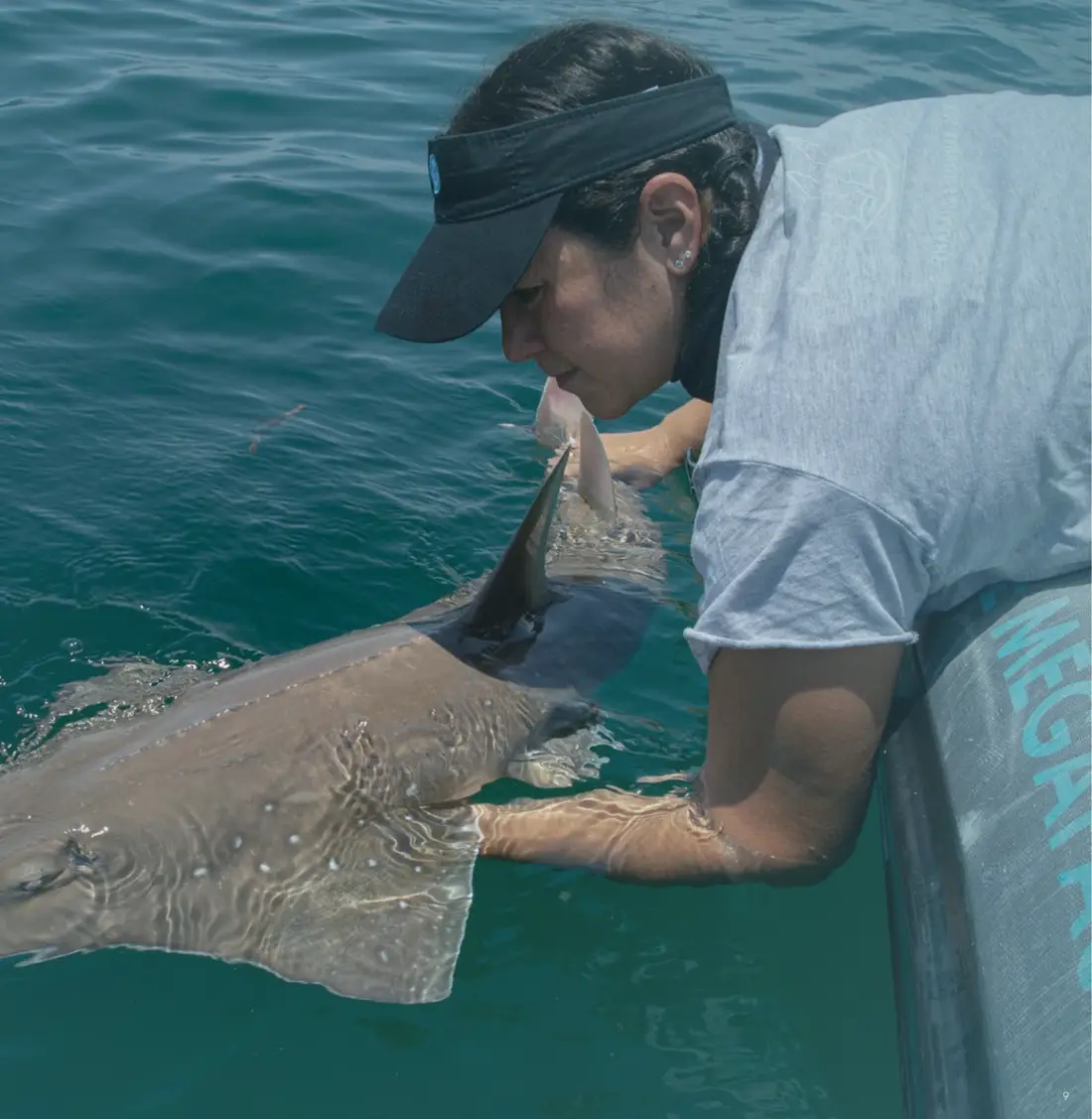
Mozambique research
Pages 12 to 17 of the report
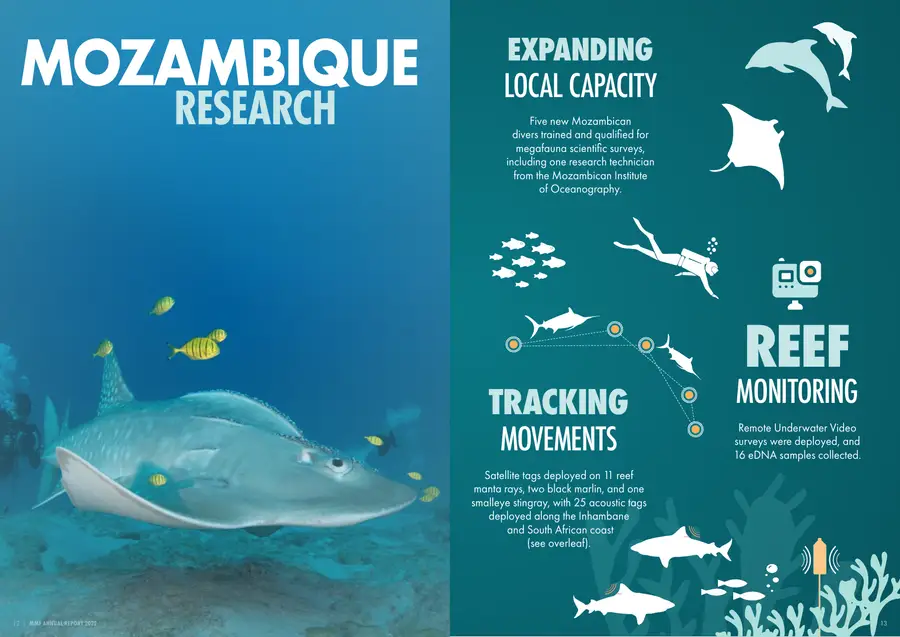
Expanding local capacity
Five new Mozambican divers trained and qualified for megafauna scientific surveys, including one research technician from the Mozambican Institute of Oceanography.
Tracking movements
Satellite tags deployed on 11 reef manta rays, two black marlin, and one smalleye stingray, with 25 acoustic tags deployed along the Inhambane and South African coast (see overleaf).
Reef monitoring
Remote Underwater Video surveys were deployed, and 16 eDNA samples collected.
We expanded the Mozambique tracking network
- Bazaruto Seascape
- Vilankulos
- Pomene
- Morrumbene
- Tofo
- Zavora
New acoustic receivers
Three new receivers deployed, including one deep water receiver, bringing the collaborative array to 25 receivers in the Inhambane Province.
New acoustic tags in 2022
- 12Reef mantas
- 1Bull shark
- 3Rhino rays
- 7Smalleye stingrays
- 4Zebra sharks
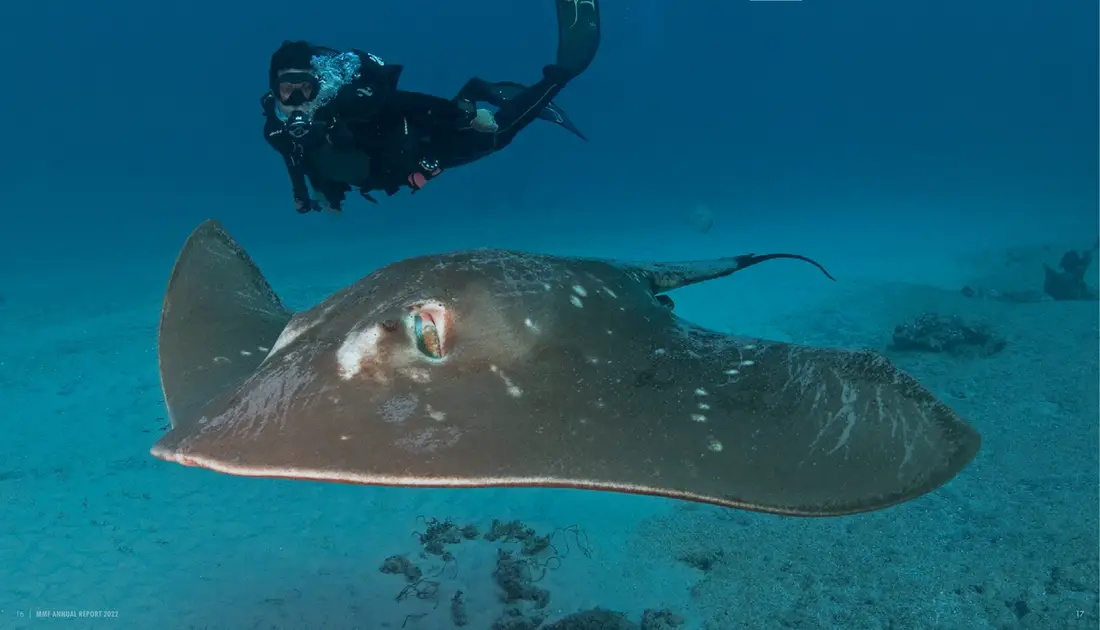
Mozambique education
Pages 18 to 23 of the report
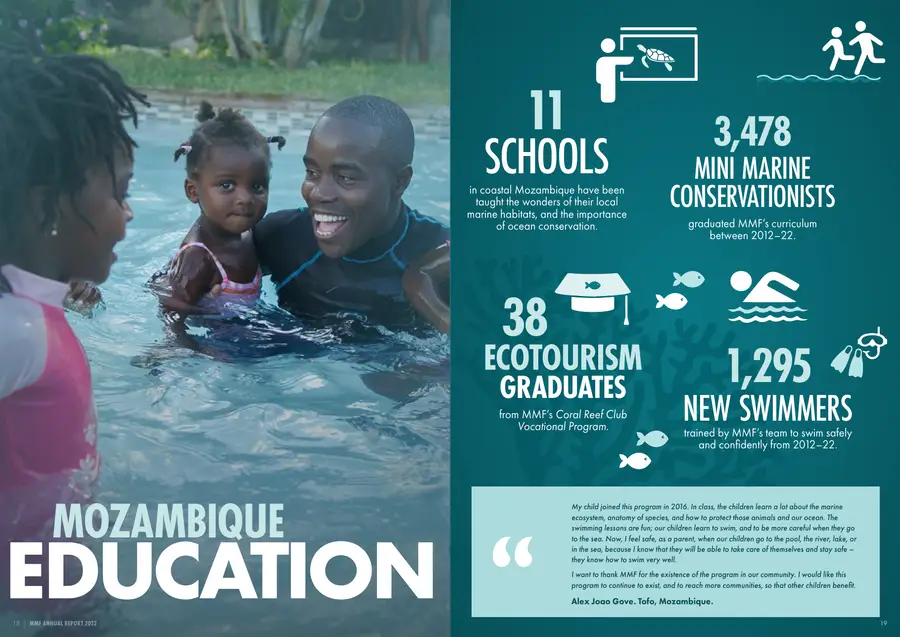
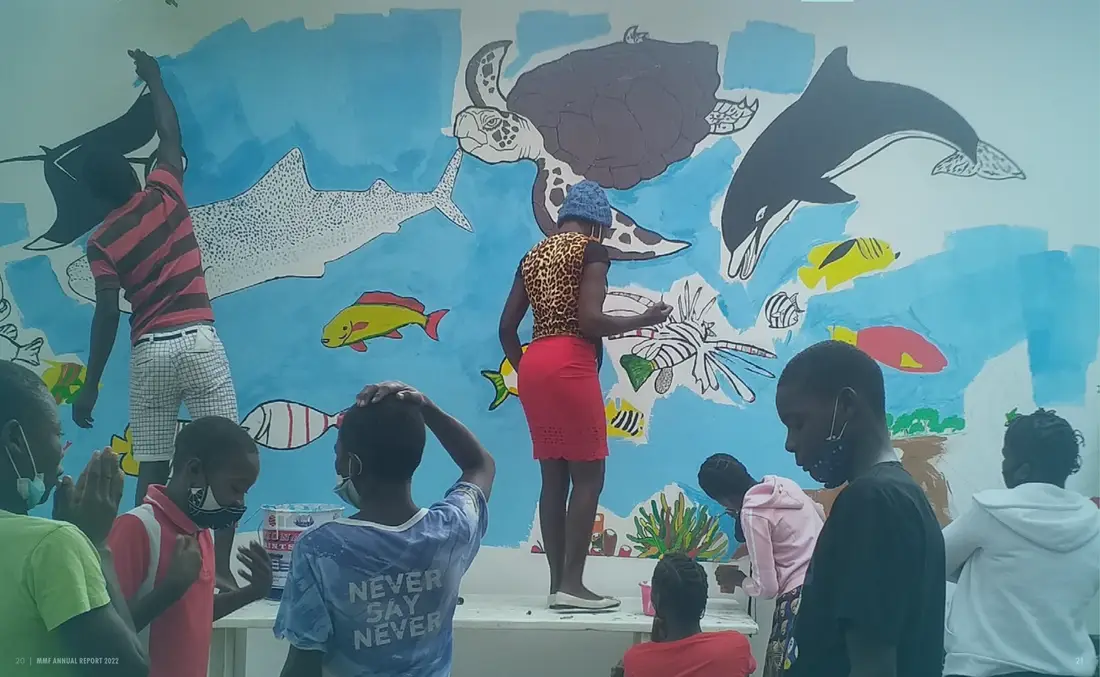
- 11Schools in coastal Mozambique have been taught the wonders of their local marine habitats, and the importance of ocean conservation.
- 3,478Mini marine conservationists graduated MMF’s curriculum between 2012–22.
- 38Ecotourism graduates from MMF’s Coral Reef Club Vocational Program.
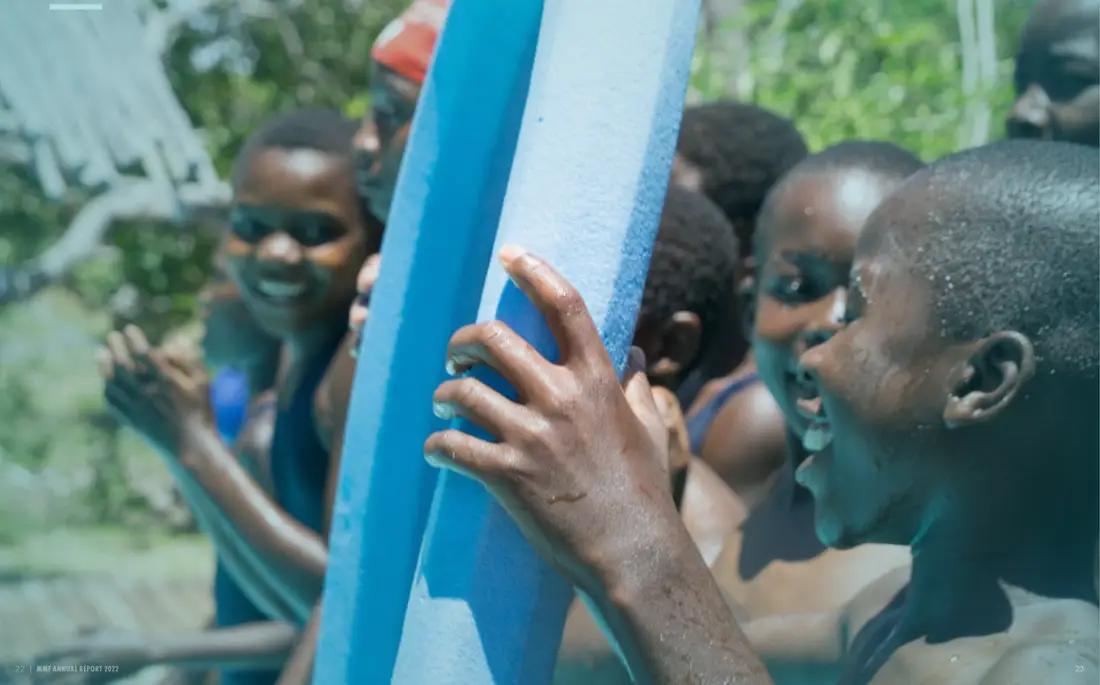
- 1,295New swimmers trained by MMF’s team to swim safely and confidently from 2012–22.
My child joined this program in 2016. In class, the children learn a lot about the marine ecosystem, anatomy of species, and how to protect those animals and our ocean. The swimming lessons are fun; our children learn to swim, and to be more careful when they go to the sea. Now, I feel safe, as a parent, when our children go to the pool, the river, lake, or in the sea, because I know that they will be able to take care of themselves and stay safe: they know how to swim very well. I want to thank MMF for the existence of the program in our community. I would like this program to continue to exist, and to reach more communities, so that other children benefit.
Madagascar highlights
Pages 24 to 27 of the report
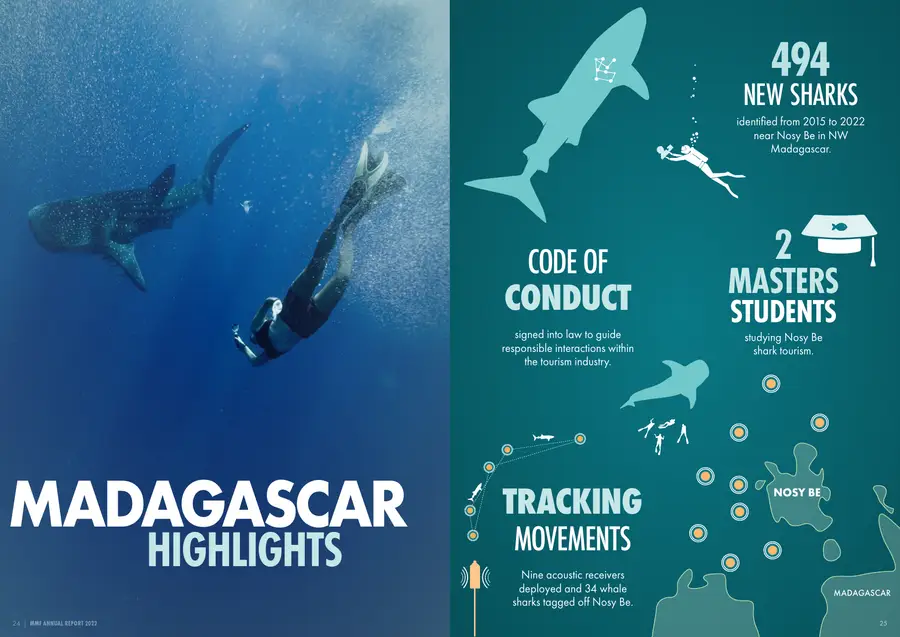
- 494New sharks identified from 2015 to 2022 near Nosy Be in NW Madagascar.
- 2Masters students studying Nosy Be shark tourism.
Code of conduct
Signed into law to guide responsible interactions within the tourism industry.
Tracking movements
Nine acoustic receivers deployed and 34 whale sharks tagged off Nosy Be.
- Nosy Be
- Madagascar
Tanzania highlights
Pages 28 to 31 of the report
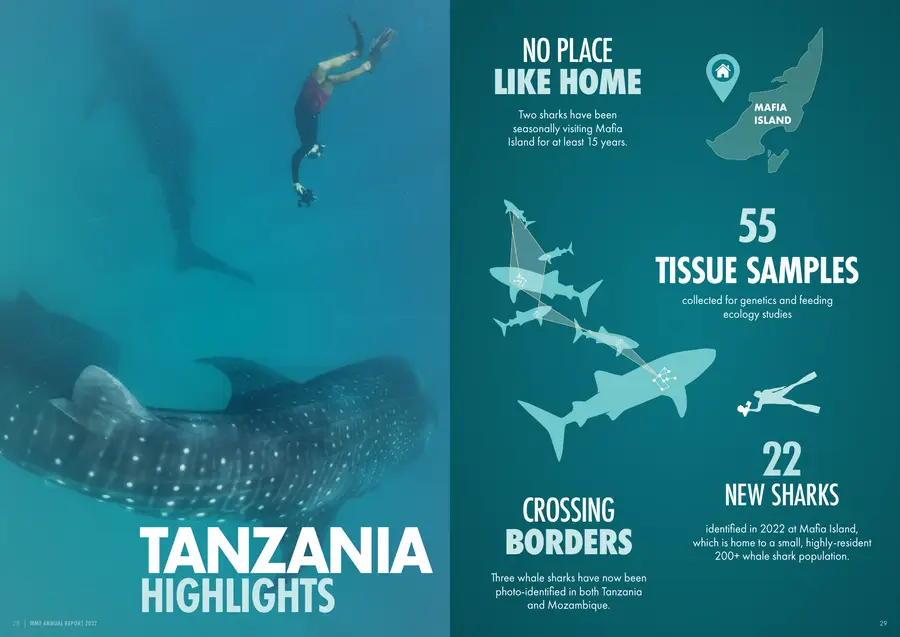
- 55Tissue samples collected for genetics and feeding ecology studies
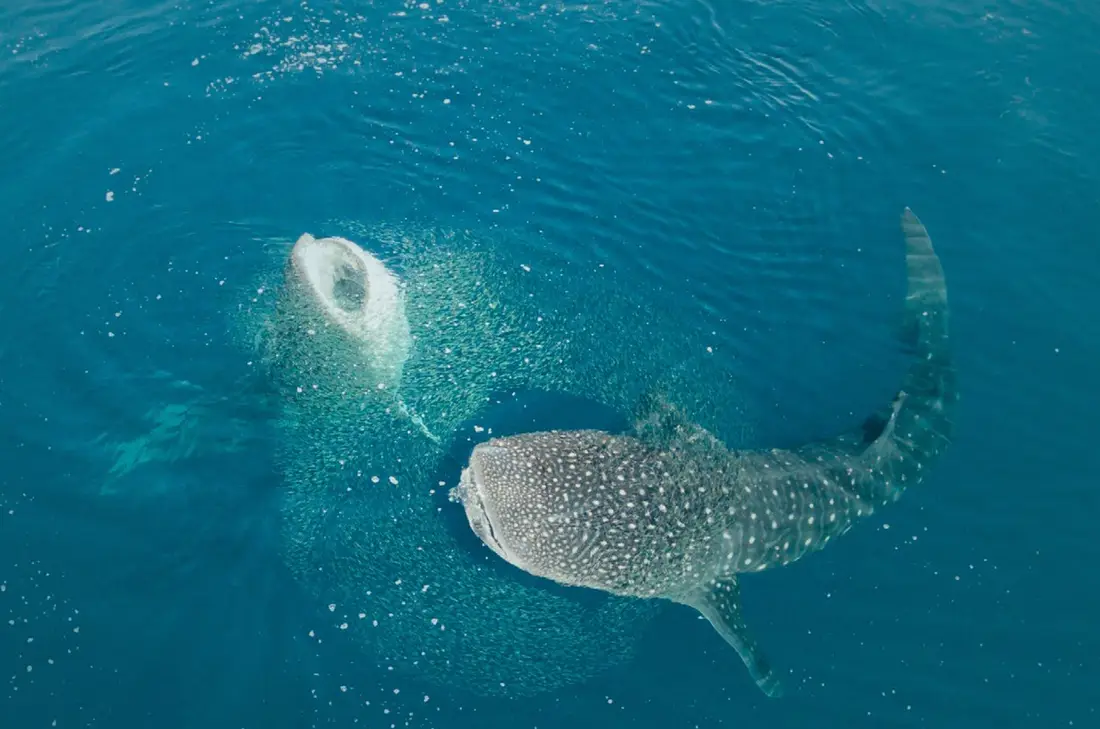
- 22New sharks identified in 2022 at Mafia Island, which is home to a small, highly-resident 200+ whale shark population.
No place like home
Two sharks have been seasonally visiting Mafia Island for at least 15 years.
Crossing borders
Three whale sharks have now been photo-identified in both Tanzania and Mozambique.
- Mafia Island
Indonesia highlights
Pages 32 to 37 of the report
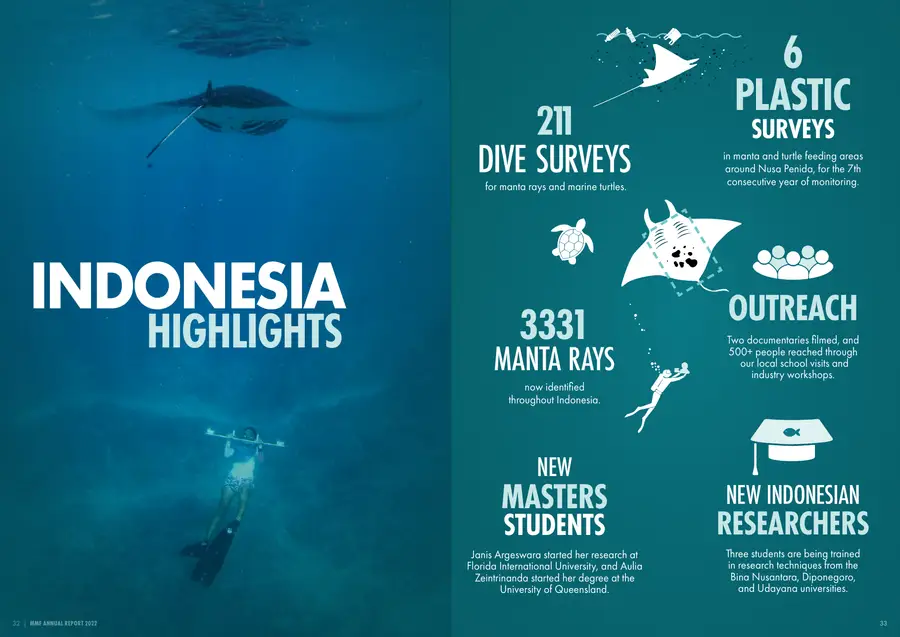
MMF Senior Scientist, Dr. Elitza Germanov, led the 7th consecutive year of plastic pollution monitoring at Nusa Penida. Caption on page 37.
- 211Dive surveys for manta rays and marine turtles.
- 6Plastic surveys in manta and turtle feeding areas around Nusa Penida, for the 7th consecutive year of monitoring.
- 3331Manta rays now identified throughout Indonesia.
Outreach
Two documentaries filmed, and 500+ people reached through our local school visits and industry workshops.
New masters students
Janis Argeswara started her research at Florida International University, and Aulia Zeintrinanda started her degree at the University of Queensland.
New Indonesian researchers
Three students are being trained in research techniques from the Bina Nusantara, Diponegoro, and Udayana universities.
Florida highlights
Pages 38 to 41 of the report
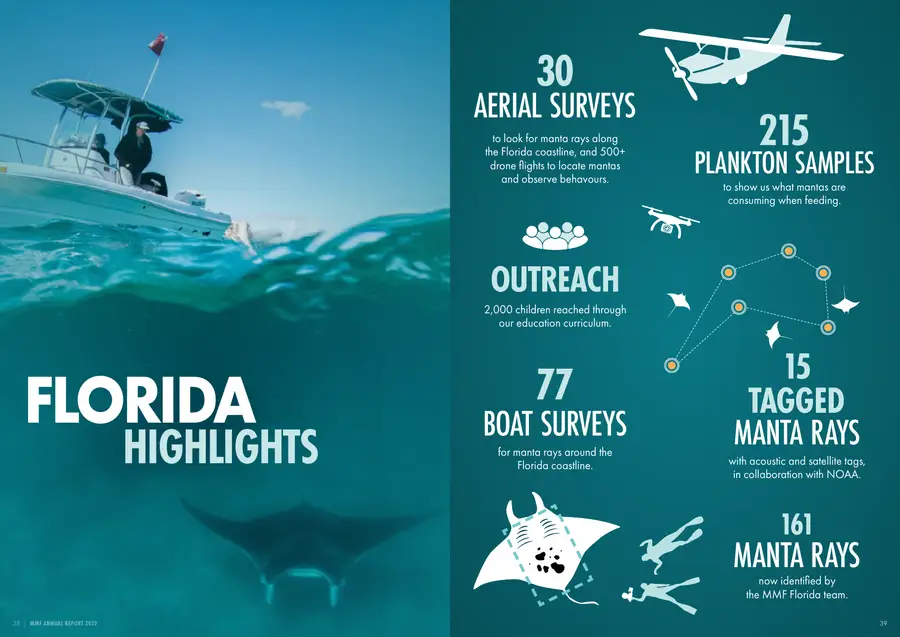
- 30Aerial surveys to look for manta rays along the Florida coastline, and 500+ drone flights to locate mantas and observe behaviors.
- 215Plankton samples to show us what mantas are consuming when feeding.
- 77Boat surveys for manta rays around the Florida coastline.
- 15Tagged manta rays with acoustic and satellite tags, in collaboration with NOAA.
- 161Manta rays now identified by the MMF Florida team.
Outreach
- 2,000Children reached through our education curriculum.
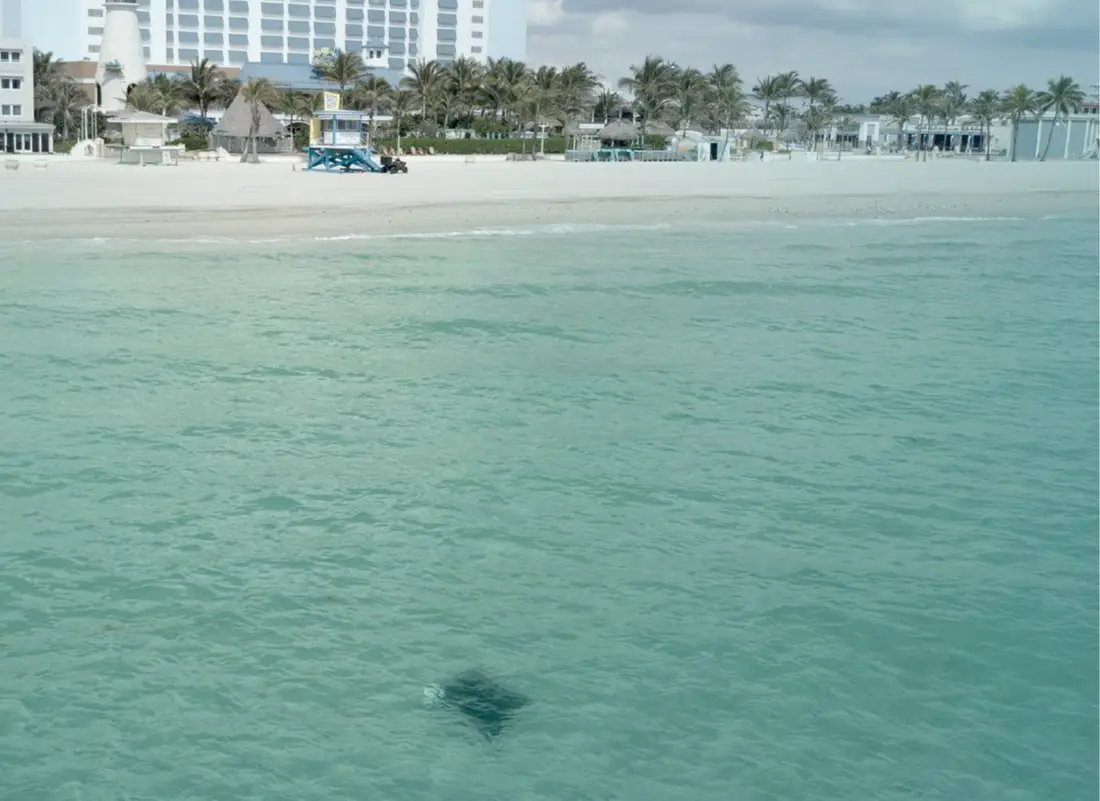
Galapagos highlights
Pages 42 to 45 of the report
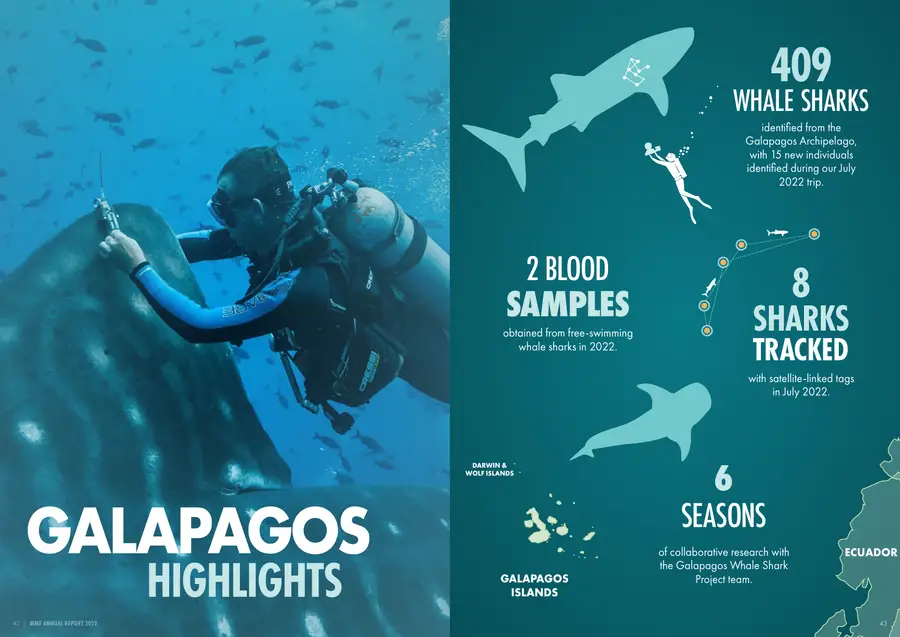
- 409Whale sharks identified from the Galapagos Archipelago, with 15 new individuals identified during our July 2022 trip.
- 2Blood samples obtained from free-swimming whale sharks in 2022.
- 8Sharks tracked with satellite-linked tags in July 2022.
- 6Seasons of collaborative research with the Galapagos Whale Shark Project team.
- Darwin & Wolf Islands
- Galapagos Islands
- Ecuador
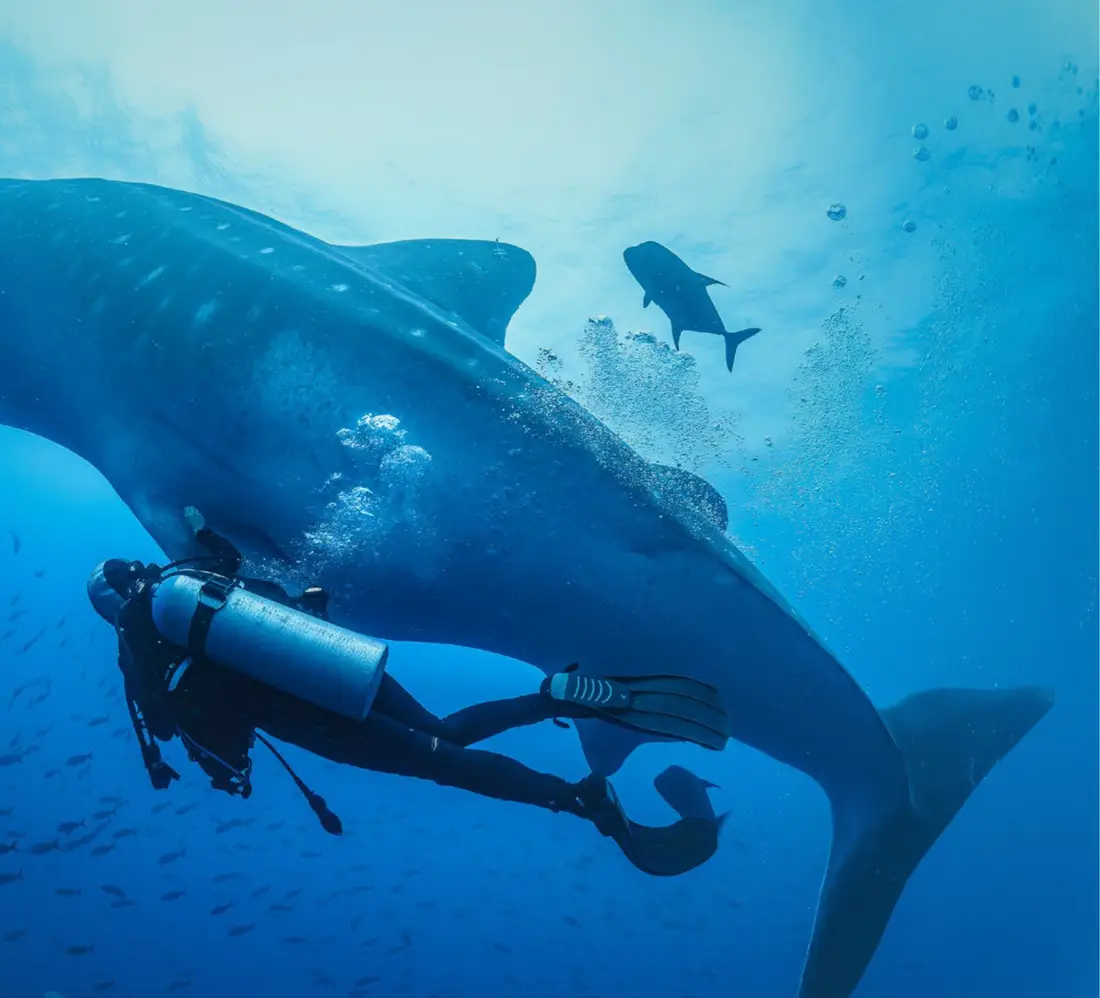
Research output
Pages 46 to 47 of the report
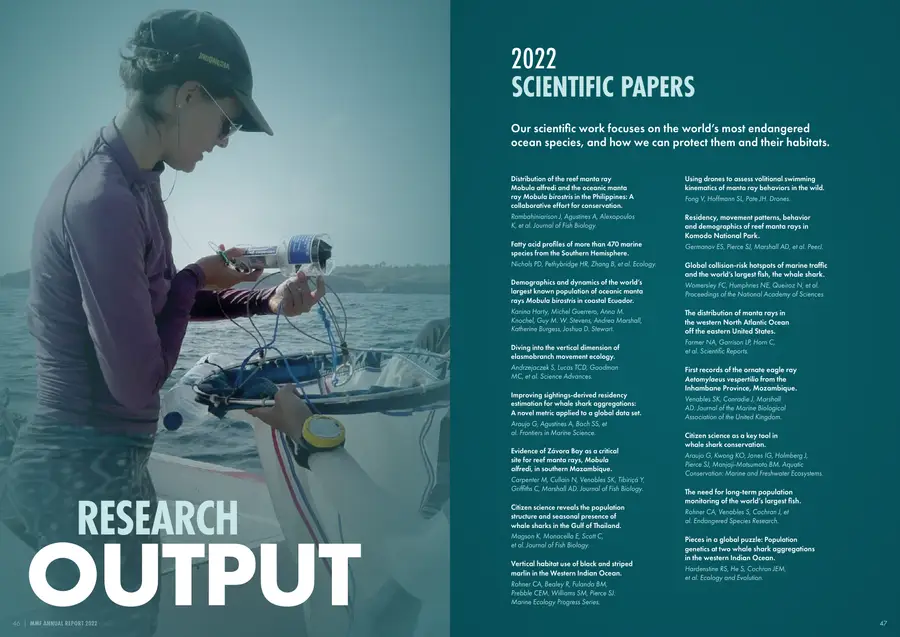
2022 scientific papers
Our scientific work focuses on the world’s most endangered ocean species, and how we can protect them and their habitats.
- Distribution of the reef manta ray Mobula alfredi and the oceanic manta ray Mobula birostris in the Philippines: A collaborative effort for conservation. Rambahiniarison J, Agustines A, Alexopoulos K, et al. Journal of Fish Biology. doi.org/10.1111/jfb.15283
- Fatty acid profiles of more than 470 marine species from the Southern Hemisphere. Nichols PD, Pethybridge HR, Zhang B, et al. Ecology. doi.org/10.1002/ecy.3888
- Demographics and dynamics of the world’s largest known population of oceanic manta rays Mobula birostris in coastal Ecuador. Kanina Harty, Michel Guerrero, Anna M. Knochel, Guy M. W. Stevens, Andrea Marshall, Katherine Burgess, Joshua D. Stewart. doi.org/10.3354/meps14189
- Diving into the vertical dimension of elasmobranch movement ecology. Andrzejaczek S, Lucas TCD, Goodman MC, et al. Science Advances. doi.org/10.1126/sciadv.abo1754
- Improving sightings-derived residency estimation for whale shark aggregations: A novel metric applied to a global data set. Araujo G, Agustines A, Bach SS, et al. Frontiers in Marine Science. doi.org/10.3389/fmars.2022.775691
- Evidence of Závora Bay as a critical site for reef manta rays, Mobula alfredi, in southern Mozambique. Carpenter M, Cullain N, Venables SK, Tibiriçá Y, Griffiths C, Marshall AD. Journal of Fish Biology. doi.org/10.1111/jfb.15132
- Citizen science reveals the population structure and seasonal presence of whale sharks in the Gulf of Thailand. Magson K, Monacella E, Scott C, et al. Journal of Fish Biology. doi.org/10.1111/jfb.15121
- Vertical habitat use of black and striped marlin in the Western Indian Ocean. Rohner CA, Bealey R, Fulanda BM, Prebble CEM, Williams SM, Pierce SJ. Marine Ecology Progress Series. doi.org/10.3354/meps14043
- Using drones to assess volitional swimming kinematics of manta ray behaviors in the wild. Fong V, Hoffmann SL, Pate JH. Drones. doi.org/10.3390/drones6050111
- Residency, movement patterns, behavior and demographics of reef manta rays in Komodo National Park. Germanov ES, Pierce SJ, Marshall AD, et al. PeerJ. doi.org/10.7717/peerj.13302
- Global collision-risk hotspots of marine traffic and the world’s largest fish, the whale shark. Womersley FC, Humphries NE, Queiroz N, et al. Proceedings of the National Academy of Sciences. doi.org/10.1073/pnas.2117440119
- The distribution of manta rays in the western North Atlantic Ocean off the eastern United States. Farmer NA, Garrison LP, Horn C, et al. Scientific Reports. doi.org/10.21203/rs.3.rs-677529/v1
- First records of the ornate eagle ray Aetomylaeus vespertilio from the Inhambane Province, Mozambique. Venables SK, Conradie J, Marshall AD. Journal of the Marine Biological Association of the United Kingdom. doi.org/10.1017/s0025315422000054
- Citizen science as a key tool in whale shark conservation. Araujo G, Kwong KO, Jones IG, Holmberg J, Pierce SJ, Manjaji-Matsumoto BM. Aquatic Conservation: Marine and Freshwater Ecosystems. doi.org/10.1002/aqc.3806
- The need for long-term population monitoring of the world’s largest fish. Rohner CA, Venables S, Cochran J, et al. Endangered Species Research. doi.org/10.3354/esr01177
- Pieces in a global puzzle: Population genetics at two whale shark aggregations in the western Indian Ocean. Hardenstine RS, He S, Cochran JEM, et al. Ecology and Evolution. doi.org/10.1002/ece3.8492
Highlighting outreach
Pages 48 to 51 of the report
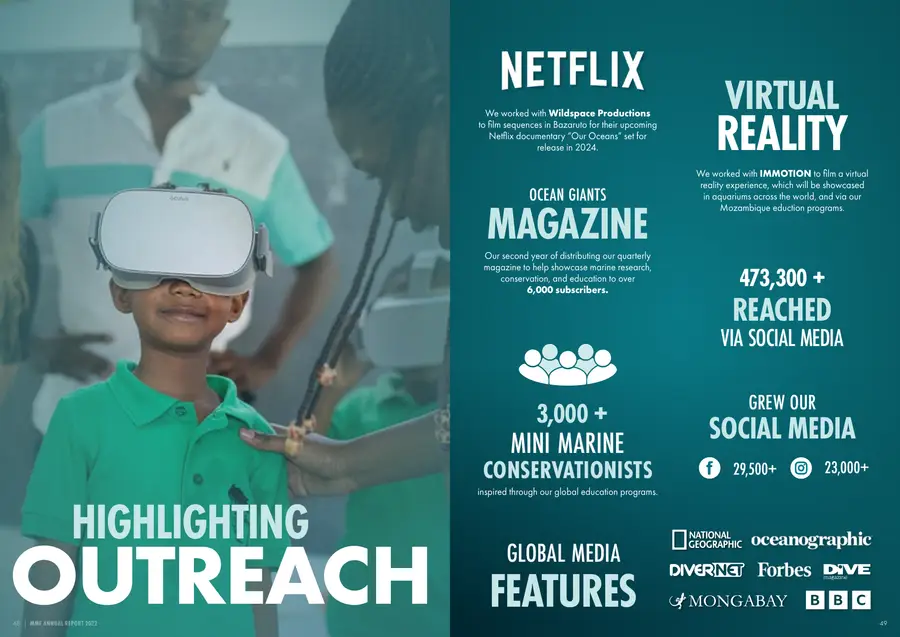
Netflix
We worked with Wildspace Productions to film sequences in Bazaruto for their upcoming Netflix documentary “Our Oceans” set for release in 2024.
Ocean Giants magazine
Our second year of distributing our quarterly magazine to help showcase marine research, conservation, and education to over 6,000 subscribers.
Virtual reality
We worked with IMMOTION to film a virtual reality experience, which will be showcased in aquariums across the world, and via our Mozambique eduction programs.
- 473,300+Reached via social media
- 3,000+Mini marine conservationists inspired through our global education programs.
Grew our social media
- 29,500+Facebook
- 23,000+Instagram
Global media features
- National Geographic
- Oceanographic
- DiverNet
- Forbes
- DIVE Magazine
- Mongabay
- BBC
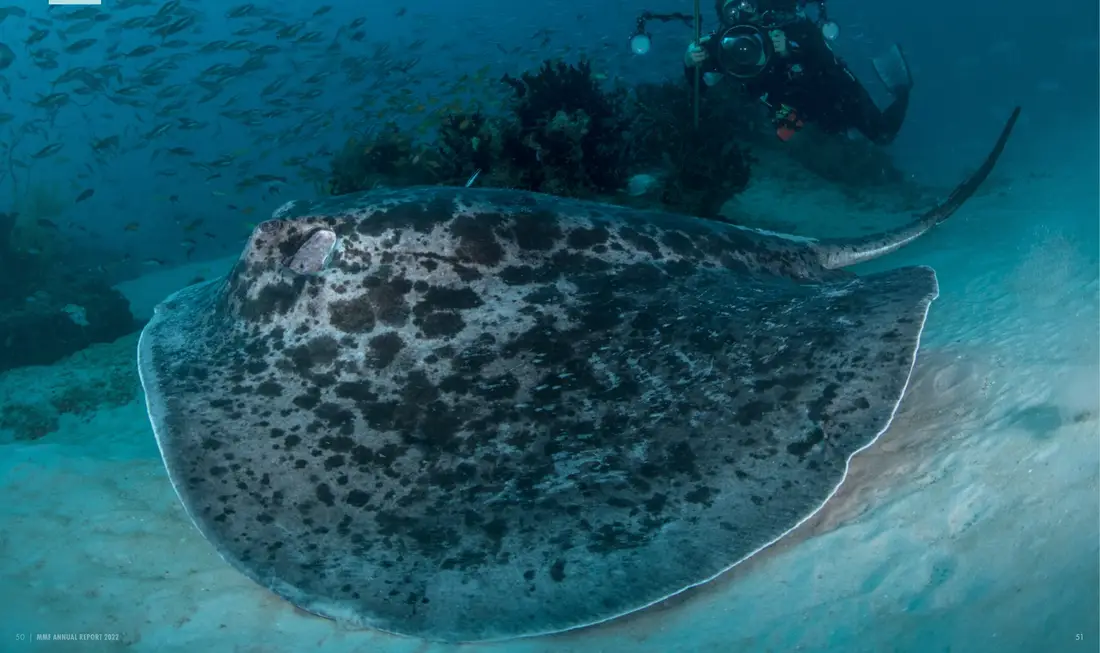
Financial summary 2022
Pages 52 to 53 of the report
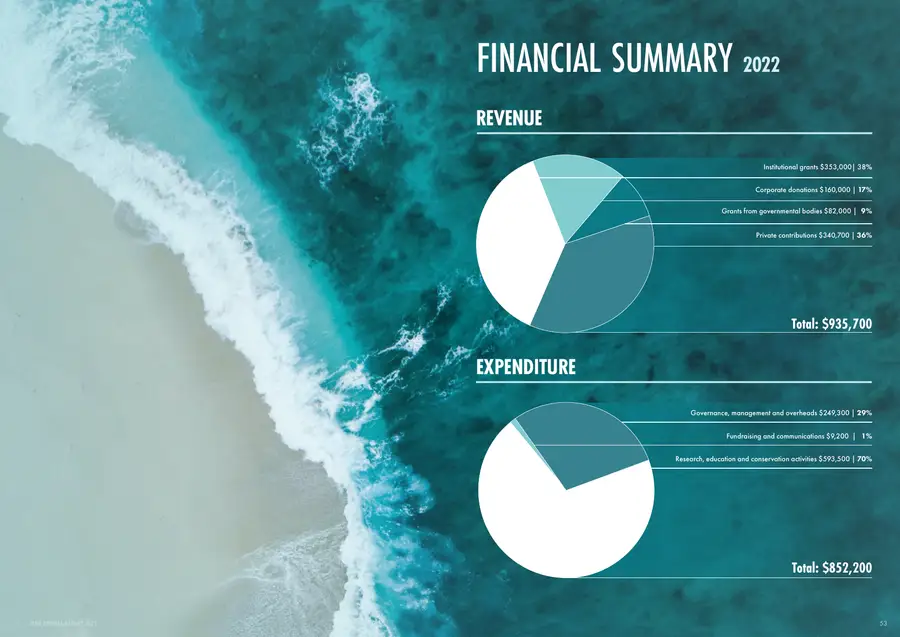
| 2022 | Share | |
|---|---|---|
| Institutional grants | $353,000 | 38% |
| Corporate donations | $160,000 | 17% |
| Grants from governmental bodies | $82,000 | 9% |
| Private contributions | $340,700 | 36% |
| Total | $935,700 |
| 2022 | Share | |
|---|---|---|
| Governance, management and overheads | $249,300 | 29% |
| Fundraising and communications | $9,200 | 1% |
| Research, education and conservation activities | $593,500 | 70% |
| Total | $852,200 |
Special thanks to our major project funders
Pages 54 to 57 of the report
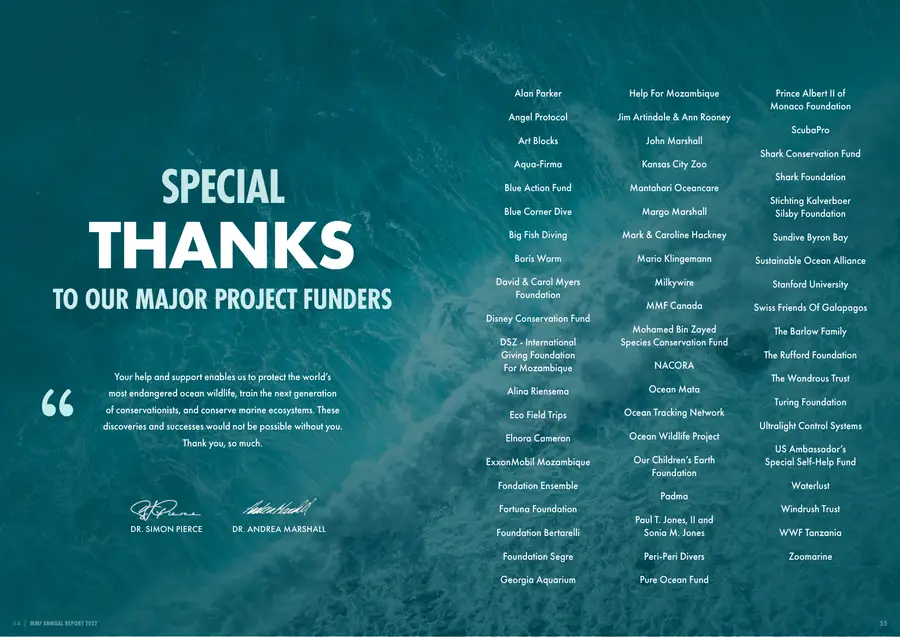
Your help and support enables us to protect the world’s most endangered ocean wildlife, train the next generation of conservationists, and conserve marine ecosystems. These discoveries and successes would not be possible without you. Thank you, so much.
Dr. Simon Pierce and Dr. Andrea Marshall
- Angel Protocol
- Art Blocks
- Aqua-Firma
- Blue Action Fund
- Blue Corner Dive
- Big Fish Diving
- David & Carol Myers Foundation
- Disney Conservation Fund
- DSZ: International Giving Foundation For Mozambique
- Eco Field Trips
- ExxonMobil Mozambique
- Fondation Ensemble
- Fortuna Foundation
- Foundation Bertarelli
- Foundation Segre
- Georgia Aquarium
- Help For Mozambique
- Kansas City Zoo
- Mantahari Oceancare
- Milkywire
- MMF Canada
- Mohamed Bin Zayed Species Conservation Fund
- NACORA
- Ocean Mata
- Ocean Tracking Network
- Ocean Wildlife Project
- Our Children’s Earth Foundation
- Padma
- Peri-Peri Divers
- Pure Ocean Fund
- Prince Albert II of Monaco Foundation
- ScubaPro
- Shark Conservation Fund
- Shark Foundation
- Stichting Kalverboer Silsby Foundation
- Sundive Byron Bay
- Sustainable Ocean Alliance
- Stanford University
- Swiss Friends Of Galapagos
- The Rufford Foundation
- The Wondrous Trust
- Turing Foundation
- Ultralight Control Systems
- US Ambassador’s Special Self-Help Fund
- Waterlust
- Windrush Trust
- WWF Tanzania
- Zoomarine
The report also thanks individual supporters by name; that list is in the PDF.
If you want to help our oceans, now is the time. Join us in saving Earth’s most iconic marine wildlife.
Become an MMF member
When you join our community, you’ll be making a transformational contribution to our organization’s conservation efforts. Your steady, incremental donations provide a reliable stream of funding. This creates a strong financial foundation for us to build out our capacity for conservation, plan for the long term, and ensure that we have the resources we need to achieve our goals.
MMF founding members
The report thanks its founding members by name; that list is in the PDF.
Healthy ecosystems are more resilient to climate change
Pages 58 to 59 of the report
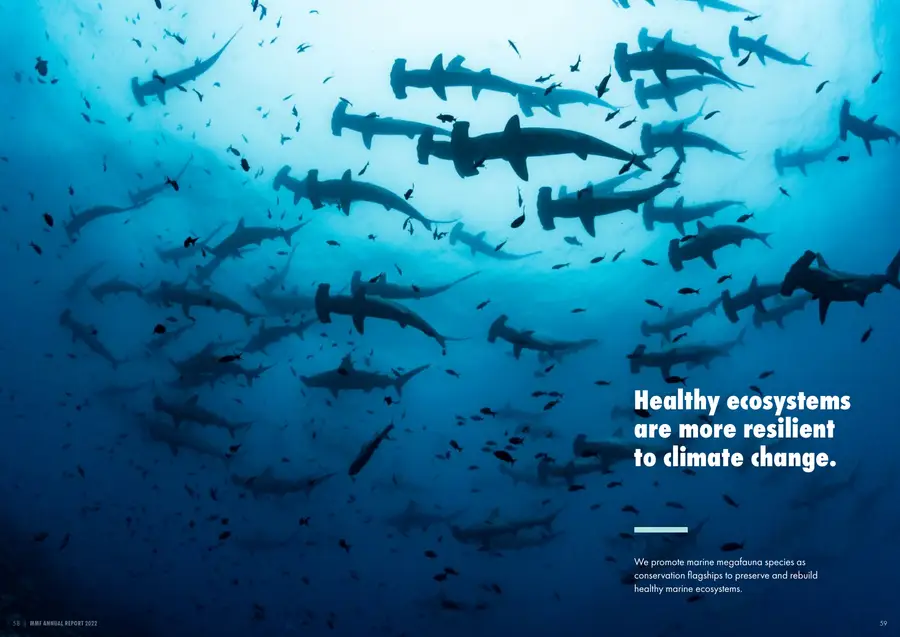
We promote marine megafauna species as conservation flagships to preserve and rebuild healthy marine ecosystems.
About this report
Page 2 of the report
© Marine Megafauna Foundation, 2023
This report, along with other information about MMF, is available online at www.marinemegafauna.org
Marine Megafauna Foundation, 7750 Okeechobee Blvd, Ste 4-3038, West Palm Beach, FL 33411
Centro de Investigação Científica Megafauna Marinha, Associação Megafauna Marinha, Praia do Tofo, Inhambane, Mozambique
MMF is a tax-exempt non-profit charitable organization under section 501(c)(3) of the US tax code (Tax ID #46-0645082).
All contributions are tax-deductible in accordance with US tax law.
The Associação Megafauna Marinha is also a registered not-for-profit association in Mozambique.
Graphic Design: Madeleine Pierce