
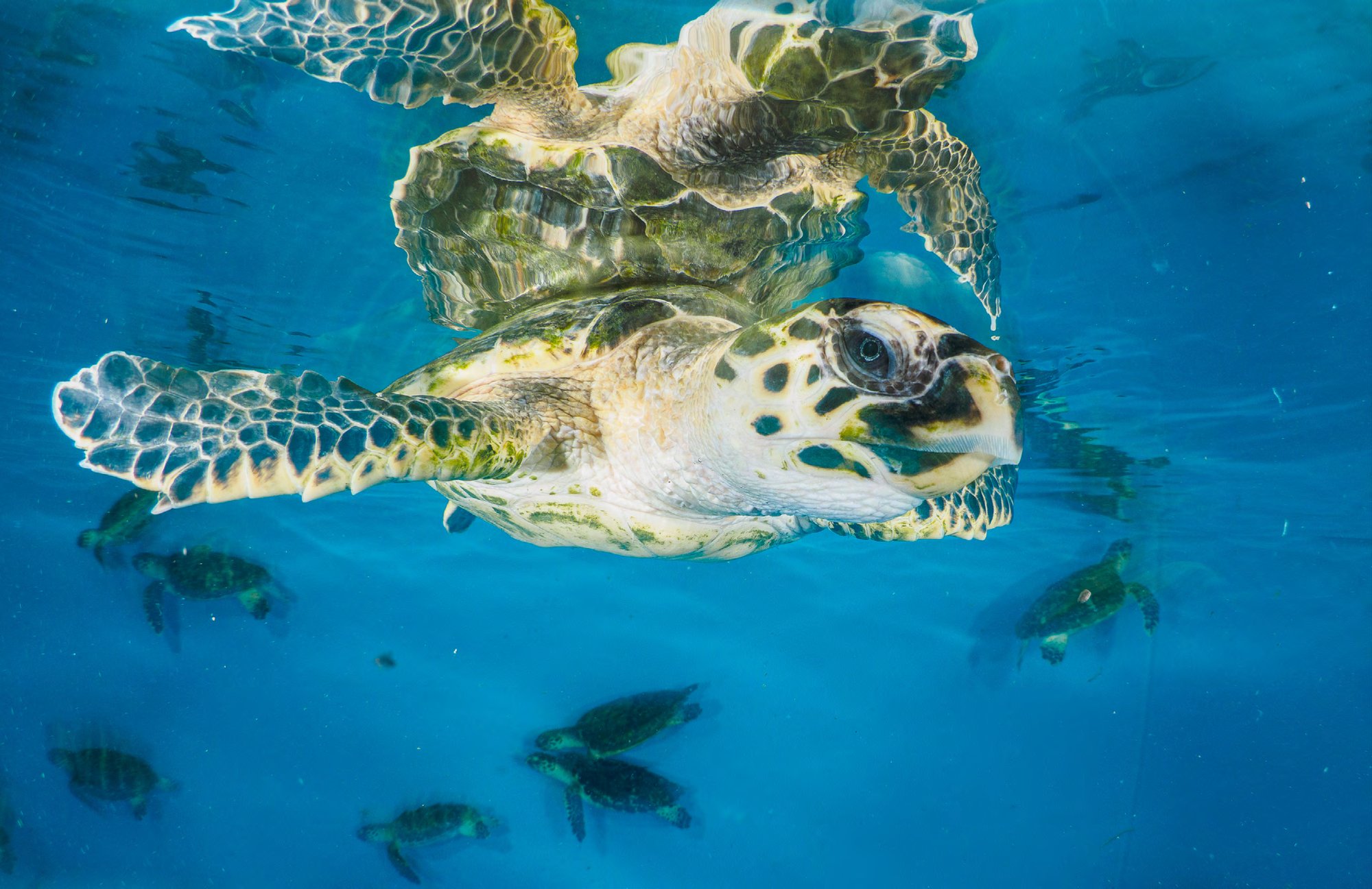
Juvenile hawksbill turtles, rehabilitated and ready for release.
I’ve talked to Dr. David Robinson previously about his research on leopard (zebra) sharks. Before David moved to Australia, he worked as a sea turtle rehabilitation expert at the Dubai Turtle Rehabilitation Project. I wanted to chat with him about that work, too! – Simon Pierce
How the project began
The DTRP, or Dubai Turtle Rehabilitation Project, was founded by Kevin Hyland, from the Wildlife Protection Office, in Dubai back in 2004. People kept on bringing him sea turtles that needed rescuing and, as he was basically a one-man band at the time, he ended up with his bath full of juvenile hawksbill turtles. Once it got to the point that he couldn’t wash himself at home, he approached the Burj al Arab and Jumeirah to see if he could use their aquarium facilities. Warren Baverstock, who ran the aquarium, was very keen. The aquarium ended up being a great facility for sea turtle rehabilitation, and it’s all worked out brilliantly.
I moved from the UK to Dubai in 2006 to be part of this project, working under Warren as the assistant manager in the aquarium too. I’d worked with sea turtles before, having done my MSc research on leatherbacks in Costa Rica, so that was a great help. In those early days, we were looking after 14–15 sea turtles through the year. As social media developed, we started posting about the turtles we were caring for, and more and more people brought in turtles for us to nurse back to health. The project built fast, and we had 350 sea turtles come through the facility in 2009.
Before the DTRP came about, well-meaning people had been trying to rescue turtles themselves. It didn’t always end well. We had tortoises brought to us in buckets of water, as people thought they were sea turtles. Another person used table salt in freshwater to try to give a turtle the right environment. They were doing their best, but it was great to develop a proper facility where we had the expertise to treat the turtles.
The Burj al Arab and Jumeirah company have been fantastic in supporting the DTRP, building a large indoor treatment facility, even cordoning off their outdoor sea-fed lagoons to give the recovering turtles a perfect, safe outdoor habitat to swim around in. Since 2016 we’ve had a dedicated outdoor lagoon system for turtle rehabilitation, partitioned off for turtles of different sizes. The Burj use their massive outdoor projectors to shine turtle images onto their buildings the night before releases. They’ve really helped raise awareness of turtle conservation. We’ve even had celebrities like Novak Djokovic, Joss Stone, and Michael Palin come in to see the turtles. Everyone loves sea turtles. Kevin overfilling his bathtub was the start of something amazing.
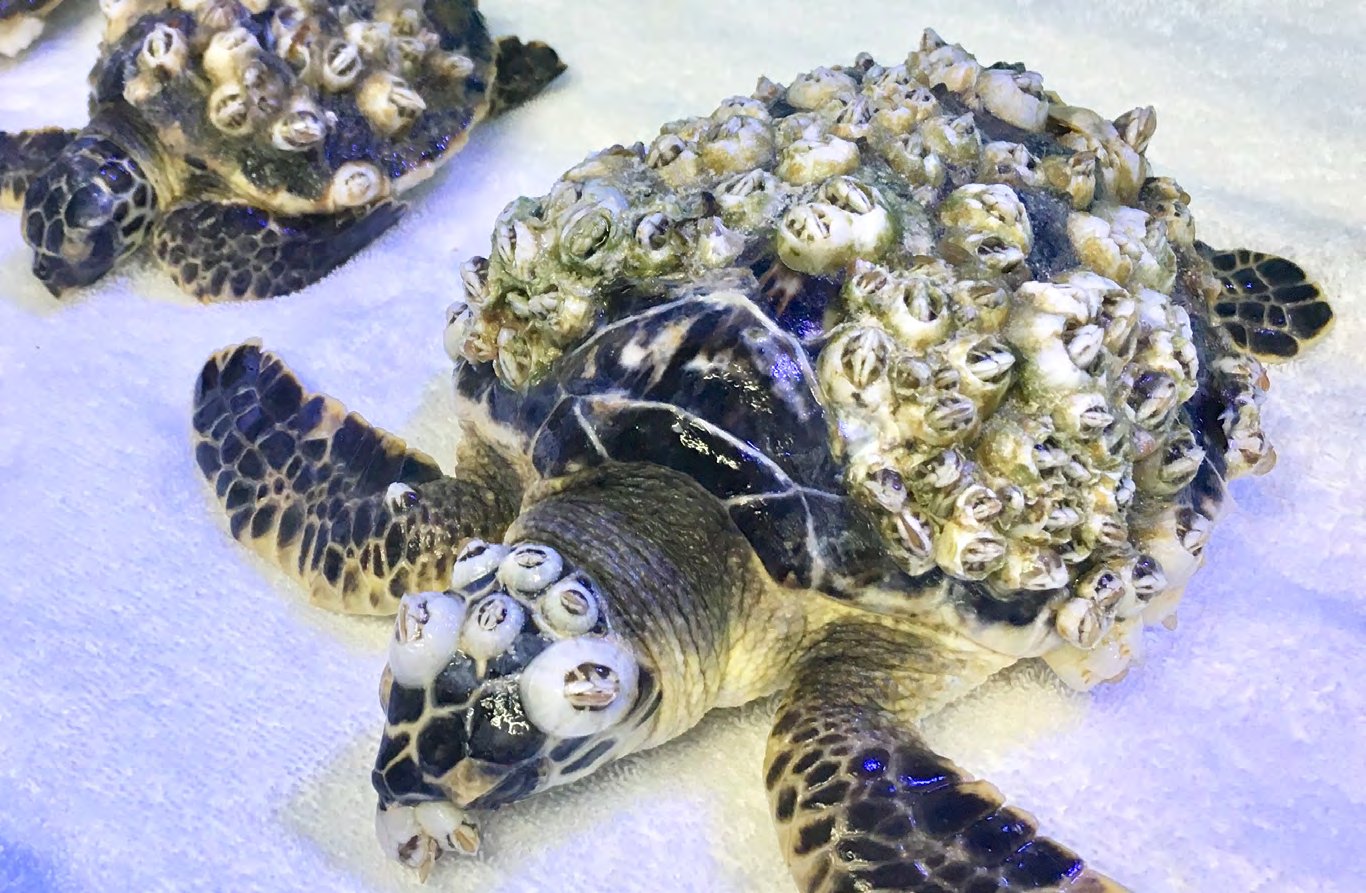
Entangled juvenile hawksbill turtle.
Why turtles need to be rescued
There are far fewer sea turtles in the UAE than there used to be. There are only about 13 nesting hawksbill turtle females left in the country. I think the last nest in Dubai itself was about 35 years ago. Before all the development, turtles would have been nesting all over the place, but the beaches just aren’t suitable for turtles anymore. With their numbers so low, rehabilitating and releasing sick and injured turtles makes a real difference to their population.
The turtles we rescue usually fall into one of two categories: either they’re ‘cold-shocked’, or they have injuries caused by humans. The first is due to the unique environmental conditions in the Gulf. The UAE is very hot in summer but, believe it or not, it gets quite cold in winter. The Arabian Gulf, which borders the UAE, is a very shallow sea. Even off the coast, 14 miles from Dubai, it’s only 10 m deep. In the summer, it gets heated to over 35ºC, but then as winter sets in it can cool down very suddenly.
Sea turtles are cold-blooded, so they gain their body heat from the environment. In summer, they’re swimming around, they’re eating, everything’s great. Two weeks later, it’s 20ºC colder. The baby turtles from that year are only about four months old at that stage, and suddenly they’re in trouble. Hunting for food becomes difficult, they haven’t got enough energy to rid themselves of parasites, barnacles, or other encrustation. They get sicker and sicker, and if there’s a storm they all get washed in – that’s when we get mass strandings of these young turtles.
Fortunately, the baby turtles are pretty easy to fix. They’re usually anemic, so we give them iron. They have infections, blood parasites, and heart flukes, which we can treat with antiparasitics and antibiotics. They’re generally starving too. That, we can treat with special post-surgery cat food. They love it. We use a bird gavage tube to get food directly into their stomach, and they usually perk up straight away and start feeding naturally again. We had something like 96% survival rate for these juvenile hawksbills. The vets that we’ve worked with in Dubai have been incredible, helping us develop our protocols so we could get all these turtles back to their homes. It’s a great success story.
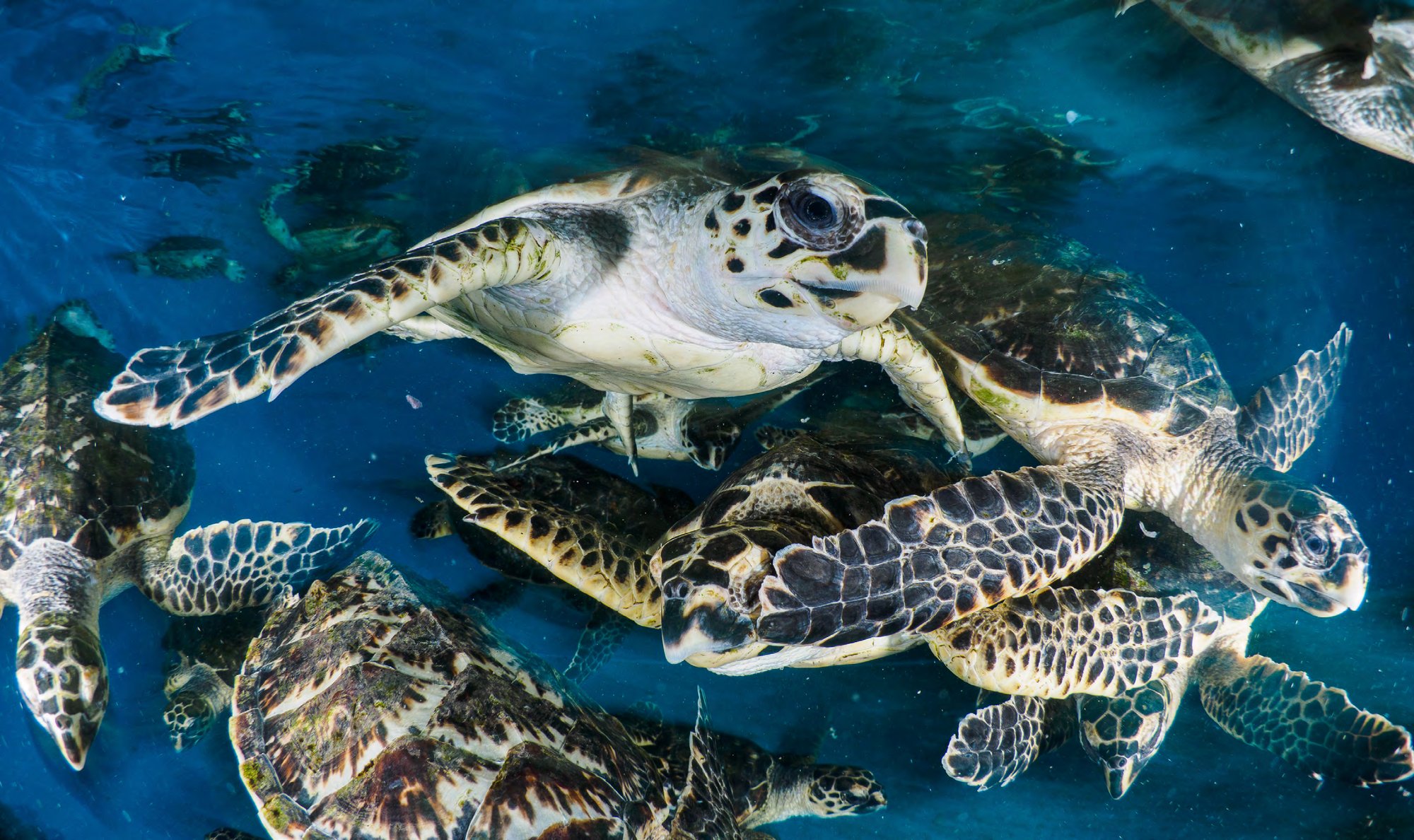
Juvenile hawksbill turtles, rehabilitated and ready for release.
Other turtles that we rescue, though, need a lot more help. The main injuries we see are from boat strikes, pollution, and fisheries. As human populations have increased, so has boat traffic, which means turtles are at risk of getting hit when they surface to breathe. There’s more plastic floating around too, so the risk of plastic ingestion is going up too, and even things like balloons are an issue – we had two juvenile hawksbills that had ingested balloons, presumably thinking they were jellyfish. A lot of smaller plastic pieces will pass through, but things like hooks and fishing line, if they get stuck in the intestine the turtle is in real trouble. By the time they wash up on the beach, it’s too late, and a lot of the large green turtles we saw were so weak that we couldn’t save them. Their intestines had stopped working. We did manage to save a few though, so we never hesitated to help, to invest the time needed for any single animal. We always tried, but the truth is that a lot of them don’t make it.
Having safe areas where the turtles can feed, mate, and nest is only becoming more important. The UAE government is acting on that, and turtles are protected by law, and there are protected areas to preserve the remaining nesting sites. So that’s good.
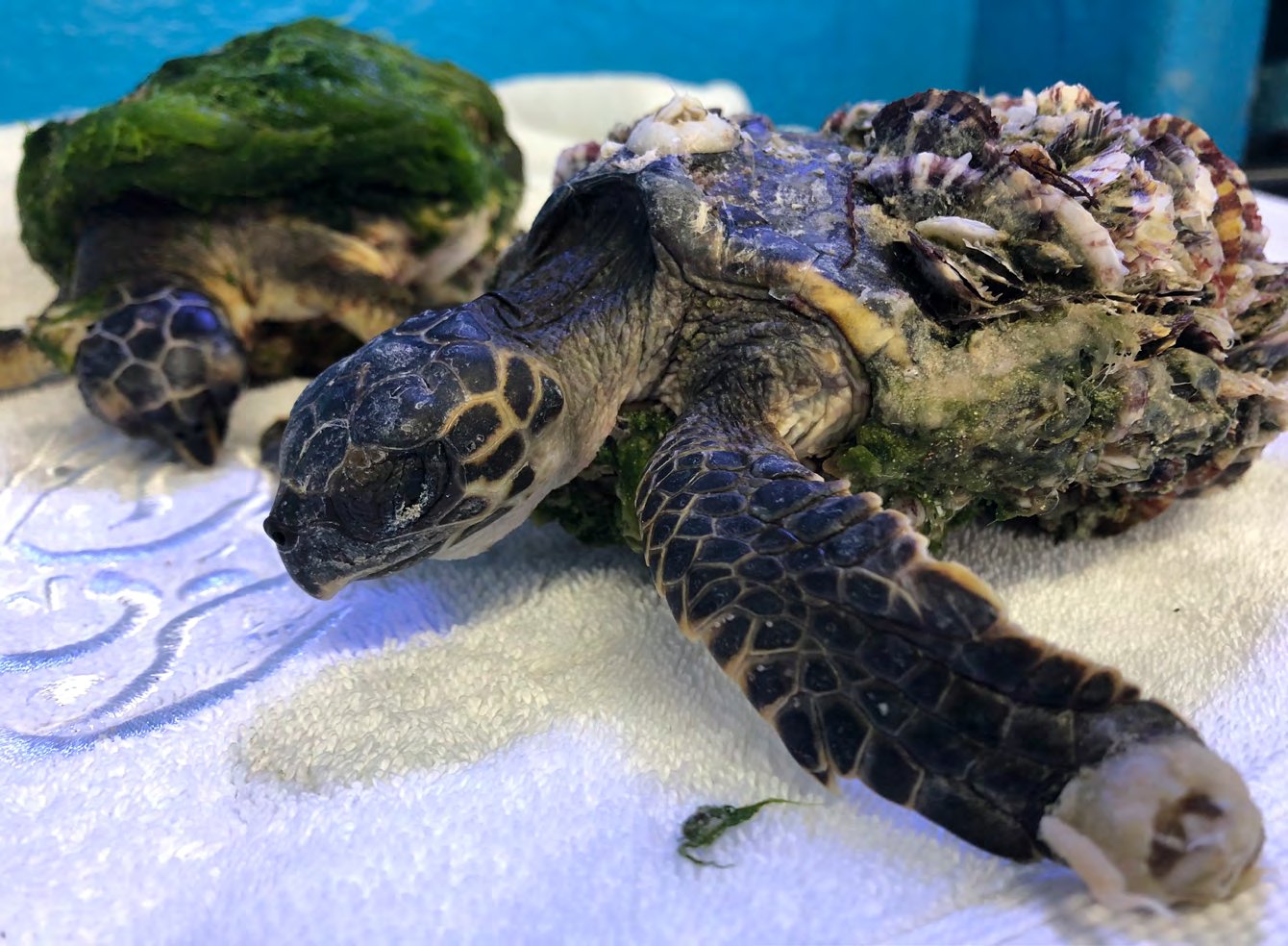
Cold-shocked juvenile hawksbill turtles.
Developing treatments
Our ability to treat sea turtles has developed a lot over the years. When I started in 2006, we didn’t have the amazing technology we have today, and we’ve worked with some fantastic vets to develop the protocols we need.
We can learn a lot by analyzing blood samples from turtles. With the large stranding events we get in winter, we’ve been one of the only projects that could take samples from a lot of different turtles almost simultaneously to find out what’s wrong with them. So when I say the young hawksbills were generally anemic, we’d have samples from 100 individuals sometimes. We wrote a paper on that, with a very talented vet, Valentina Caliendo.
There’s a great online turtle rehabilitation community, and we’re always sharing information. Some of these rehab centers are in remote areas, or they don’t have much funding, and it can be very difficult for them to get even basic antibiotics. We were lucky to be working in a major city, a wealthy city, so for us finance wasn’t an issue. That was an amazing blessing, especially for the turtles, as we could pool all our blood sample data and make it available so that other rehab centers could use it too.
Turtles have an astounding ability to recover from even the most severe injuries. Watching them manage to re-seal themselves is incredible. If we could get them through that initial infection they usually recovered well. Even when boat strikes cut right through their shell, we’d literally screw the two halves together, and within a month we’d see connective tissue appear in the gap. They’d fuse themselves back together. They’re amazing animals.
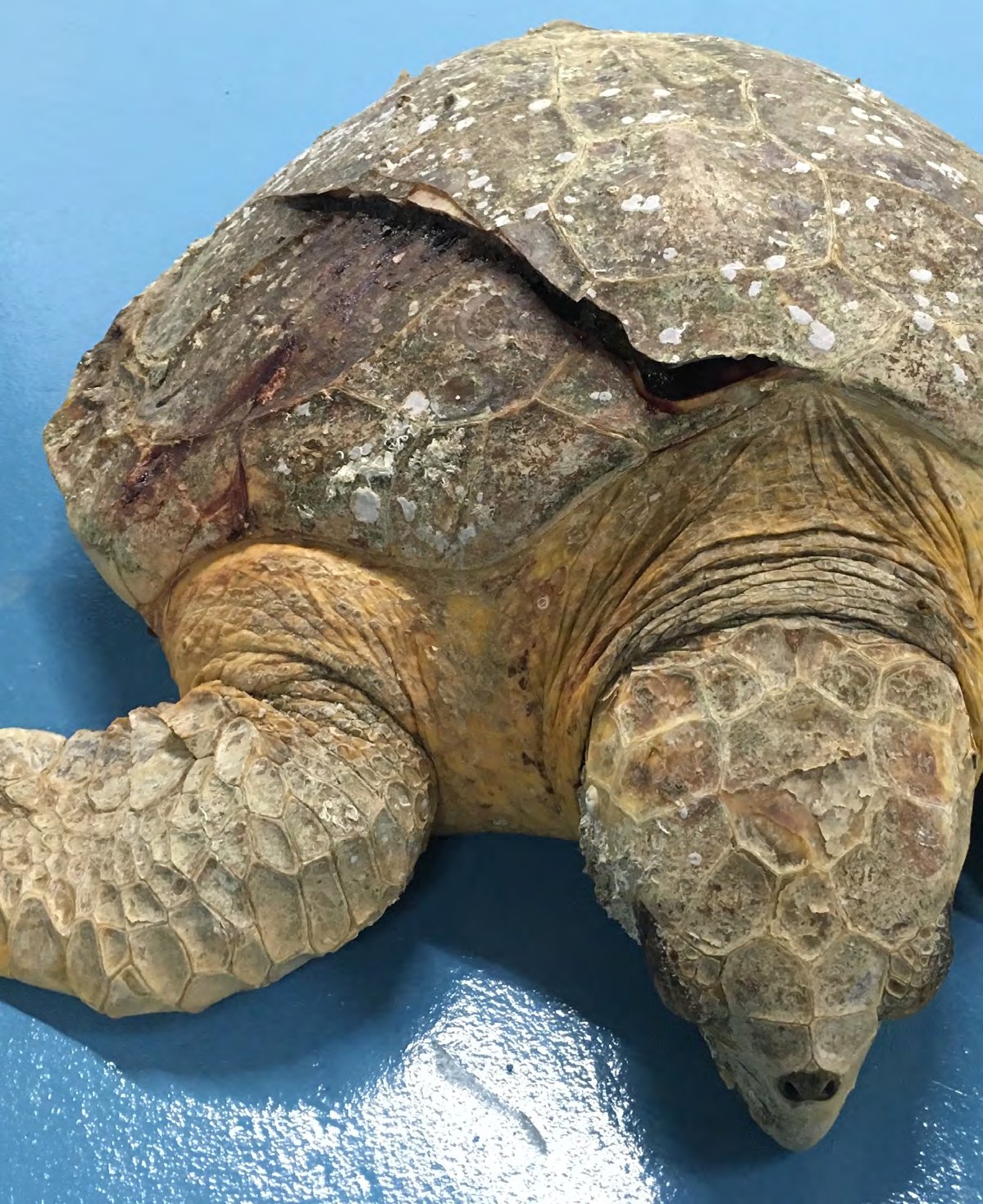
Loggerhead turtle recovery after being crushed in the intake pipe of a desalination plant.
Tracking success
We had a green turtle brought in on the very first day I started at work, in 2006. We called her Dibba, because that’s where she was found. She had a massive head injury. Sometimes fishermen, if the turtle is thrashing around stuck in their net, will smack them to stun or kill them so they’re easier to untangle. They’re not after the turtle; they just get dumped. Dibba washed ashore, severely injured, and we spent three years looking after her while she recovered. Eventually, we were able to release her, and we glued a small satellite tag to her shell so we could check she was okay. She made the largest journey of any green turtle recorded to date. She swam from the east coast of the UAE, all the way to the Maldives, up to Sri Lanka, and then into the Andaman Sea. It was incredible, a 7,000 km swim. It was fantastic to see an animal we knew so well set off so strong and healthy.
Tagging the larger turtles we release is great, as for months afterward we can remotely check in on how they’re doing – where they are, and whether they’re behaving normally. It often takes the turtles a few days to reorientate themselves following release, but then the older turtles, in particular, often bolt straight back to near where they washed up – it’s great to see them returning to their familiar foraging areas.
Our most recent paper focused on turtle amputees. When turtles get fishing line wrapped around their front flipper, it can lead to full amputation. We were seeing over ten turtles a year with missing flippers. Standard rehabilitation guidelines were that these turtles couldn’t be released, but we were seeing them recover and adapt surprisingly well. We decided to release and track some of them with satellite tags to see if they could survive back in the wild. It was a gamble, but the alternative was for them to spend the rest of their life in captivity. We know from field data that turtles with one flipper can still reproduce; they’re able to dig nests if they still have both back flippers. Sure enough, these turtles acted normally in the wild. They went back to their regular foraging areas, and their survivorship was the same as other released turtles over the time we tracked them. They all made it.
Amputations are on the rise globally, so knowing that these turtles can still be rehabilitated and released is really important – there just aren’t enough turtles out there, and we want to give them the best life we can. Getting them back out into the world is really important.
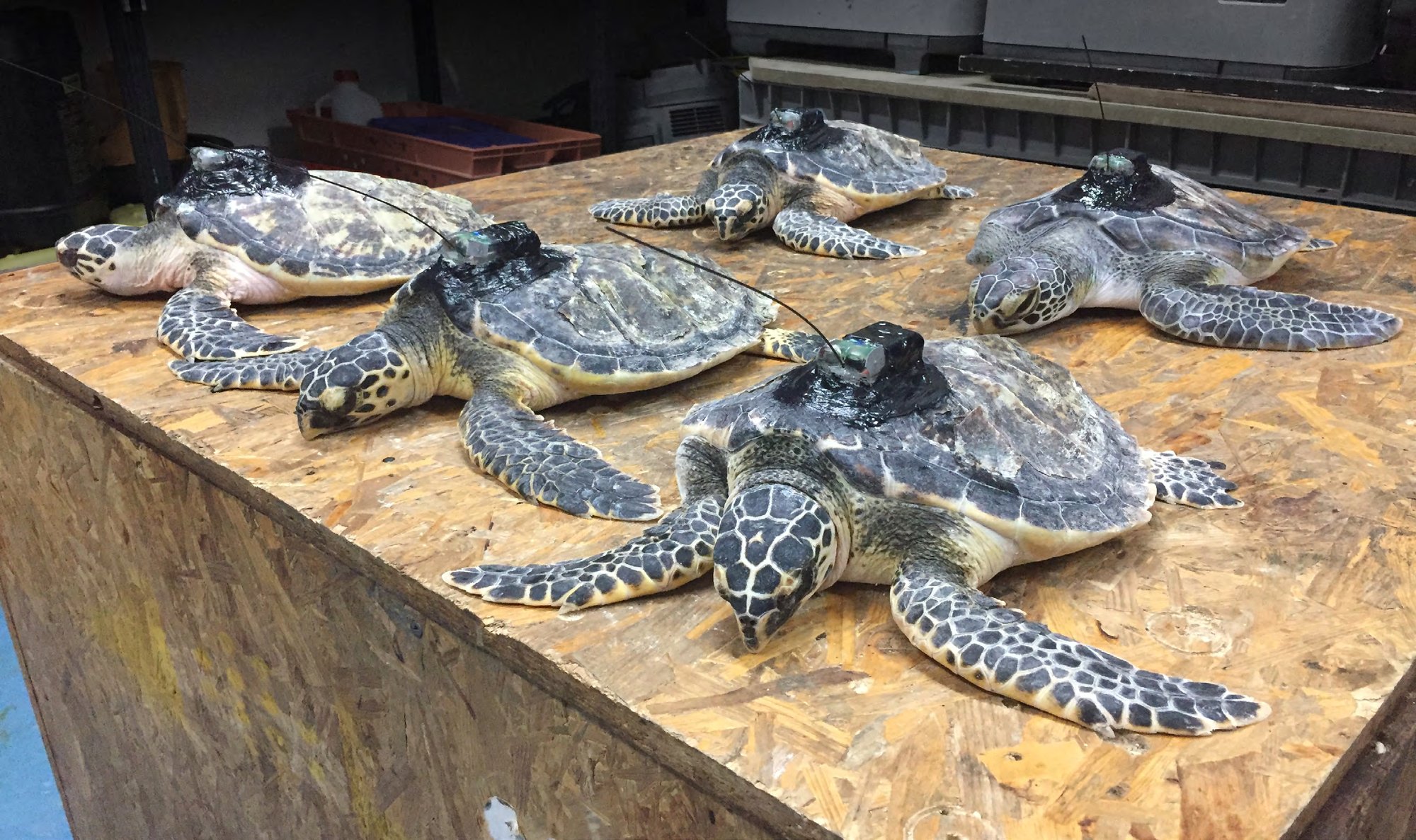
Hawksbill and green turtles, tagged and ready for release.
Creating awareness
The DTRP started around when social media use started increasing, and we’ve found it to be a great tool for conservation. We can show the rehabilitation process, the turtle’s release, and raise awareness of the issues that turtles face. One turtle we cared for, called Hope, had been hit by a boat. It had completely destroyed her carapace. We did some research into how we could rebuild her carapace, and created a full plastic shell to help her bones fuse back together. She made an amazing recovery; she was out in the lagoon once we dealt with her initial infection, and people really engaged with this turtle that had a big white plastic shell with a red cross on it. She had a huge following, and it was fantastic when we were eventually able to release her back into the wild.
Our posts also gave us the chance to share the reality of the job. We were quite real with people, sharing when turtles passed away, and our post-mortem results where we identified what had killed them. If you hide that aspect of it, the horrible injuries from boat strikes, turtles starving to death from plastic ingestion, then nothing will ever change. We need people to recognize these threats and stop them happening in the future. Some of our released turtles have been killed too, which hits really hard. We’ve lost five of the tagged turtles to human causes: boat strikes or net entanglement. We can spend three years rehabilitating a sea turtle, getting it healthy again, and finally releasing it. Five days later it’s hit by a boat, and it’s dead. The investment that goes into rehabilitating an animal is huge. Financially, emotionally, and so much of our time. And that can all be wasted in a second. Rehabilitation can be a tough gig.
The releases, though, were the biggest reward for us. We’d bring in kids from local schools, and they’d help release the turtles. Sometimes, after a mass stranding of juvenile hawksbills, there’d be 150 turtles all being released at once. It’s something the kids remember for the rest of their lives, and it’s fantastic for us too. Over the winters we’d do school visits, and it was great to see the faces of these children light up, and for us to know we’d sparked something in this next generation of conservationists. We’re really lucky to see sea turtles a lot, but most people don’t, and it’s really important for people to have these experiences. It’s like sharks, too. If people don’t have their own knowledge on what they’re really like, all they know about them is from the media, where they’re usually these scary monsters. When people see the animals themselves, they can form their own opinion, and start caring about their conservation. That’s how change happens.
The project itself is going from strength to strength. It’s achieved so much over the years. We’ve released about 2,000 turtles back into the wild that would have otherwise died. When there’s only 13 nesting hawksbill in the country, it really makes a difference. The young turtles won’t be nesting for another 20 years, but we’re giving the species a chance at a better future.
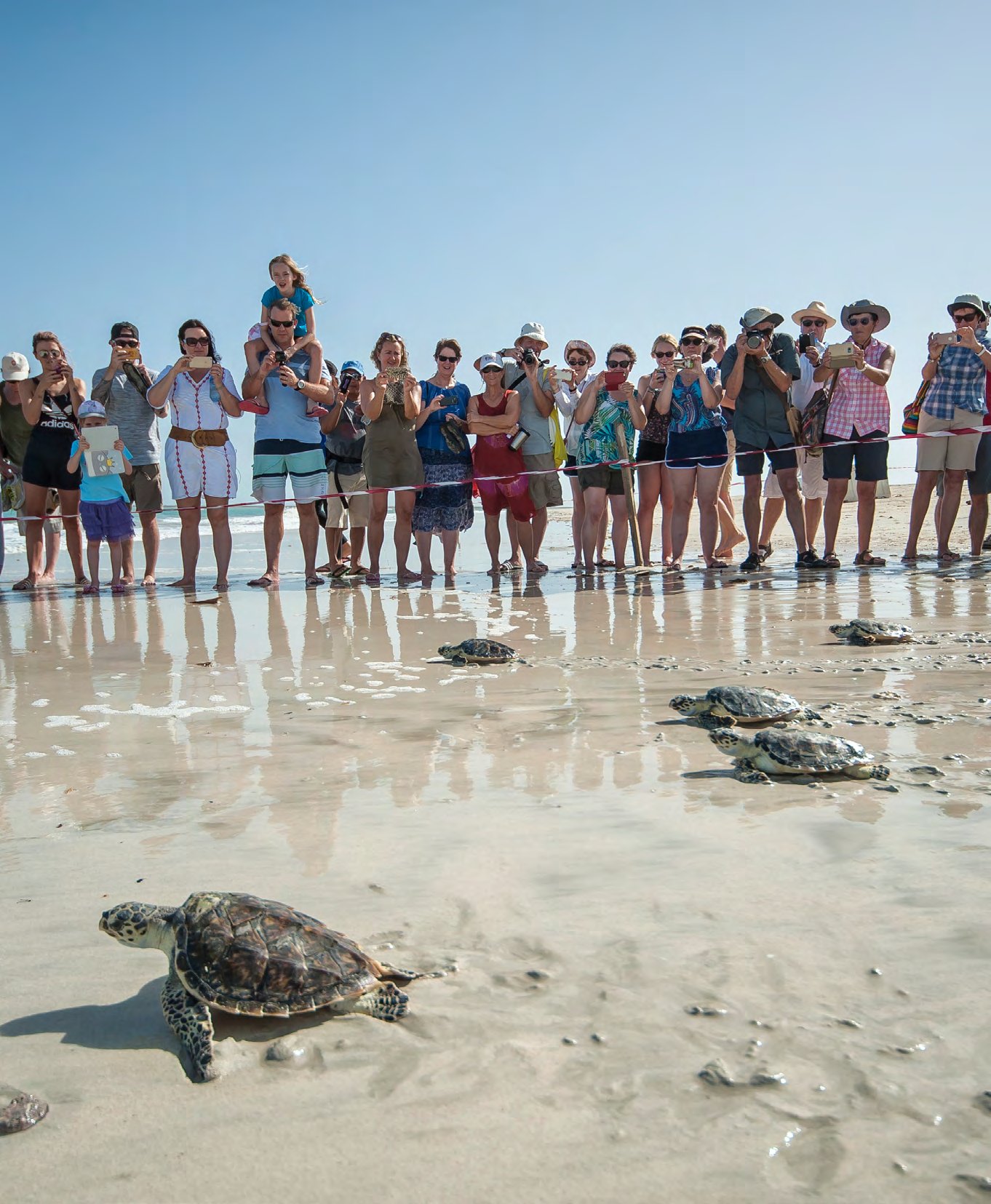
Release day in Dubai.
This article was originally published in Ocean Giants, MMF’s magazine, Issue #04 (Winter 2021). Download the full issue as a PDF.