
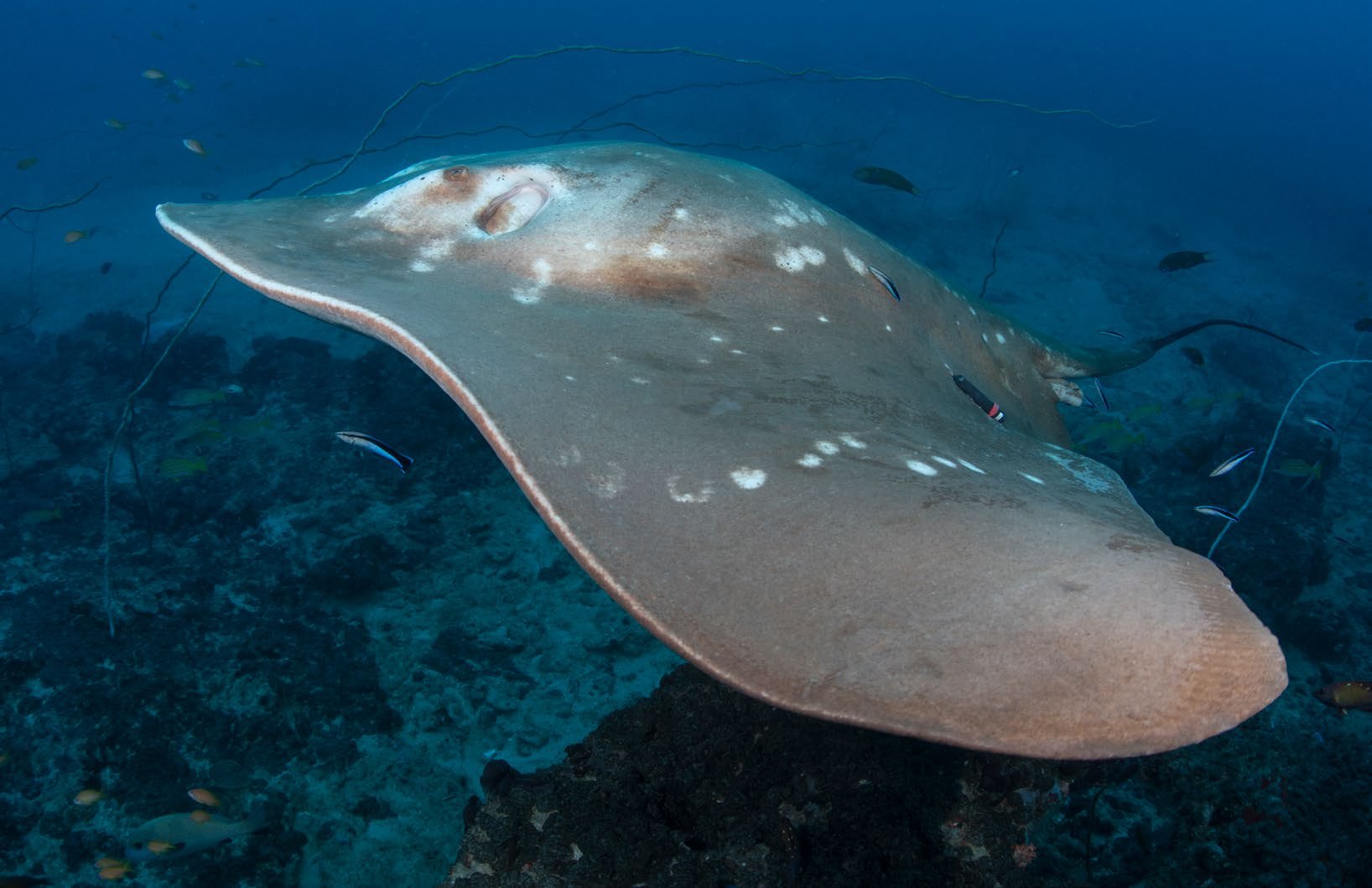
A smalleye stingray with an acoustic tag.
The MMF team in Mozambique are conducting the first field research on the huge, poorly-known smalleye stingray. We asked Andrea to tell us more about the project! – Simon Pierce
“At the bare minimum you are going to need an armored breastplate to protect you”, one of my research associates blurted out. I mulled the statement over for a minute. Perhaps, I thought. If I was being honest with myself I was incredibly nervous about what we were proposing. The idea of tagging the world’s largest marine stingray, free-swimming in the wild, was intimidating to say the least. With massive stingers the size of your forearm, and the tail musculature needed to deploy it mid-water into anything that presents a threat to them, these rays certainly have the capability of defending themselves effectively. Since no one had ever tried to do this before, it was unclear how they would react and if I was putting myself at mortal risk.
As a shark and ray expert, I have been researching different species in the field for over 20 years. Along the way, I have personally tagged more than 100 individual sharks and rays and I feel extremely comfortable doing so. I also have been working with this specific species of ray in the wild for years in Mozambique and had always found them to be docile, slow-moving, and relatively unafraid of our presence. To be fair, they likely do not see very well so their placid nature could have more to do with them not seeing us than being ‘accepting’ of our presence.
Known commonly as the “smalleye stingray”, these massive rays have extremely small eyes relative to their body size. They look a bit like tiny raisins sunken into their heads and they definitely don’t give the impression they see very well. We often see them bumping into soft coral sea whips or sponges as they track around the inshore reefs to visit cleaning stations. In fact, when another species accidentally bump into them, it seems to elicit a disproportionately strong response, almost as if they had not seen the animal at all and were shocked by the sudden contact.
These observations were worrying as I was unsure of how these specific rays may respond to me prodding them with my tagging pole. Different species of sharks and rays have wildly different responses to tagging. Whale sharks barely react. However, given the fact that they have the thickest skin of any animal, they simply may not feel it. Giant oceanic manta rays, on the other hand, know I have done something to them, but they often act like they are not bothered by it. Other species like wedgefish are very startled by anything foreign touching them and race off from the perceived danger. An animal that feels like tagging is a threat to them may react by trying to defend themselves. In the case of the smalleye stingray, this kind of reaction could result in them deploying their stinger into the offending perpetrator – in this case, me.
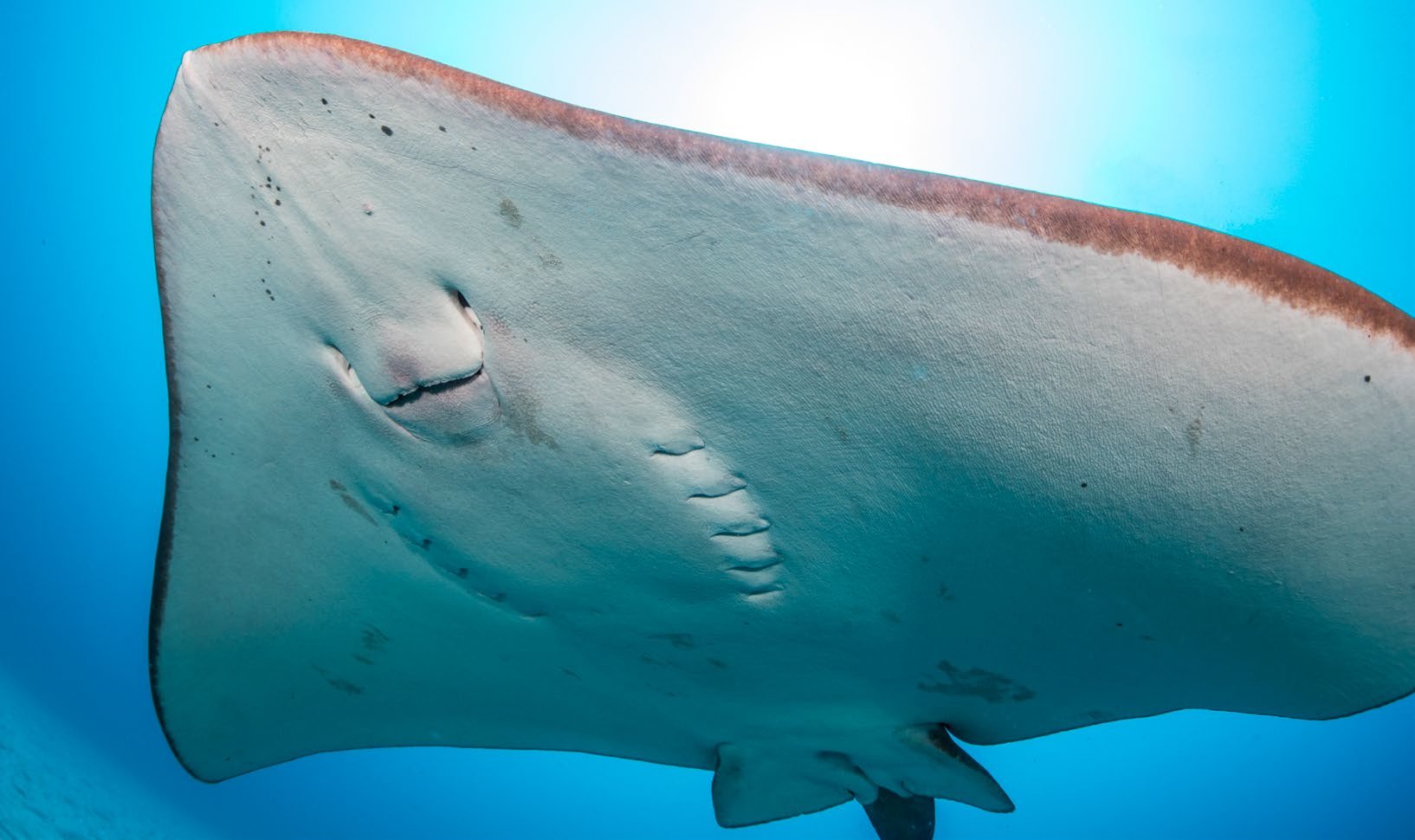
The underside of a smalleye stingray.
Given the situation, the risk was temptingly worth the reward. The development of sophisticated animal-borne tags has been a game changer for marine researchers, particularly those of us needing to track rare, elusive, or highly mobile species. We have learned so much about manta rays, whale sharks, and marine predators like bull sharks by tagging them. So tagging a smalleye might be our best and only opportunity to learn more about one of the world’s rarest and most elusive species of rays – a species that has never been studied before, and is likely to be endangered.
We only discovered we had ‘smalleye stingrays’ in Africa in 2008. The other co-founder of MMF, Dr Simon Pierce, and I had been regularly encountering a huge species of stingray that we were unfamiliar with on our deep reefs in southern Mozambique. After some sleuthing we determined it was an extremely rare species, occasionally seen in fisheries on the other side of the Indian Ocean. It was not known from Africa and it turned out to be a whopping 5000 km range extension from the Maldives, the furthest west they had previously been seen in the Indian Ocean. We continued to encounter them regularly and it did not take us long to realize that we were sitting on the largest identified population in the world, and the only known location where they could be studied reliably.
Fast forward a decade and we were now faced with the daunting challenge of tagging some representative individuals in an attempt to learn more about their movement patterns, habitat preferences, and daily habits. Even with the highest rates of encounters in the world, our researchers were not seeing them very often and interactions were limited to inshore cleaning stations. If we wanted to know more about this intriguing animal, tagging them with satellite and acoustic tags was the only way to find out more details about where they travel and how they spend most of their time.
I certainly had some suspicions. Seeing them only on our deeper reefs led me to believe they might be a deep water species, one that would only come up to shallower waters periodically for a clean. We also believed them to be pelagic or at least semi-pelagic, meaning that they may, like manta rays, be in constant motion – never resting on the sea floor like a typical stingray. We believed this because we had never come across one sitting at the bottom. Plus, their body shape, was designed for swimming, with elongated wing-like pectoral fins that enable them to swim more efficiently than their more rounded counterparts, which can only awkwardly ungulate from one location to the next. If they were highly mobile like mantas, they may travel far distances as well or at least swim around quite a bit – another possible explanation for why we were not encountering them regularly on our reefs.
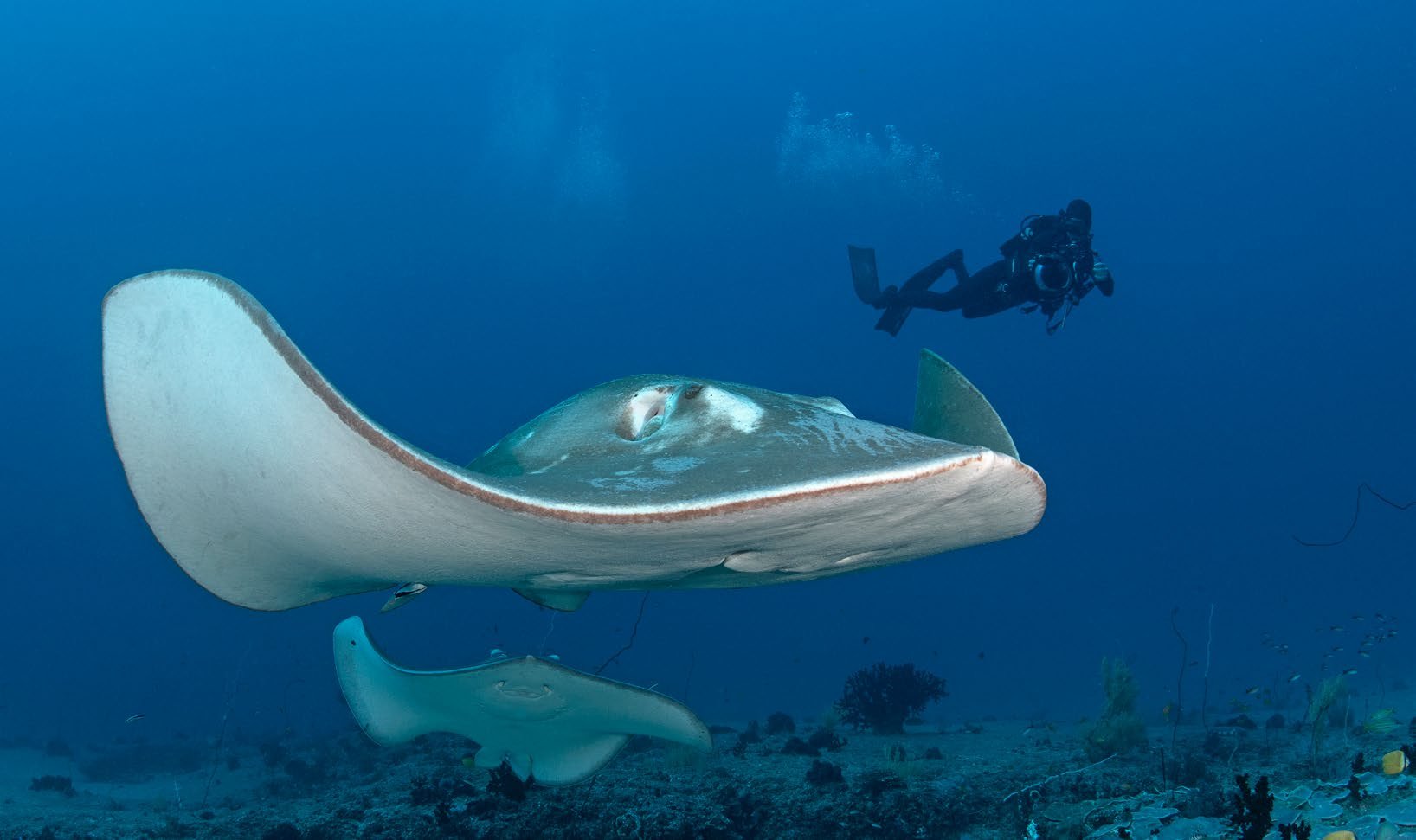
Janneman Conradie filming a smalleye stingray (with whipray follower).
Then there were the eyes. The impossibly tiny eyes. There had to be an explanation for those. Sharks and rays, or at least those that live in the shallows, typically rely heavily on vision and generally have good eyesight. This ray was different. Did it live in a deep water environment where vision was not needed? Had its other senses heightened, making sight less important? What on earth could be the explanation for miniature eyes on such an enormous body and was the development of their super-sized stinger related? Poor vision resulting in the need for an over-the-top defensive system?
Tagging was the natural progression for studying hard-to-access marine species. We already had the equipment needed to deploy various types of tags on large-bodied animals underwater. My preferred tool was a Hawaiian sling. A simple pole with an elastic on one end, that when pulled, would launch the pole at speed toward its target with enough force to sink a small anchor under the skin of an animal. The tags themselves would sit outside the animal and eventually come off. Some tags are programmed to release after a set amount of time, others simply work their way out of the animal over time like a splinter. The different types of tags provide researchers with different types of information.
Acoustic tags work in conjunction with fixed ‘listening’ receivers affixed to the seabed. They provide highly accurate information about how animals are using specific areas or habitats. The animal has to be in close range to the receivers to log its presence at a site and it helps us to understand how often they visit these specific areas of interest, how long they spend once there, and ultimately how important these environments are to them. Satellite tags are helpful in other ways. They collect data independently as the animal moves along, recording things like water temperature, depth, and the animal’s physical location as it travels through time and space. The location data are often not incredibly precise, as GPS does not work underwater, but you still get a pretty good idea of what the individual animal has been up to for the past few months to a year.
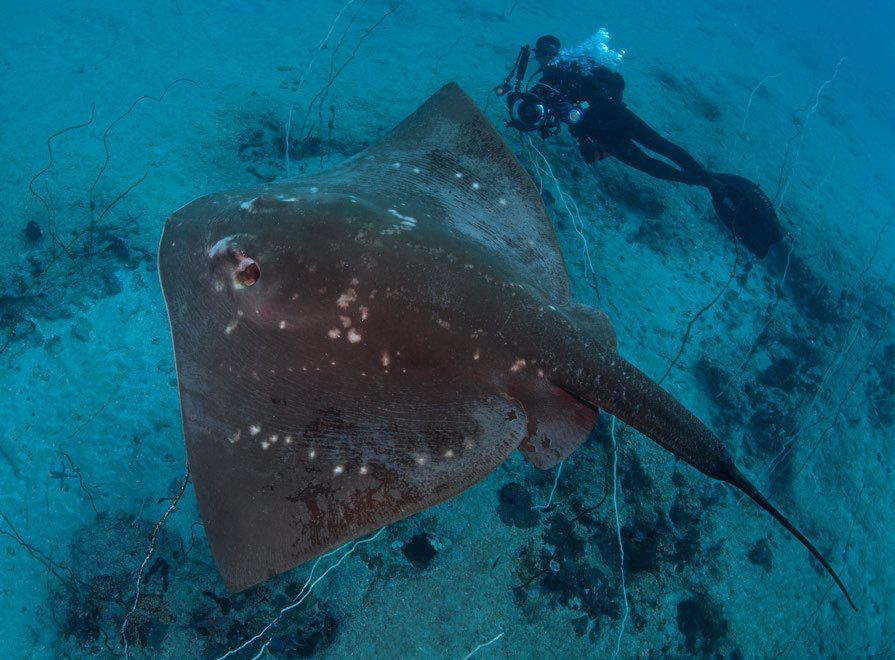
Andrea with tag and biopsy poles.
As novel and exciting as this research seemingly was, it took ages to get support for the project and the necessary funding in place. To make matters more challenging, even after everything was secured and all the necessary planning had taken place, I still had to go out and actually find some individuals to tag. This turned out to be a lot harder than we thought. While we encounter smalleye stingrays more than anyone else in the world, we do not see them all that commonly. Divers in southern Mozambique might see one every week, but not necessarily the researcher swimming around with the tagging pole. It became clear that this was going to take some patience and persistence.
The first day I went out prepared to tag a smalleye I was beyond nervous – which was a foreign feeling for me underwater. Being underwater is my happy place. It is where I feel most capable and most confident. So why was my stomach doing flip-flops? If I only had an indication of how the ray was going to react. Then it dawned on me. I realized that as a tester I could try to genetically sample one first and see what happens. We use the same pole for this just a different modified tip which extracts out some tissue rather than placing on a tag. It was perfect. I could sample the animal from the underside as it was swimming, well away from where it could deploy its stinger, and I could see how it reacted. After a few weeks, I found one, tried it, and was pleasantly surprised to see that while the ray did have a small reaction – it swam away from me – there was no retaliation against the perceived predator. My confidence soared. No armored breastplate would be necessary, I chuckled to myself. Thank goodness.
Despite feeling amped and really ready for the task ahead, it ended up being ages before I saw my next smalleye. I actually waited for almost 6 months before the first opportunity presented itself. Luckily I had been anticipating the day for so long that I was ready when it arrived. It had been incredibly frustrating to dive with the pole and the tag every day, not knowing when I would see a smalleye. It is actually a lot harder than it sounds as we also have to carry large cameras and quite a bit of other scientific gear as well on each dive. It was for that reason that I was caught off-guard when I saw the large familiar shape approaching me from across the reef. I knew instantly what it was. The way it swims is unique and its shape is unmistakable. It was a mature male but not a particularly large individual, maybe 2 meters disc width. I suddenly realized that I needed to ditch the extraneous gear I was carrying. I had not one but three tagging poles in my hands as well as my large housed underwater camera and some tools to clean one of my listening stations – so I was fully loaded.
However, in a split second, I realized that the smalleye was actually finished cleaning and was now swimming across the reef to make its exit across the sand. I knew there was no time to safely stow the rest of my gear. I simply transferred it all to one hand and swam forward toward the approaching ray. Instinctively, because it was on the move, I knew I would get one shot at this before it disappeared into the depths. I hardly had a moment to second guess myself or be nervous. It was now or never.
Trying to maintain as much distance as I could from the tail, which was particularly challenging as I also needed to be close enough to position the tag safely and effectively, I stretched my arm out as far as I could. I instinctively used my camera and the other poles to block my torso as much as I could, on the off chance the ray would react defensively. I cocked the spear and let go. The tag went in perfectly. Textbook tagging. Even better, the ray barely reacted. I was stunned. I stared dumbfounded, as it actually slowly circled back around. Perhaps with its miniature eyes, it wanted to try to have a look at what I was or figure out what I just did. I paused, watching it for a moment. Then an idea dawned.
I happened to have another tag with me. An acoustic tag. I had brought it along on the off chance I had an opportunity to tag a manta. I slowly began to wonder if I could possibly place a second tag on the smalleye. Double tagging is the holy grail for researchers as each tag provides different types of information. Placed together they can help ground truth one another and when data are analyzed together, they can provide even more robust information about the movements and habits of the tagged individual. I never considered that I would get this opportunity, certainly not on my first attempt. I hesitated for a moment and then decided to go for it. Be bold I thought. I switched poles.
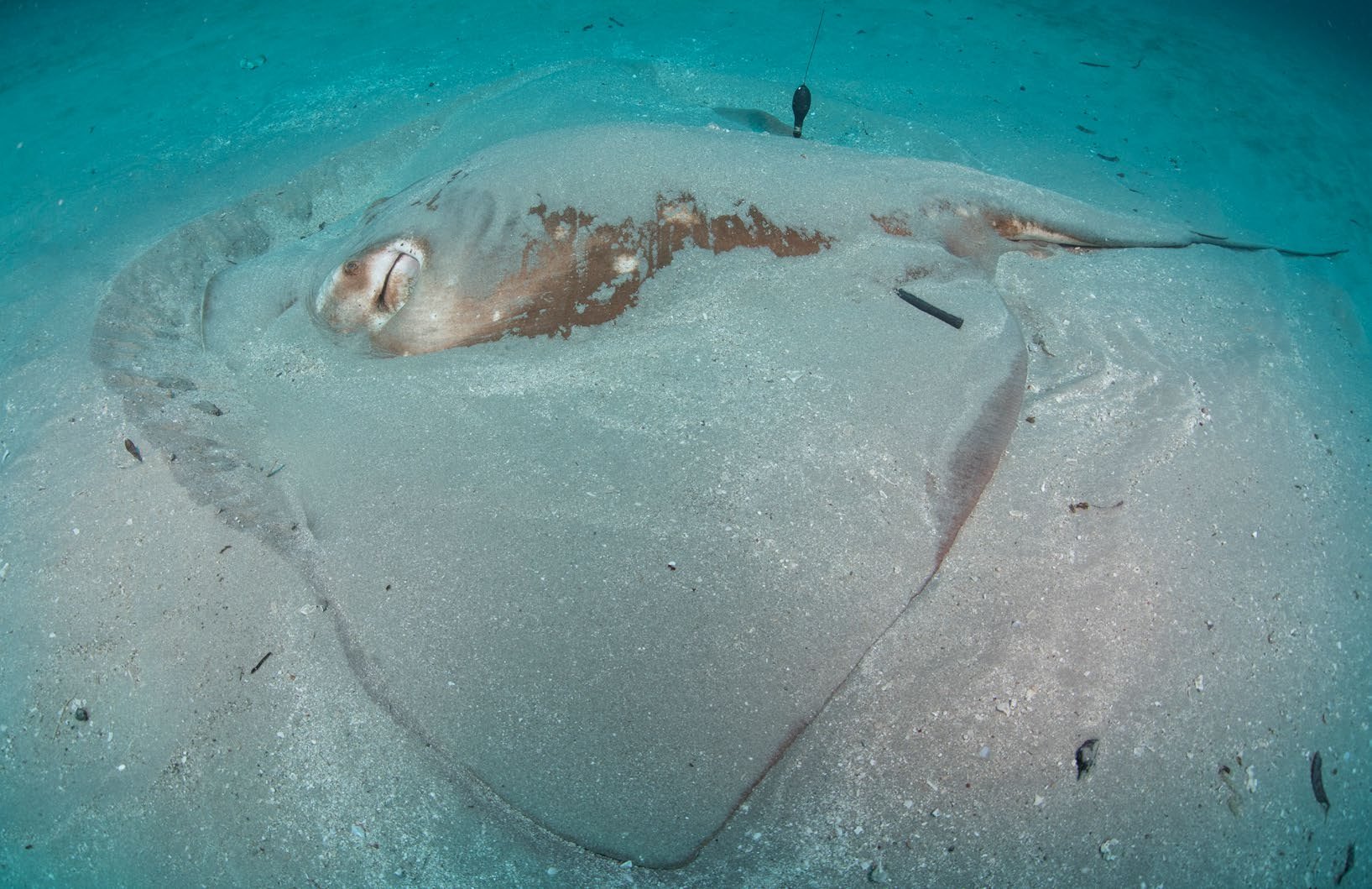
Smalleye stingray double-tagged with an acoustic and satellite tag.
The smalleye was holding position. I swam over the top of him and placed the second tag, this time on the opposite side. The tag slid in easily. This time the ray moved off. I suppose he now realized that I was genuinely up to something – this was not a nip from a well-meaning cleaner fish.
As it started to swim off I began to gasp for air. It was only at that moment that I realized that I had been holding my breath for what must have been ages. I had been so nervous. It had taken so much time and effort to get to this moment. I suppose I was scared that if I even breathed it might swim away. I also had been so nervous about the tagging itself. Would I be able to get close enough to place the tag correctly without feeling like I was compromising my safety? What would happen if it reacted poorly? My husband and I were alone on the reef and he was right next to me the whole time filming the entire historic event in 8k. If anything went wrong he would have had to witness it, first-hand, a fact which had put a lot of additional pressure on me. Now that it was over, my emotions were all over the place. There was an extreme high from the adrenaline, an overwhelming sense of relief, and of course elation and a sense of accomplishment. We had done it.
It is a remarkable privilege to be able to study a species for the first time in the wild and all of the hard work comes down to moments like this. I have had the privilege more than once in my life and I always feel such enormous gratitude for these opportunities. My passion has always been to learn more about marine animals that seem ‘unknowable’. To be able, in some small way, to give these species a voice. I love being able to ‘introduce’ them to the world, to inspire people to love our oceans, and particularly remind kids and young scientists that there is still so much to discover about our planet.
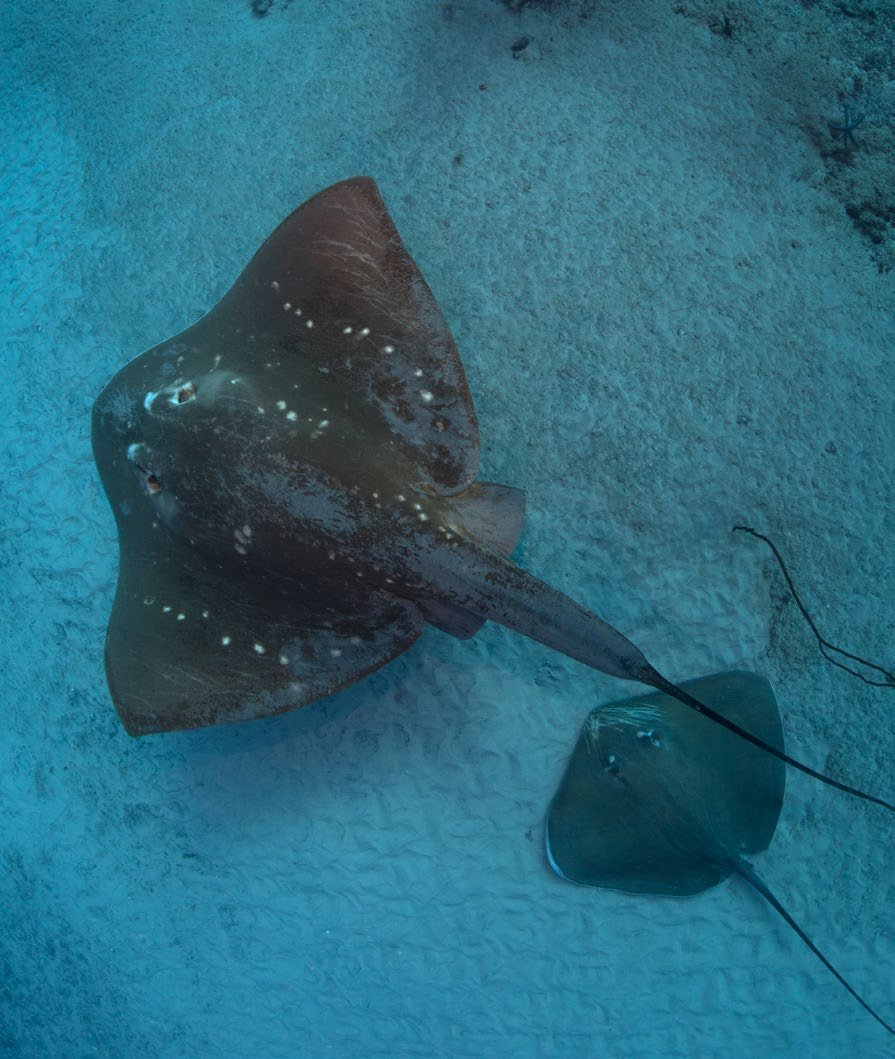
Smalleye stingray and whipray follower.
As the ray swam out over the sand at the edge of the reef he slowed, almost beckoning us to follow. My husband and I only had to look at each other for half a second and we immediately pursued. Just to see – forever inquisitive. The ray continued for a while. His leisurely pace had us huffing and puffing behind him. We were quickly running out of bottom time and air. We almost started to ascend, but then something remarkable happened. He stopped swimming. Out of the blue, he suddenly stopped swimming and parked himself on the sand – just like a normal stingray! He then slowly proceeded to bury himself, throwing sand over his body creating a massive sandstorm in the process. Once settled in, he grew still and just lay there. He didn’t seem to mind us swimming around him – now taking photographs and footage of the first deployed tags. He just sat there. So there it was, hypothesis #2 – disproved. Smalleye stingrays are NOT pelagic, like mantas. They do in fact rest and bury themselves like normal stingrays do. One small piece of the puzzle was solved.
Sometimes I get frustrated with the fact that science is a slow road. Like most, I would prefer the answer ‘right now’, but I have come to appreciate that it simply does not work that way, particularly when studying elusive marine species. After coming down from the initial high of my world-first tagging and learning something incredibly interesting about their behavior in the process, I was giddy to find out more. Annoyingly, the satellite tag was programmed to release in only 6 months’ time and the acoustic tag could stay on pinging away for years! It would take a long, long time before we had the answers we sought.
We have now placed 11 tags on smalleyes and, of those, three individuals were double-tagged. For the first time, we are really gaining insight into the extraordinary lives of these massive, highly mobile stingrays. Most of the time the rays have reacted well to the tagging but it is worth mentioning that some have not. I share this not to vilify the animal, but as precautionary information to others that might want to replicate our work. The incredible musculature at the base of their tail does give these rays the strength and the power to pick their tail up like a scorpion and deploy their stinger mid-water in an act of defense. We have only ever seen them do this as a direct response to being tagged, I am sure they would react the same way if attacked by a predator. Luckily we have been able to dodge their attempts to protect themselves, but it has given us a healthy respect for the capabilities of this species. I of course always regret when our actions cause any animal to feel the need to defend themselves. As life-long protectors of marine megafauna, we always endeavor to make interactions as quick and painless as possible.
It is absolutely vital for us to learn more about this incredibly rare and enigmatic species. Southern Mozambique may be the largest remaining population of these giant rays in our oceans, and the Inhambane Seascape may be their most critical habitat in the country. Determining how we may best protect this key population is essential and we have precious little time to accomplish it. I am grateful to live in a time where conservation biologists like myself are supported in our research by such incredible technology. Technology that allows us to ask and answer questions about our most elusive and endangered species in a timely way – giving us a better chance to safeguard them.
This article was originally published in Ocean Giants, MMF’s magazine, Issue #08 (Summer 2023). Download the full issue as a PDF. Read more about this work on our smalleye stingray project page.