SAVING OCEAN GIANTS.
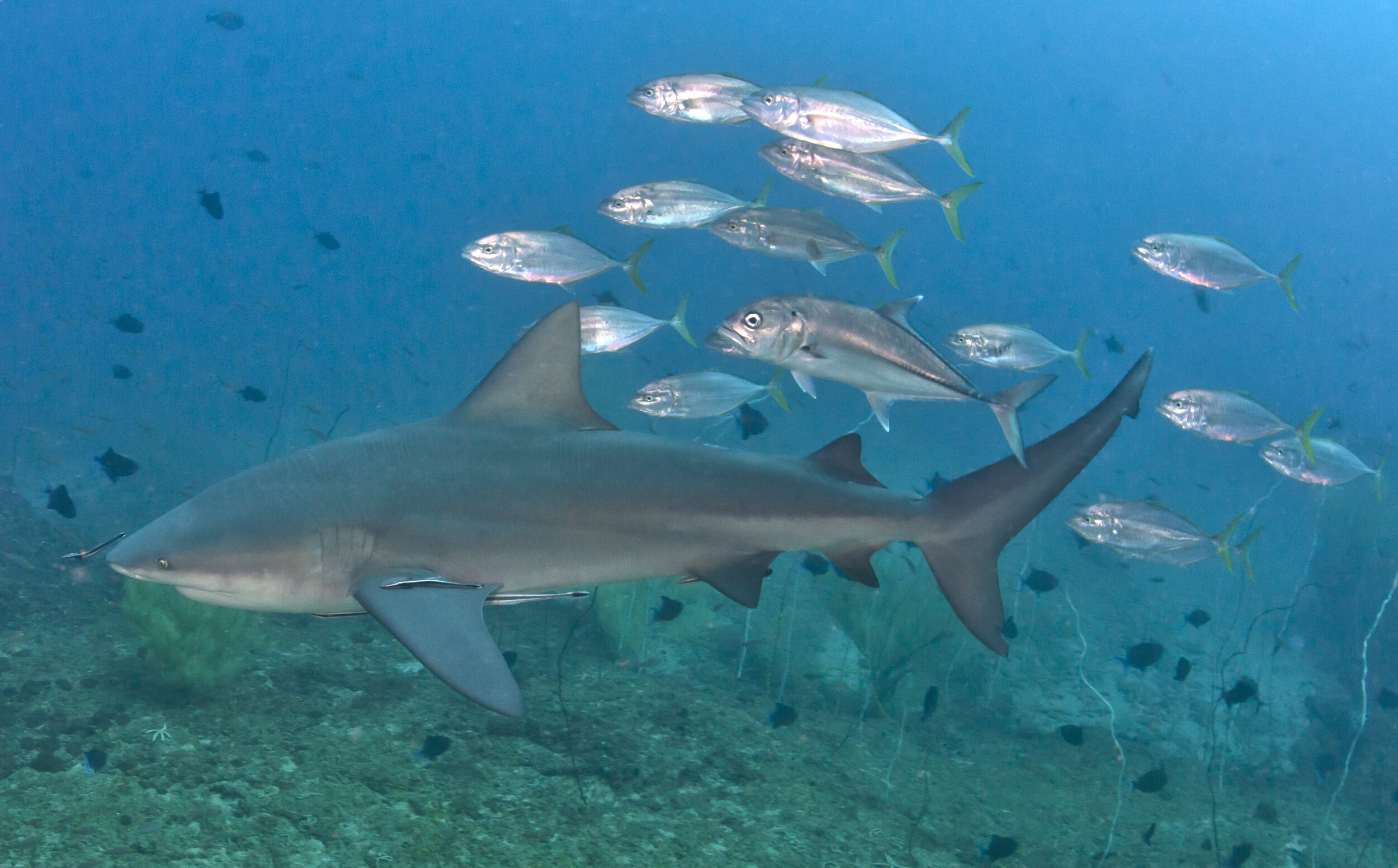
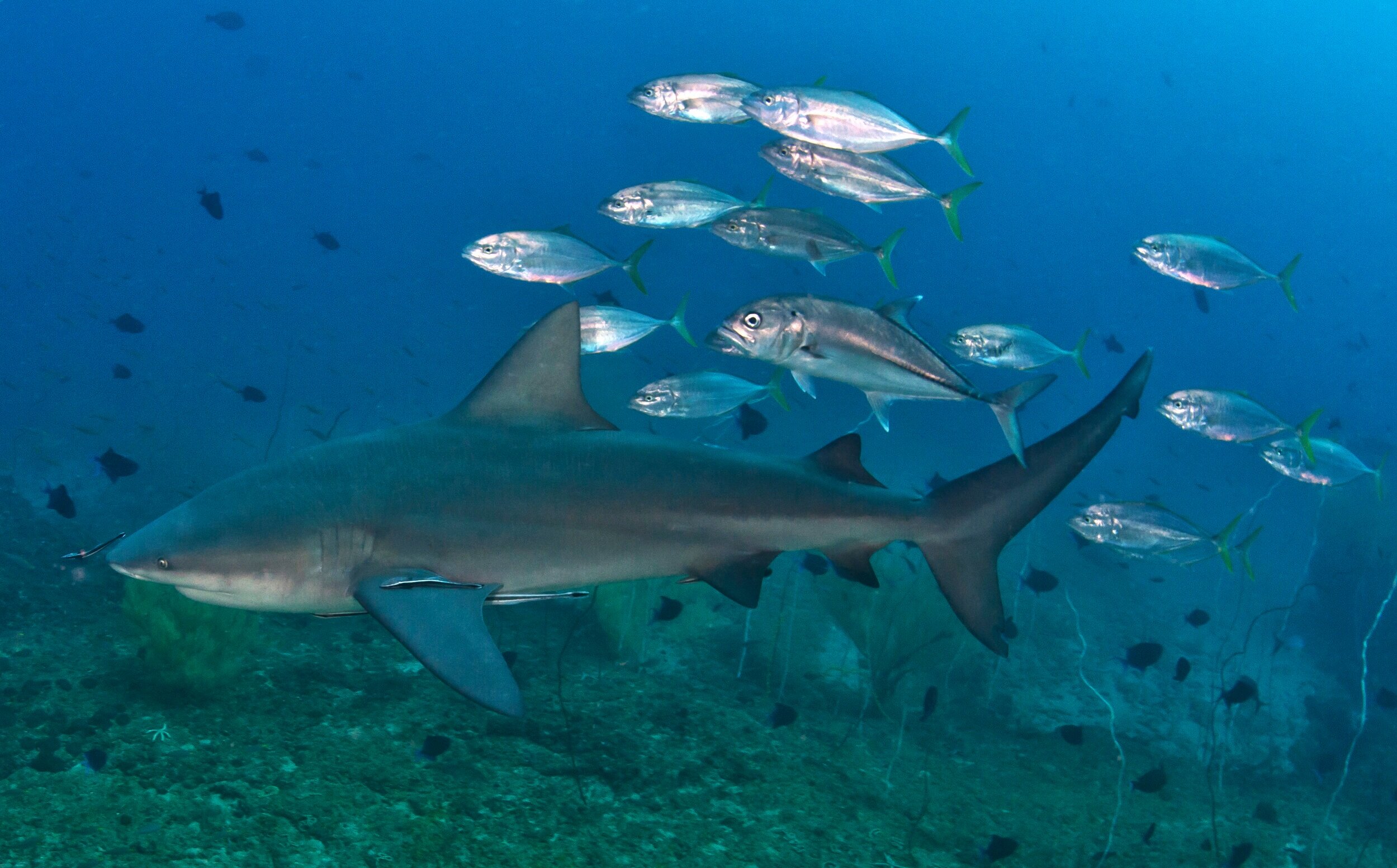
Bull shark
Carcharhinus leucas
VulnerableThe shark that swims up rivers: a heavy-bodied coastal predator that raises its pups in estuaries, crosses international borders as a matter of routine, and is caught in fisheries at every stage of that journey.
Key facts
- Bull sharks are one of the very few sharks that can live in freshwater as well as the sea, and they have been recorded far up the Mississippi, the Amazon, and the Zambezi.
- In southern Africa they are known as Zambezi sharks, after the river they swim into.
- Adults are usually 2 to 3 meters (7 to 10 feet) long. The largest are always females, at around 3.2 meters (10.5 feet).
- They are slow to mature. On South Africa's east coast, half the females were mature only at about 20 years old.
- Pups are born in estuaries and river mouths, and females return to the region where they were born to give birth.
- Young bull sharks survive unusually well in estuaries: 77% of tagged pups in one Florida study were still alive 18 months later.
- Adult bull sharks we track in Mozambique's Bazaruto Seascape are there year-round, and 82% of their core habitat falls inside marine protected areas.
- In 2025 we co-authored the first record of a bull shark crossing between ocean basins: from Mozambique around the Cape and up to Nigeria, more than 7,000 kilometers (4,500 miles).
- 63% of the bull sharks we tagged in a four-year study crossed the border between Mozambique and South Africa.
- The IUCN Red List classifies the bull shark as Vulnerable. All requiem sharks, the family it belongs to, were added to CITES Appendix II in 2022.
Meet the bull shark
Bull sharks are built like their name suggests: short, thick-bodied, blunt-nosed, and heavy for their length. Adults are typically 2 to 3 meters (7 to 10 feet) long, and the largest are always females. Growth studies around Reunion Island in the western Indian Ocean put the maximum size for females at around 3.2 meters, with males a little smaller and shorter-lived.
What sets them apart from almost every other shark is where they can go. Nearly all sharks are locked into the sea because their body chemistry depends on it. Bull sharks are euryhaline: an experiment that moved juveniles from freshwater into seawater over 16 days showed that their rectal gland and kidneys change gear to handle either environment, adjusting the salts and urea they hold in their blood. That study came to a useful conclusion about the young sharks’ preference for the upper reaches of rivers: physiologically they could cope perfectly well in the sea, so they are probably up there to escape predators or to find food, not because they have to be.
This is why bull sharks turn up hundreds of kilometers inland — in the Mississippi, the Amazon, and Lake Nicaragua, and in African rivers including the Zambezi, which is where the southern African name for the species comes from. Freshwater is not a fixed address, though: chemical analysis of the teeth of adult bull sharks in Fiji found marine signatures throughout, with no sign of extended freshwater residence. Rivers matter most at the two ends of the life cycle — giving birth, and growing up. There is more on size, diet, and safety on our bull shark facts page.
Where bull sharks live
Bull sharks live in warm coastal waters worldwide, in the tropical and subtropical Atlantic, Indian, and Pacific Oceans, plus the rivers and estuaries that drain into them. They favor shallow, often murky inshore water, and they are found in habitats as different as Florida lagoons, Australian canal estates, Fijian rivers, and the coral reefs of the Great Barrier Reef.
Southern Mozambique is where we work on them. Our acoustic tracking across the Bazaruto Seascape, published in 2026 and led by MMF’s Dr. Stephanie Venables with Dr. Ryan Daly of the Oceanographic Research Institute among the co-authors, found adult bull sharks present year-round, with core habitat concentrated along the seaward reefs and inshore of the San Sebastian Peninsula. Encouragingly, 82% of that core habitat sits inside existing marine protected areas — though important habitat extends past the boundaries. The same study showed the seascape doing a second job: acting as a seasonal waypoint on a coastal movement corridor, used by transient sharks for short stays, mostly between May and November.
Genetics show that bull shark populations are connected along continuous coastlines but separated by deep water. Analysis of nearly 1,500 genetic markers from 215 sharks across the Indian and Pacific Oceans found South Africa, Indonesia, Western Australia, Papua New Guinea, and eastern Australia clustering together while Fiji stood apart — a population isolated by ocean trenches and open water.
Nurseries and rivers
Bull sharks are born in estuaries and river mouths, and those places do something measurable for them. Long-term acoustic monitoring of newborn bull sharks in a south Florida estuary found that 77% survived beyond 18 months, a lower mortality rate than for comparable juvenile sharks in more marine habitats. The likely reasons are fewer predators and less competition. An estuary is a nursery because it is a refuge.
Young bull sharks work these systems carefully. In the Caloosahatchee River in Florida, sharks under two years old moved up and down a 27-kilometer stretch tracking salinity, generally avoiding water fresher than about 7 parts per thousand and favoring 7 to 20, with the relationship strongest in the youngest sharks. Thirty years of sampling in Florida’s Indian River Lagoon, covering 449 bull sharks, identified it as the northern limit of functional nursery habitat in the northwest Atlantic.
Nurseries are described from around the world: Chetumal Bay in the Mexican Caribbean, where 63 sharks landed by artisanal fishers were all immature and mostly newborn; the Coyote estuary in Costa Rica, an important juvenile feeding ground; and Fiji’s Rewa River, where 172 young sharks caught across three river systems were overwhelmingly newborns, with a defined summer birthing season. In Fiji, tracking then closed the loop: 31 female bull sharks tagged at a coastal site were followed into four rivers across three successive birthing seasons.
Estuaries are also where bull sharks meet coastal development head-on. On Australia’s Gold Coast, newborn and juvenile sharks preferred the natural Nerang River over the adjoining artificial canals — and it is the upper tidal reaches, exactly the stretch under most modification pressure, that serve as the nursery. In Florida’s Indian River Lagoon, young bull sharks did the opposite: 51% of tracking positions were in altered habitat, including dredged creeks, marinas, and power plant outfalls.
Movements and migrations
For a species long assumed to hug the coast, bull sharks travel a very long way. Our regional collaboration began mapping this with acoustic telemetry in southern Mozambique, where 18 adults tracked for 10 to 22 months mixed periods of residency with coastal migrations of 433 to 709 kilometers, ten of them returning to the study site and covering up to 3,760 kilometers in a year. Migration was strongest in austral winter and spring, and residency dropped as water temperature fell.
Those journeys routinely cross borders. Tracking 102 sharks of four species on a 350-receiver network between South Africa and Mozambique from 2018 to 2022, we found that 63% of tagged bull sharks made transboundary movements, with the longest migrations spanning 980 to 2,256 kilometers. The point of that paper is blunt: these are shared animals, and management on one side of a line does not protect them.
Then, in 2025, a bull shark redrew the map. A satellite- and acoustic-tagged female moved from southeast Africa through southern Mozambique and South Africa, around the Cape, and was recorded in a fishery off Nigeria — more than 7,000 kilometers, the first documented movement of a bull shark between ocean basins. MMF’s Dr. Stephanie Venables is a co-author, and Dr. Ryan Daly led the work.
Elsewhere, the pattern repeats at different scales. On the central Great Barrier Reef, 51% of 33 tagged adults migrated up to 1,400 kilometers while the rest stayed put — classic partial migration, with most migrants mature females moving in summer, probably to give birth. A pregnant female in the Seychelles was tracked 2,000 kilometers to Madagascar and back, spending her time there in water shallower than 5 meters and returning slender and no longer pregnant. In Biscayne Bay, Florida, adults tracked for up to 4.5 years showed strong fidelity to the tagging area alongside seasonal shifts to the Gulf coast.
Feeding and ecology
Bull sharks are opportunists and they eat big. Working in the southwest Indian Ocean, our regional collaborators used stable isotopes to show that bull sharks had significantly broader dietary niches than the top predatory fish alongside them, drawing on a wider range of carbon sources over a larger area, and that adults shifted onto consistently higher-level prey than sub-adults as they grew and ranged further. That combination — large, mobile, and unfussy — is what makes them ecological connectors, moving energy between reefs, estuaries, and rivers.
The menu includes other elasmobranchs. Off Praia do Tofo in Mozambique, our study of shark bite injuries on reef manta rays found 571 bite wounds on 283 identified individuals, over three-quarters of the local manta population carrying scars, with bull sharks and tiger sharks named as the likely main culprits. Almost all the wounds were healed, and almost all were on the rear of the body.
Where people feed bull sharks, the sharks show up but do not settle. At a long-running provisioning site in Fiji, eight years of diver counts and acoustic tracking showed sharks drawn to the site whether or not food was on offer, staying longer on feeding days, and still leaving the area for weeks or months at the end of each year to breed.
Reproduction and life history
Bull sharks give birth to live young, nourished through a placental connection, in litters of roughly one to thirteen pups. Litters sampled at Reunion Island held 5, 8, 9, and 11 embryos, and genetic work on them produced the first evidence of multiple paternity in the species: two of the four litters had two fathers, with one male siring most of the pups. Newborns are around 70 to 80 centimeters long in most of the world; around Reunion they are larger, at 92 to 100 centimeters.
Then they wait a long time. Ageing 123 bull sharks from South Africa’s east coast, researchers found half of females mature at about 1.9 meters precaudal length and 21 years old, males at 20, with the oldest sharks aged in their early thirties and captive animals suggesting a maximum age beyond 50. Reunion sharks reached an estimated maximum of 33 years for females. Late maturity, small litters, and a long life is the textbook profile of a species that cannot absorb heavy fishing.
Females also come home to give birth. Comparing DNA from juveniles in 13 river systems across northern Australia showed genetic patterns consistent with female reproductive philopatry — mothers returning to their own natal rivers — and the same signal appears in nurseries across the Gulf of Mexico and western North Atlantic, where mitochondrial DNA separated the two regions while nuclear markers did not, indicating that it is the females who stay loyal to a nursery and the males who disperse. It means an estuary lost is a lineage lost.
How many are there, and how are they doing?
There is no global population estimate for bull sharks, and the long-running data sets that exist are mostly indirect. The clearest regional signal comes from the shark nets set off KwaZulu-Natal beaches in South Africa, which double as a fisheries-independent monitor. Across 1978 to 2003, bull sharks were one of four species whose catch rate declined significantly — and the analysis concluded that the nets themselves were not the main cause, pointing instead to other fisheries.
Mozambique’s picture is one of rising pressure rather than measured decline. Fisheries assessments have recorded shark catches increasing by up to 220% in recent years, with bull sharks among the most commonly landed species in some areas, making up as much as 17.3% of total shark catches. The IUCN Red List classifies the bull shark as Vulnerable globally, in an assessment led by Dr. Cassandra Rigby, on the basis of that combination of slow reproduction and intensifying coastal fishing.
Current research
Our bull shark work in Mozambique started in 2012 with acoustic tags in the Bazaruto Archipelago National Park, and 38 sharks have been tracked on that array since. The receivers are now part of a regional network of around 38 stations covering roughly 400 kilometers of coast, shared with collaborators in South Africa and across the western Indian Ocean. Alongside tagging we collect fin clips and muscle tissue for genetics and stable isotope analysis, run underwater visual surveys and baited remote video, and work with coastal communities on the human–shark conflict that makes bull sharks harder to protect than most species.
The tracking has produced two findings that pull in opposite directions. Some sharks are extraordinarily loyal to one place: one female was detected on the same handful of receivers for more than five years. Others are commuters, tagged elsewhere in the seascape and returning to the park on a predictable annual schedule. Deeper offshore reefs account for around 72% of daytime detections, and neighboring reefs only 3 kilometers apart can show almost opposite day-night patterns — so even a small area is not one habitat but several. Our priorities now are extending the array’s coverage, closing the genetic picture for southern Africa, and turning all of it into the transboundary management case that Mozambique and South Africa need to make together.
Threats and protection
Bull sharks are caught in artisanal seine nets and gillnets, in commercial fisheries, and in the beach nets of shark-control programs in South Africa and Australia. Their habits compound the risk: a species that uses estuaries, mangroves, shallow bays, rivers, and reefs across its life cycle meets fishing gear and habitat loss at every stage, and one that crosses international borders this routinely can be protected in one country and fished in the next. Coastal development, dredging, and pollution hit the nurseries specifically, and young sharks that favor altered habitats such as power plant outfalls accumulate contaminants there.
There is also a conflict that most shark conservation does not have to deal with. Bull sharks hunt in the same shallow, turbid water where people swim, and along the Mozambican coast interactions have caused deaths. The result is resentment and, in some communities, active persecution. Work at Reunion Island shows what better information can do: tracking 20 sharks found that smaller ones used the southwest coast while larger ones held the north, matching the timing and location of recorded bites — the basis for targeted, non-lethal risk management instead of culling. In KwaZulu-Natal, replacing some beach nets with baited drumlines and removing others cut shark mortality in the program by 64% while maintaining bathing safety.
Formal protection is thin but improving. All requiem sharks — the family Carcharhinidae, which includes the bull shark — were added to CITES Appendix II at the 2022 Conference of the Parties, with a one-year delay to give countries time to prepare, in force from November 2023, so international trade in bull shark fins and meat is now regulated. There is no listing under the Convention on Migratory Species. That leaves national fisheries rules and marine protected areas doing most of the work, which is why knowing that 82% of the Bazaruto sharks’ core habitat already falls inside protected boundaries matters — and why the 18% that does not is where we are looking next.
Where we study them
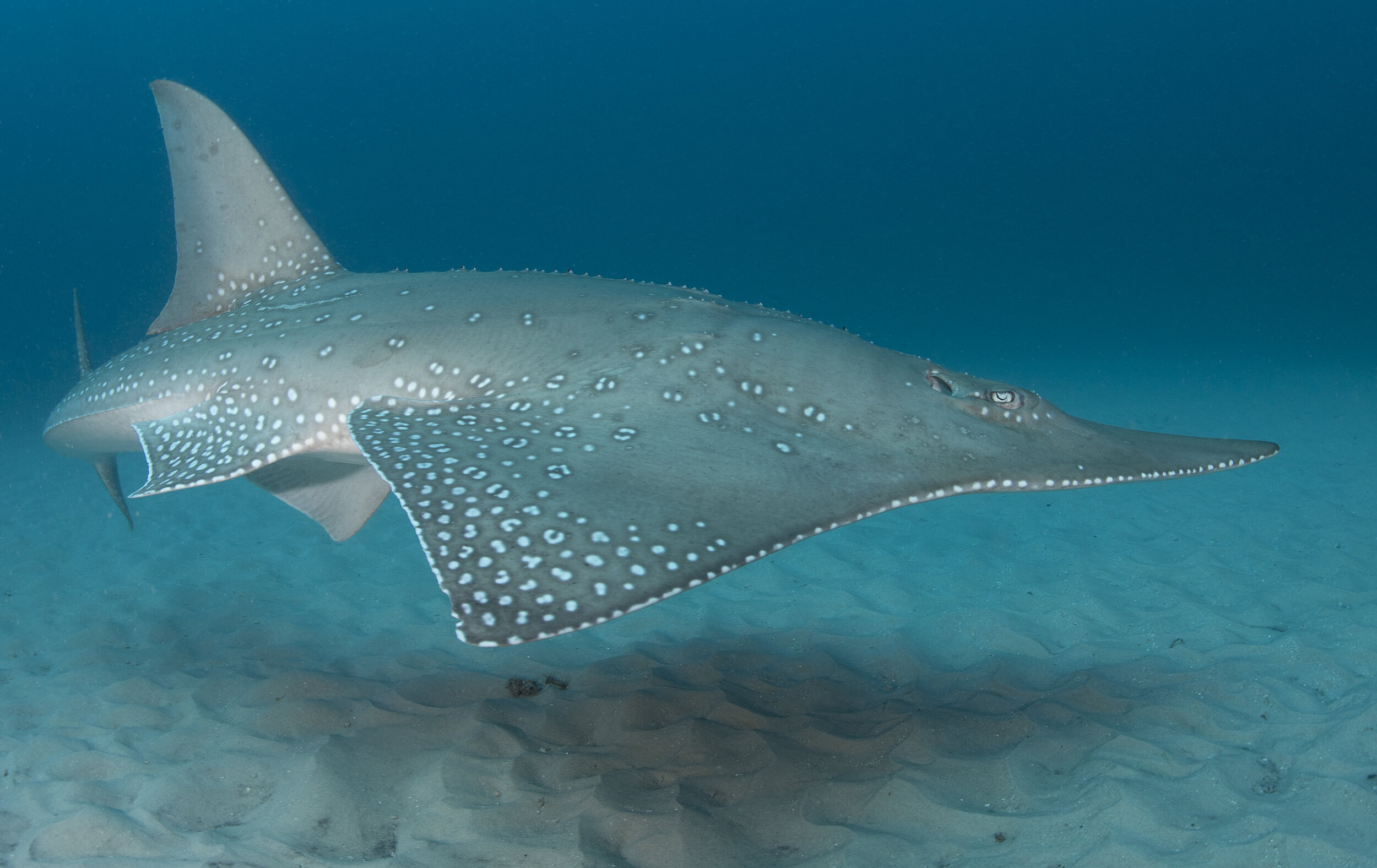 Mozambique Acoustic Telemetry Network
A shared network of underwater listening stations along Mozambique's Inhambane coast that follows tagged sharks and rays as they move.
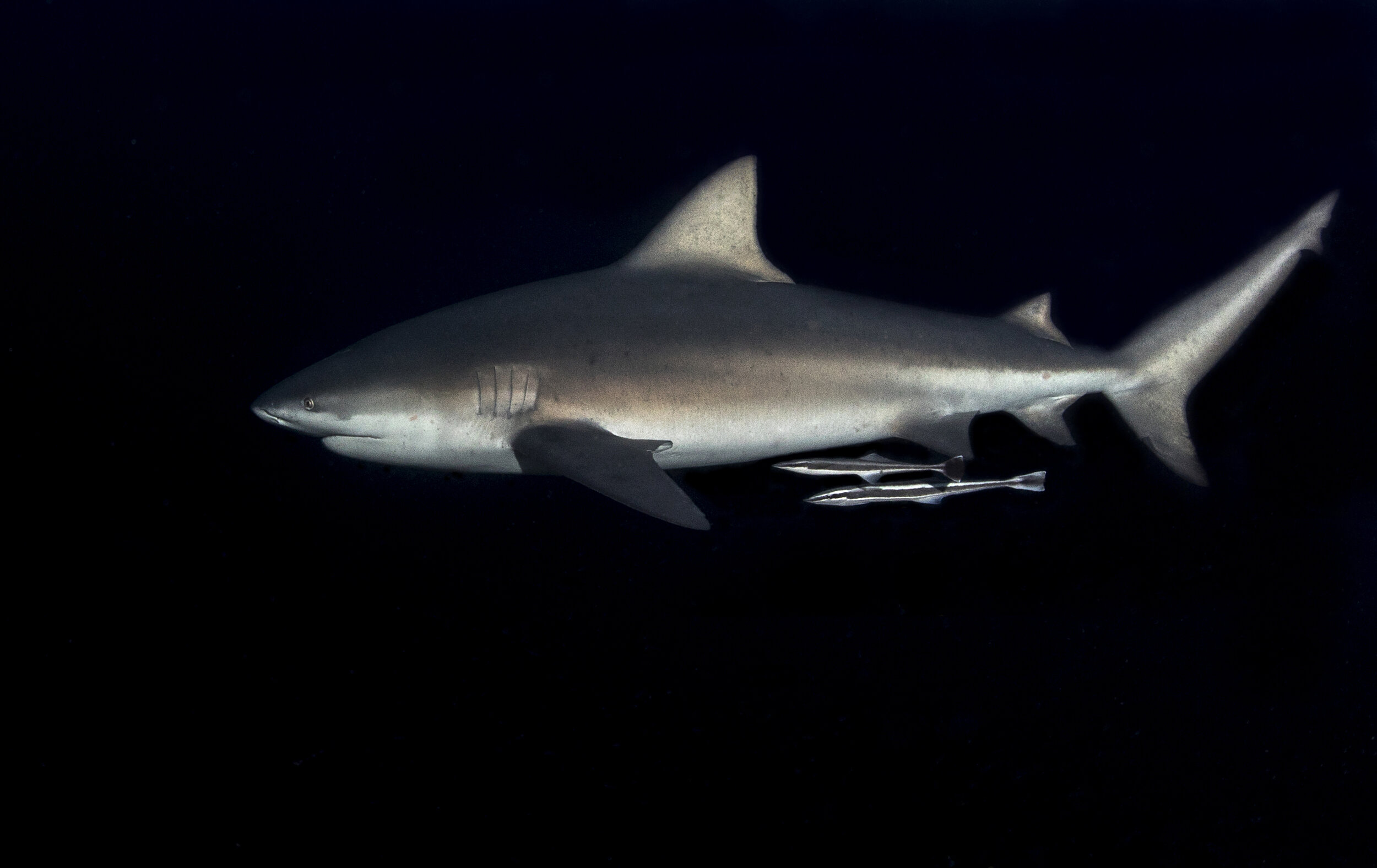 Mozambique Bull Shark Research ProjectCompleted
How bull sharks use Mozambique's coast, from year-round residents of the Bazaruto Archipelago to migrants that cross national borders, and the fishing pressure they face.
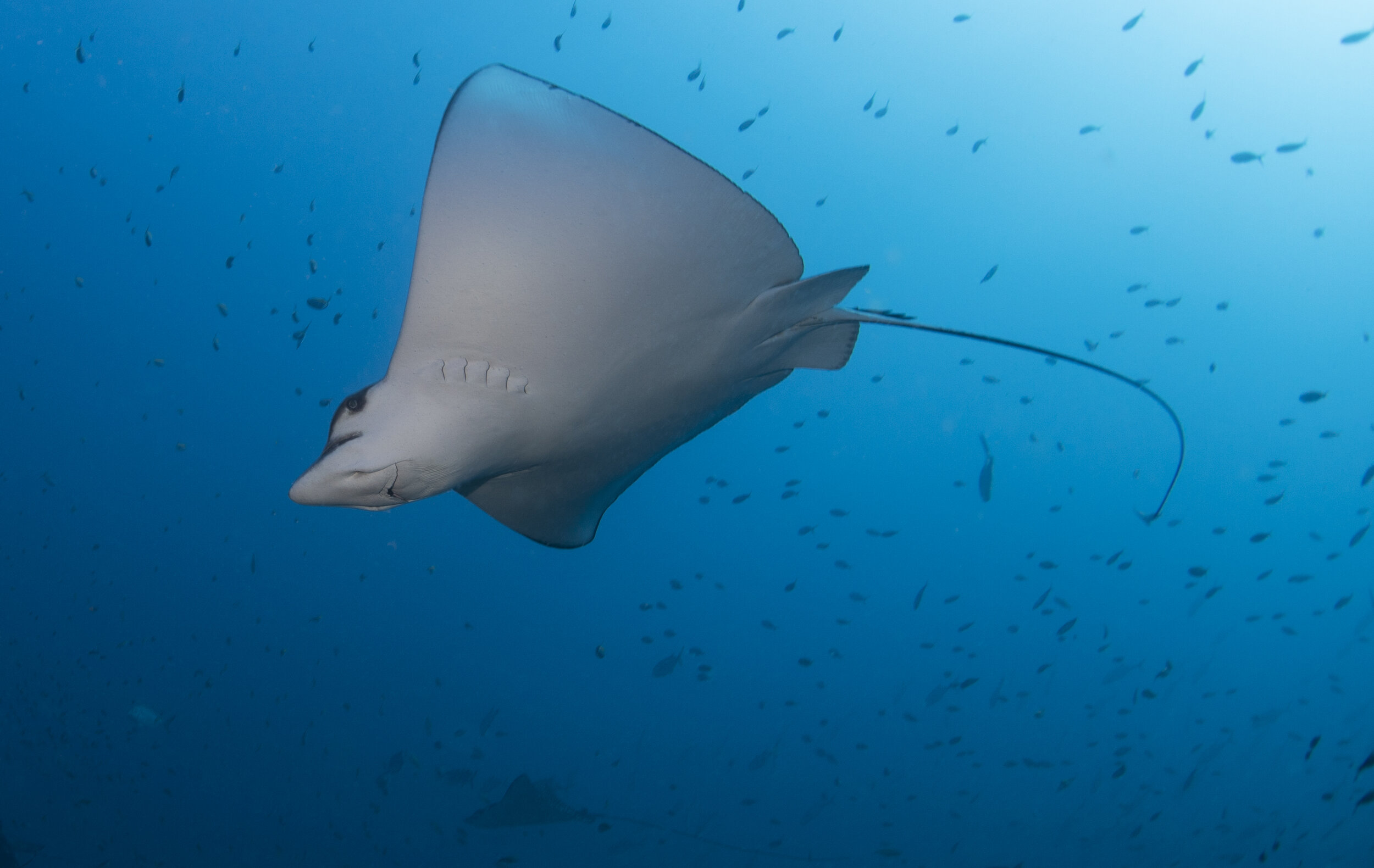 Mozambique Elasmobranch Diversity Research Project
A census of the sharks and rays of Mozambique's Inhambane Province, combining long-term diver surveys with baited cameras, remote camera traps, and environmental DNA.