
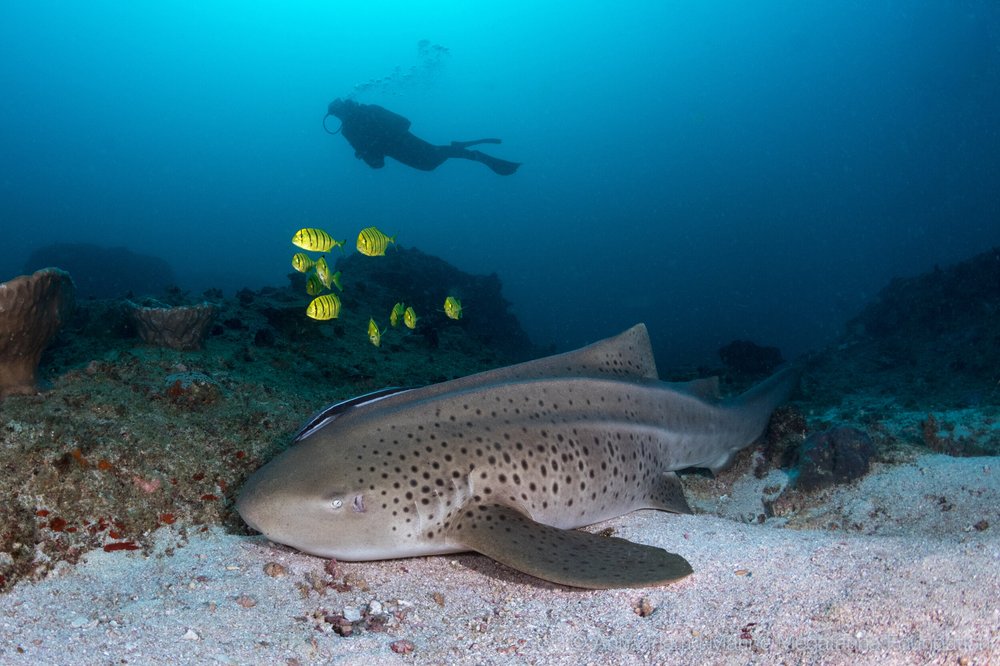
Fourteen years of dive surveys have identified 164 individual leopard sharks along Mozambique’s Inhambane coast, most of them adult or nearly adult. The study also includes the first recorded leopard shark courtship in the Western Indian Ocean.
A threatened shark on a few reefs
Leopard sharks (Stegostoma tigrinum), also known as zebra sharks, are threatened across much of their Indo-Pacific range. The regional population that includes Mozambique, stretching from the Western Indian Ocean to Southeast Asia, is listed as Critically Endangered on the IUCN Red List.
The new study, published in Endangered Species Research, was led by Jule Buschmann of the All Out Africa Marine Research Centre. It was co-authored by MMF’s Nilza de Catarina and Anna Flam, with Jennifer Keeping of All Out Africa and the University of Glasgow. Researchers from All Out Africa and MMF, together with trained volunteers, carried out 9,219 dive surveys between 2011 and 2025. The surveys covered reefs from the Bazaruto Archipelago south to Závora. They recorded 631 leopard shark sightings and identified 164 individuals from their unique spot patterns, nearly doubling the number known from the first study of the species in Mozambique.
Fourteen years, 164 sharks
Of the 144 sharks whose sex could be determined, 101 (about 70%) were female. Size estimates suggest most were adults or nearly adult. Sightings were concentrated at a small cluster of reefs north of Tofo. Of the identified sharks, 35% were seen more than once, and 27% were recorded in more than one year, one of them 11 years apart.
The team estimated that about 88 leopard sharks used the reefs north of Tofo over the study period. The uncertainty around that figure is wide, from 50 to 154 sharks. New individuals kept turning up throughout the study, so these reefs are likely part of a larger population. Sightings were strongly seasonal, peaking in the southern summer, when the water on the reefs is warmer and clearer. The study did not show that warmth or clarity on their own drive that pattern. Morrungulo, about 60 kilometers (37 miles) north of Tofo, had the most sightings per dive of any area. It may be a second important site, though it has had far fewer surveys.
Give them space
Leopard sharks often rest on sand next to the reef during the day. In 55% of the 89 encounters where their behavior was recorded, the sharks moved away from divers. Their odds of leaving were about 10 times higher when the nearest diver came within 3 to 5 meters (10 to 16 feet) than when divers stayed more than 5 meters (16 feet) away. Within 3 meters (10 feet), the odds were about 14 times higher.
That gives divers and dive operators a simple rule: stay more than 5 meters (16 feet) from a resting leopard shark.
First courtship records
The team documented three courtship interactions, at Tofo in January 2020 and October 2022 and at Morrungulo in November 2021. In each, a male closely followed a female or bit at her tail. These are the first records of leopard shark courtship in the Western Indian Ocean. They suggest the Inhambane coast may be important for breeding, although that remains to be confirmed.
What the findings make possible
The Tofo coast is already recognized as a Key Biodiversity Area and an Important Shark and Ray Area. This study adds detail for protecting leopard sharks there: the reefs north of Tofo, and possible corridors linking Tofo to Morrungulo, are strong candidates for protected areas or other place-based management. In Mozambique, only leopard sharks shorter than 1.5 meters (5 feet) are protected under national fisheries rules, which leaves adults unprotected. The authors recommend extending protection to sharks of all sizes, protecting key reefs, and setting minimum approach distances for divers. They also recommend limiting bottom-set gillnets, fishing nets set on the seabed, in important habitat.
Read the study, learn about our leopard shark research in Mozambique, or support our work in Mozambique.