
Mozambique Projects
Závora Marine Conservation
What’s this project about?
Závora Bay is one of the last places on the East African coast where reef manta rays still gather in numbers. Our research station there is the only year-round scientific presence on the site.
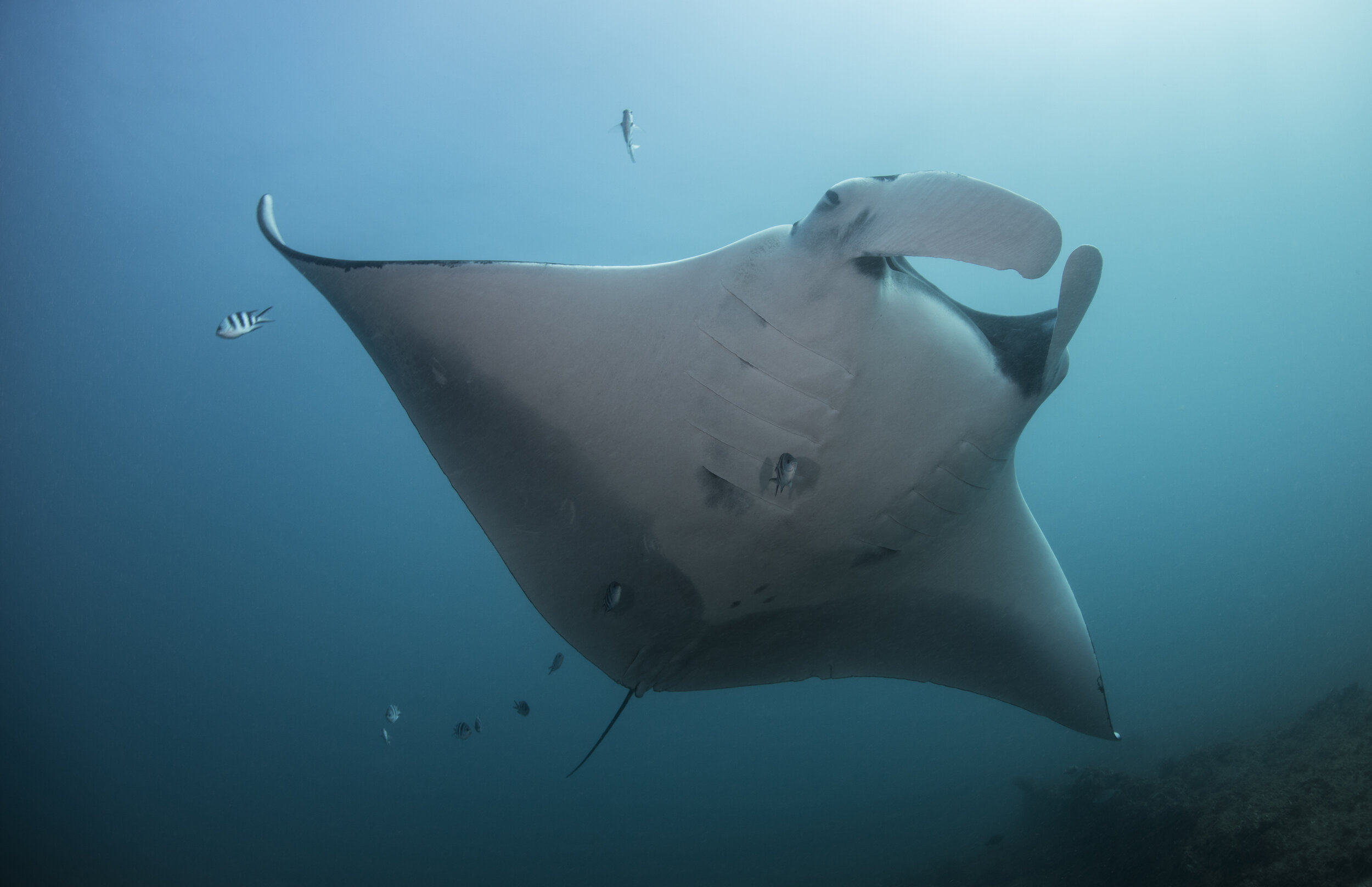
Závora sits at the southern end of the Inhambane coastline, 90 km south of Tofo. Its two cleaning stations, Red Sands and White Sands, draw reef manta rays (Mobula alfredi) from along the coast, and the bay is also visited by oceanic manta rays (Mobula birostris), smalleye stingrays, leopard sharks, and, in season, humpback whales. Photo-identification surveys have run here since 2009, and an 11-year study identified 583 individual manta rays at Red Sands alone.
The site matters because the wider population is in trouble. At Tofo, manta ray sightings have fallen by 99% over 20 years. At Závora, sightings dropped by 82% between 2009 and 2023, and the rays shifted from year-round residents to a seasonal aggregation between July and November that appears to be linked to reproduction. Závora is where the remaining animals still come, which makes it the place where protection would do the most good.
Objectives.
Understand what the Závora aggregation needs, and turn that knowledge into local protection.
- Maintain the long-term photo-identification record so population trends at Závora can be measured year on year.
- Track how manta rays and other species move between Závora, Tofo, the Bazaruto Archipelago, and South Africa, using the station’s acoustic receiver array and satellite tags.
- Document the artisanal fishery at Závora, including which sharks and rays are landed, so that management is based on what is actually caught.
- Support the Závora fishing community and its Community Fisheries Council in establishing a locally managed marine area that covers the cleaning stations.
- Bring conservation education to Závora’s schools alongside the science, extending our Ocean Guardians program to the south of the province.
How we work.
Long-term monitoring. Every dive at Závora is a survey. We photograph the undersides of manta rays, which carry spot patterns as individual as fingerprints, and match them against a catalog that reaches back to 2009. That record is what allowed us to measure the decline at Závora rather than guess at it, and it is what will tell us if protection works.
Tracking movements. An array of acoustic receivers on the seabed logs every tagged animal that passes within range. Together with pop-up satellite tags, it has shown that Závora’s manta rays range far beyond the bay. One individual made a round trip of roughly 870 km to Sodwana Bay in South Africa, and animals tagged here have been recorded inside South Africa’s iSimangaliso Wetland Park. Those results are the basis of our case for managing the population across the border, described on the African Manta Ray Project page.
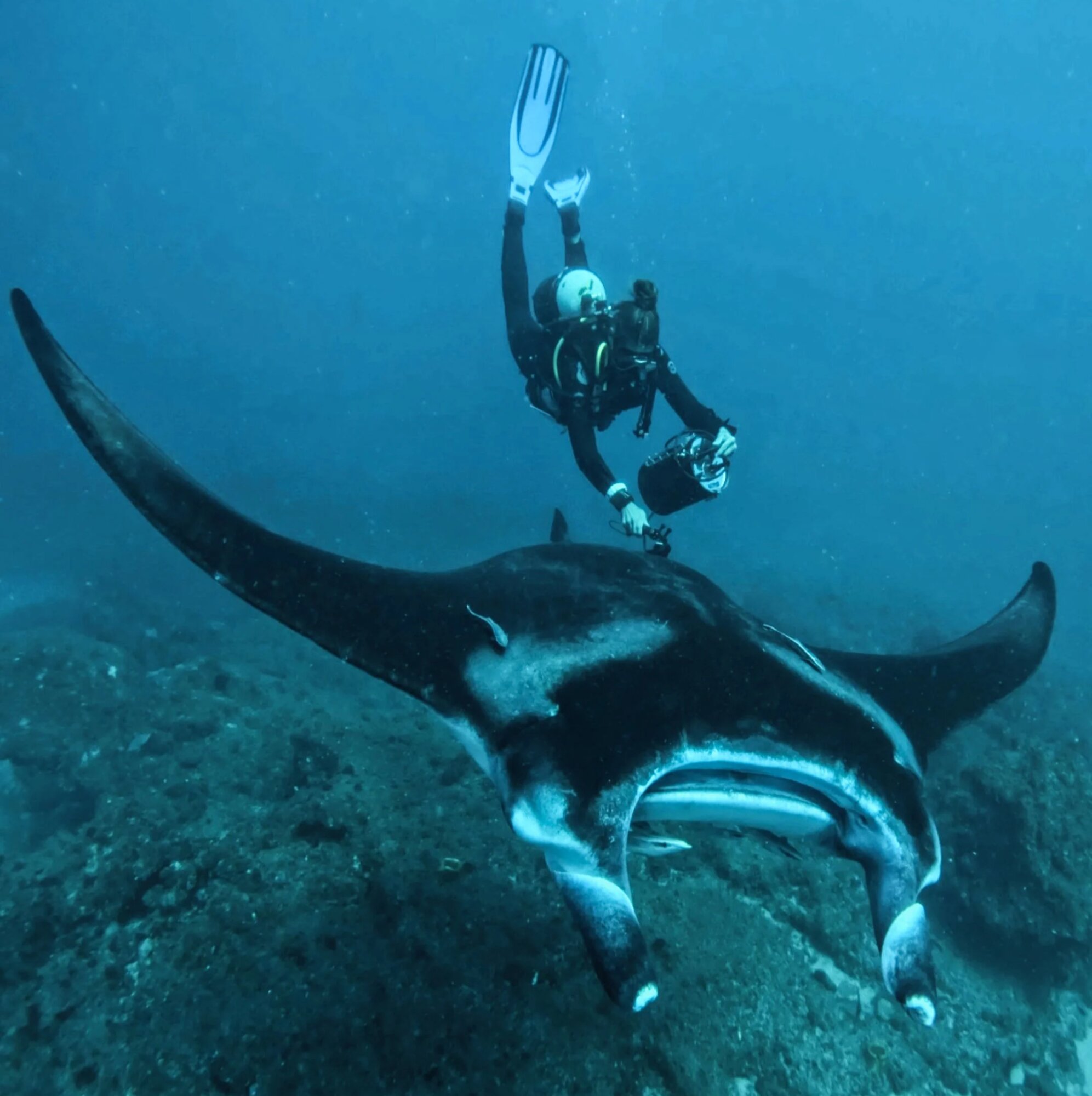
Studying reproduction in the wild. Závora is where we pioneered in-water ultrasound of free-swimming manta rays and other sharks and rays, scanning several species for the first time in the wild. Knowing which females are pregnant, and when, tells us why the seasonal aggregation forms and how vulnerable it is.
Working with the fishery. Our team records shark and ray landings with Závora’s fishers, building the first picture of what the local gillnet and line fisheries catch. This is done alongside the fishers, not to them: we meet monthly with the Community Fisheries Council to share results, discuss fishing practices, and plan spatial management together.
Training the next generation. The station hosts interns and research fellows from Mozambique and abroad, who join every part of the work from surveys to community meetings.
Why Závora, and why now.
Mozambique gave manta and devil rays legal protection in January 2021, a decision MMF’s research helped to bring about. Protection on paper is not the same as protection in the water. Gillnets set across the coastal corridor still catch manta rays, and the area of core habitat covered by existing protected areas is small. A locally managed marine area at Závora, run by the community that fishes there, is the practical next step, and the groundwork for it is being laid now.
From 2027 we plan to run Závora as a fully integrated MMF conservation site, combining the research station, the fisheries program, and conservation education under one plan. That is the work your support makes possible.
Project Leaders.
Dr Nakia Cullain
Senior Scientist
Nakia first came to Závora in 2016 as director of the marine lab there and joined MMF in 2020. She leads MMF’s manta and devil ray research across Mozambique, including the Závora station, the acoustic tracking program, and the analysis of two decades of sightings data.
Ed Bevan
Project Scientist – Závora
Ed is a marine biologist who leads the in-water ultrasound work on manta ray reproductive biology at Závora.
Emily Eaton
Project Scientist – Závora
Emily is a marine biologist and dive instructor who leads the fisheries landings monitoring with the Závora fishing community.
Supporters.
Field operations at Závora have been supported by Milkywire’s WRLD Oceans Fund. The in-water ultrasound program uses equipment loaned by uShaka Marine World, with MMF Canada raising funds for a dedicated unit.
Donate to Závora Marine Conservation
Partners
Závora Community Fisheries Council (CCP) · iSimangaliso Wetland Park, South Africa · Dalhousie University