
MMF recorded more whale shark (Rhincodon typus) sightings per survey trip at Mafia Island, Tanzania, in 2025 than in 2024, and some of the sharks have been known to the team for more than a decade. A survey of tourists found that the sharks draw many visitors to the island, and that concern about crowding around them has grown since 2023.
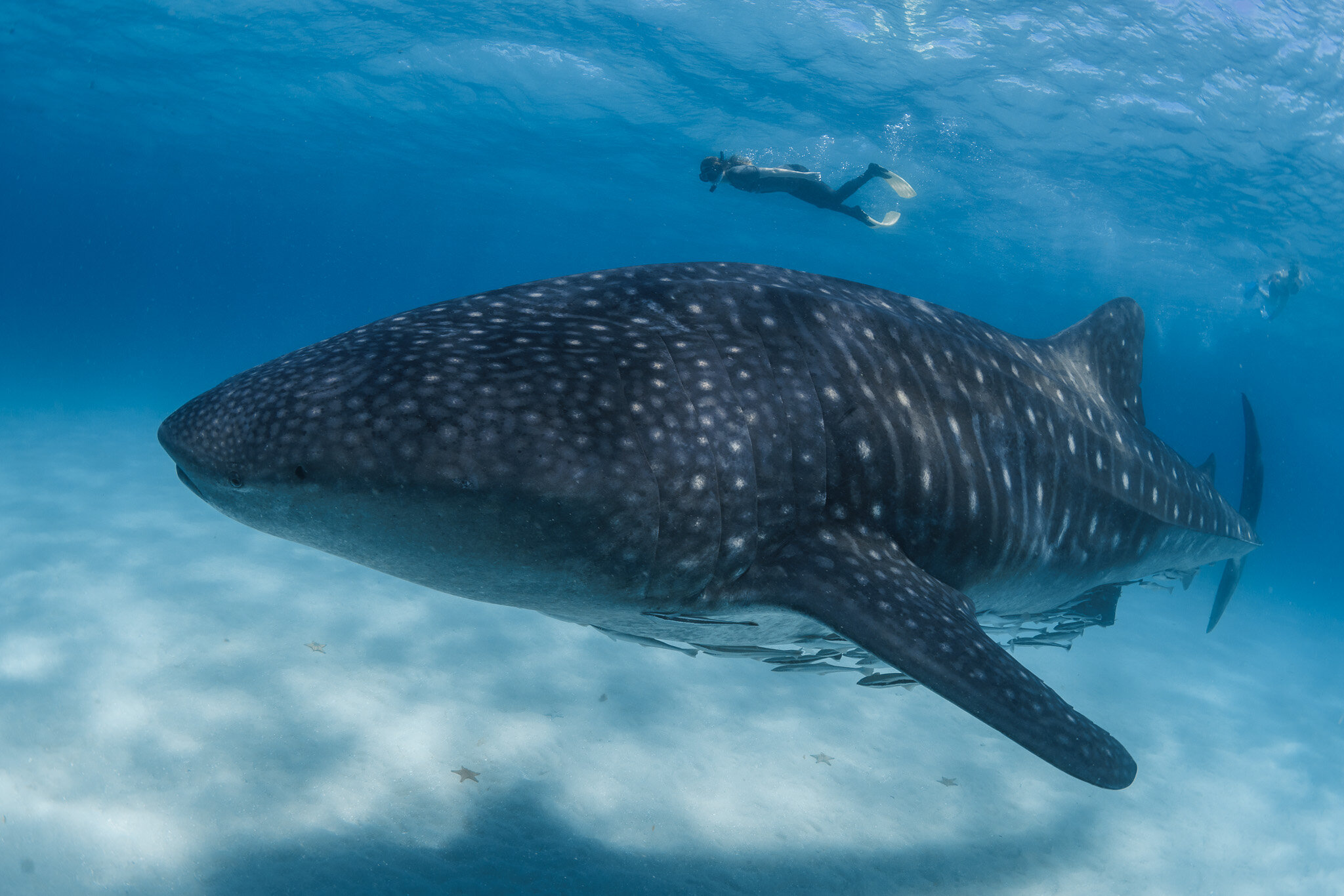
Snorkelers with a whale shark over the sandy shallows of Mafia Island, Tanzania.
A strong season in Kilindoni Bay
MMF, together with the Tanzania Fisheries Research Institute (TAFIRI) and other Tanzanian and international collaborators, has studied whale sharks at Mafia Island since 2012. The sharks gather in the shallow waters of Kilindoni Bay, off the island’s southwest coast, which makes Mafia perhaps the most reliable place to see whale sharks in Africa. The new report, by MMF Principal Scientist Dr. Chris Rohner and colleagues, covers the team’s 12th survey season, in November and December 2025.
Across 26 boat surveys, the team recorded 171 sightings of whale sharks they could identify, including repeat sightings of the same sharks. That is an average of 6.6 sharks per trip, with up to 16 on November 20. That is well up on 2024, a shorter season of 18 trips with 3.0 sharks per trip, and above the project’s long-term average of 5.6 sharks per trip. Since 2012, the team has completed 461 survey trips and recorded about 2,600 encounters with identified sharks.
The sharks come to Mafia to feed on dense swarms of tiny shrimp. Feeding brings them together, so the best days for finding sharks are the days they are feeding.
Old friends
Mafia Island hosts a relatively small group of whale sharks. Combining the team’s surveys with photos submitted by the public to Sharkbook.ai, 268 individual whale sharks have now been identified there. In 2025, the team identified 62 different sharks, nine of them seen for the first time.
What stands out is how often the same sharks return. Seven sharks have now been seen in 11 of the 12 survey seasons, and five of them were back in 2025. One is TZ-065, known as “Chambo,” an adult male about 8 meters (26 feet) long. Another 10 sharks seen in 2025 have been recorded in at least six different seasons. The same sharks are also seen again and again within a season: the team saw each shark 2.8 times on average, and one, TZ-254, on eight separate days. Compared with other places where whale sharks gather, Mafia stands out for how often the same sharks are seen again.
As in earlier years, 98% of the sharks whose sex was known were male, and most were not yet adults. All were between 4 and 8 meters (13 and 26 feet) long.
A possible shark nursery nearby
In December 2024, MMF and Thanda Island began a second study, of blacktip reef sharks (Carcharhinus melanopterus) in the Shungimbili Island Marine Reserve, a no-take zone off Mafia’s northwest coast. The species is listed as Vulnerable on the IUCN Red List, meaning it faces a high risk of extinction, and its numbers are falling. The regular presence of blacktip reef sharks around Thanda Island prompted the study.
The team uses baited remote underwater video systems (BRUVs): a camera aimed at a bait box and left to film for about 30 minutes. From the footage, they record the most sharks seen at once, estimate their lengths, and take stills of the fin on each shark’s back, whose markings can identify individuals on Sharkbook.ai. The question is whether the reserve is a shark nursery. To qualify, an area needs more newborn and young sharks than other areas, young sharks that stay there for long periods, and use of the area year after year. The study is in its early stages. You can read more on the project page.
Whale sharks bring visitors to Mafia
With WATONET, the Whale Shark Tour Operators Network of Tanzania, the team surveyed 200 tourists who went on whale shark tours in 2025. The survey repeats ones run in 2013 and 2023, so changes in the tourism industry can be tracked over time.
Almost three quarters of the tourists (73%) had decided to take a whale shark tour before they arrived. For 58%, seeing whale sharks was “extremely important” in their decision to visit. Almost half (46%) said they would not have come to Mafia Island at all without whale shark tours, up from 29% in 2023. Another 19% would have stayed fewer days.
Visitors stayed 5.4 days on average and spent an estimated US$1,142 each on the island. That covered tours and other activities, accommodation, meals, domestic travel, and souvenirs, much of it with local businesses. A total of 3,139 whale shark tour fees were paid between September 2025 and February 2026. Assuming each visitor took one or one and a half tours, the report estimates these visitors spent about US$2.4 million to US$3.6 million during their stays.
Nearly everyone was happy with the experience: 93% were satisfied with their tour and 99% would recommend it. Only 5% were unhappy with the number of sharks they saw, and 5% with how close they got.
Too many people around one shark
The main complaint was crowding. More than half of the tourists (55%) said there were too many other swimmers, and 47% too many other boats, up from 45% and 31% in 2023. The code of conduct recommends no more than 10 snorkelers with a whale shark at once. The largest group each tourist saw with one shark averaged about 16 people. Almost two thirds (64%) saw more than 10, up from 52% in 2023. The tourists themselves thought no more than about eight people should swim with a shark at a time.
The team’s own counts tell the same story. They recorded an average of 6.0 tourist boats per survey trip in 2025, the highest since the project began and well above the average of 3.6 since 2012. When many sharks are around, the boats spread out and there are few problems. When only one or a few sharks are present, the boats gather around them, and the shark usually dives deep to escape the crowd. The tourists lose their view, and the shark has to change its natural behavior.
Following the code of conduct
Every tourist surveyed had been told about the code of conduct on their tour. Boats should approach slowly and not drop snorkelers in with a shark that already has a group swimming with it. Snorkelers should not touch a shark or block its path, should keep their distance, and should swim calmly without splashing.
The breach by boat operators that tourists reported most often was putting too many snorkelers in with one shark. Operators can prevent that by waiting their turn. Following the code, especially the limit on swimmers, is the simplest way to give tourists a better experience and disturb the sharks less. The survey is part of MMF’s work with WATONET. The report suggests that part of the whale shark tour fee could help WATONET monitor tours and check that the guidelines are followed.
The report’s authors are Dr. Chris Rohner, Jens Paulsen, Rianne Laan, Dr. Clare Prebble, Bigeyo Kuboja, and Dr. Simon Pierce. This work was funded in 2025 by Jumeirah Thanda Island, Aqua-Firma, the Shark Foundation, and Waterlust. To learn more, visit our Tanzania whale shark project, our work in Tanzania, and our whale shark program, or adopt a whale shark to support new research on whale sharks.