
Five shark species covered by an international conservation agreement have been tracked crossing Australia’s ocean borders. For most of the sharks and rays reviewed, the team found no published movement data linked to Australian waters.
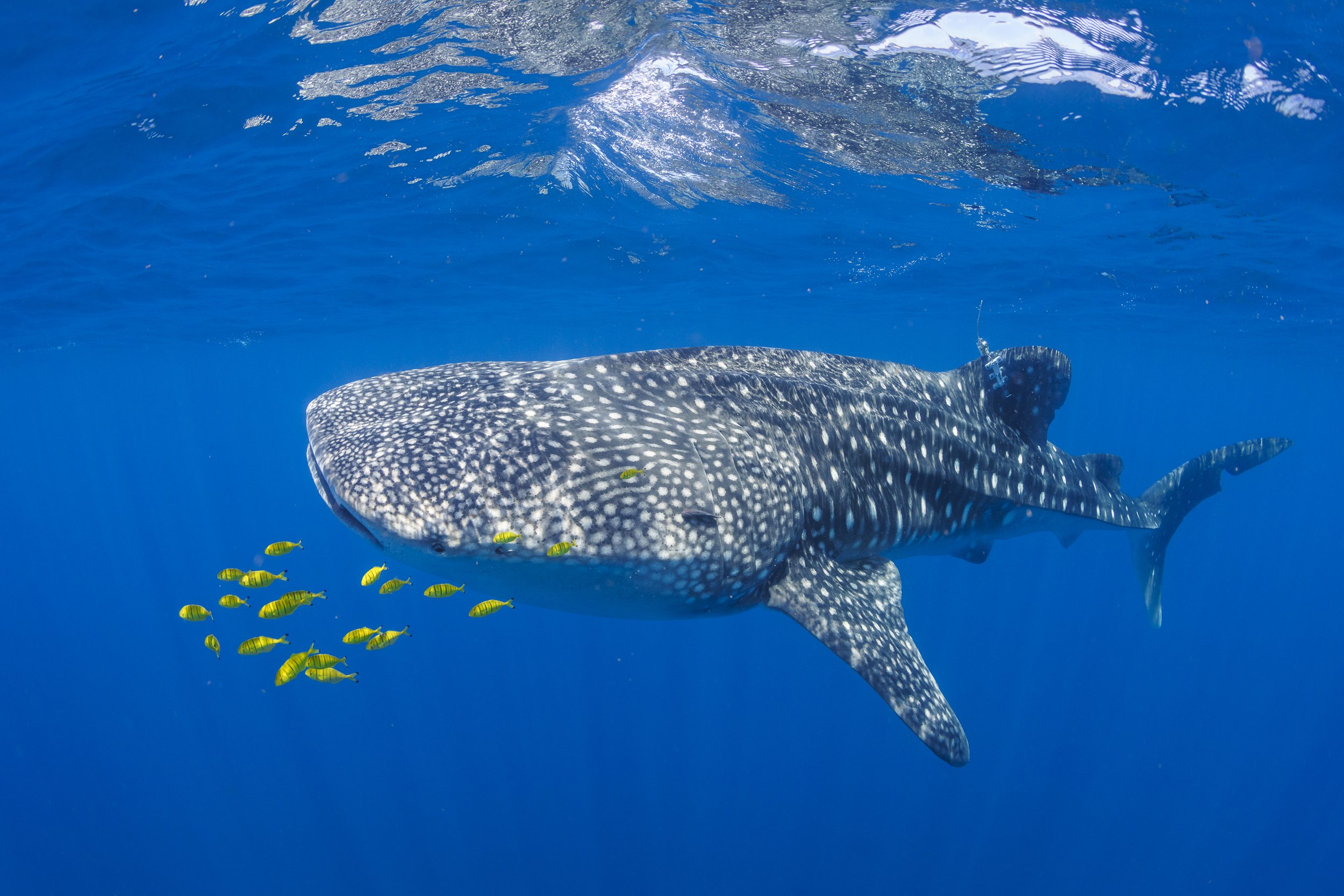
A satellite-tagged whale shark (Rhincodon typus) at Wreck Bay on the northern Great Barrier Reef, Australia.
Why borders matter
Shark movements connect countries with different approaches to fishing and conservation. The Convention on Migratory Species (CMS) asks countries to cooperate to protect animals that cross their borders. To do that, governments first need to know which countries share which species.
Mapping what we know
The new study in Conservation Biology was led by Diego Bezerra of the University of Queensland. MMF Principal Scientist Dr. Chris Rohner and Co-Founder and Executive Director Dr. Simon Pierce are among the co-authors.
The team reviewed more than 30 years of research on the 29 shark and ray species covered by CMS that use Australian waters, drawing on studies published up to mid-2023. The records came from satellite tags, tags that send sound signals to underwater receivers, and animals recognized again from their tags or photographs. The team combined them into maps of the known links between the places each species uses.
“We shortlisted 29 species that occur within Australian waters, developed network models and built the first cross-boundary migratory connectivity baseline for Australian sharks and rays,” Bezerra said in a University of Queensland news release.
Five sharks crossing borders
The review identified 140 sharks from five CMS-listed species moving into or out of Australian waters. They were white sharks (Carcharodon carcharias), whale sharks, shortfin makos (Isurus oxyrinchus), blue sharks (Prionace glauca), and school sharks (Galeorhinus galeus). Together, they linked Australia with seven other countries and territories, and with international waters. White sharks linked Australia with the most places. Across several species, 34 sharks moved between Australia and New Zealand.
Whale shark movements centered on Ningaloo in Western Australia, where the sharks gather seasonally to feed. Some traveled through the Timor Sea to Indonesia. The review also documented links with Papua New Guinea, and movements from Ningaloo and the Great Barrier Reef to Micronesia.
The team also examined tiger sharks (Galeocerdo cuvier), which are not listed under CMS. Their movements linked Australia with six other countries and territories, including New Zealand and South Africa. The authors say this is strong evidence for listing tiger sharks under the convention, which would require the countries that have signed it to cooperate on their management.
The review found no published record of a ray crossing an international border with Australia. Reef manta rays (Mobula alfredi) on the Great Barrier Reef and at Ningaloo moved seasonally between the northern and southern parts of each reef, staying within Australian waters.
The gaps
The bigger story is what is missing. The team found no published movement information for 18 of the 29 species reviewed (62%). None of the five devil ray species had movement data from Australian waters. The three sawfishes listed as threatened in Australia had three studies between them, and two of the three had none. White sharks and whale sharks had 38 studies combined.
The authors say these gaps are likely driven by how and where animals have been tracked, not by how far they actually travel. The maps show the minimum known connections, not the exact routes animals take.
What comes next
The authors recommend extending Australia’s network of underwater receivers across the shallow Torres Strait, between Australia and Papua New Guinea. For the deeper Timor Sea and the western Pacific, they recommend tagging more of the species that fisheries catch and keep, using tags that store data until they are recovered. They also call for research on species with one or no movement studies, and for scientists in neighboring countries to share and interpret tracking data together.
In the news
Bezerra, Daniel Dunn, and Ross Dwyer wrote about the study for The Conversation. It was also covered by Oceanographic Magazine and Earth.com.
The study was supported by an Australian Research Council Discovery Project and the Marine Geospatial Ecology Lab at Duke University. Read the full paper, visit our whale shark and reef manta ray pages, or adopt a whale shark to support new research on whale sharks.