
Scientists have confirmed pregnancy in three free-swimming oceanic manta rays using an underwater ultrasound that never touches the animal. One of the three showed no outward sign of being pregnant at all.
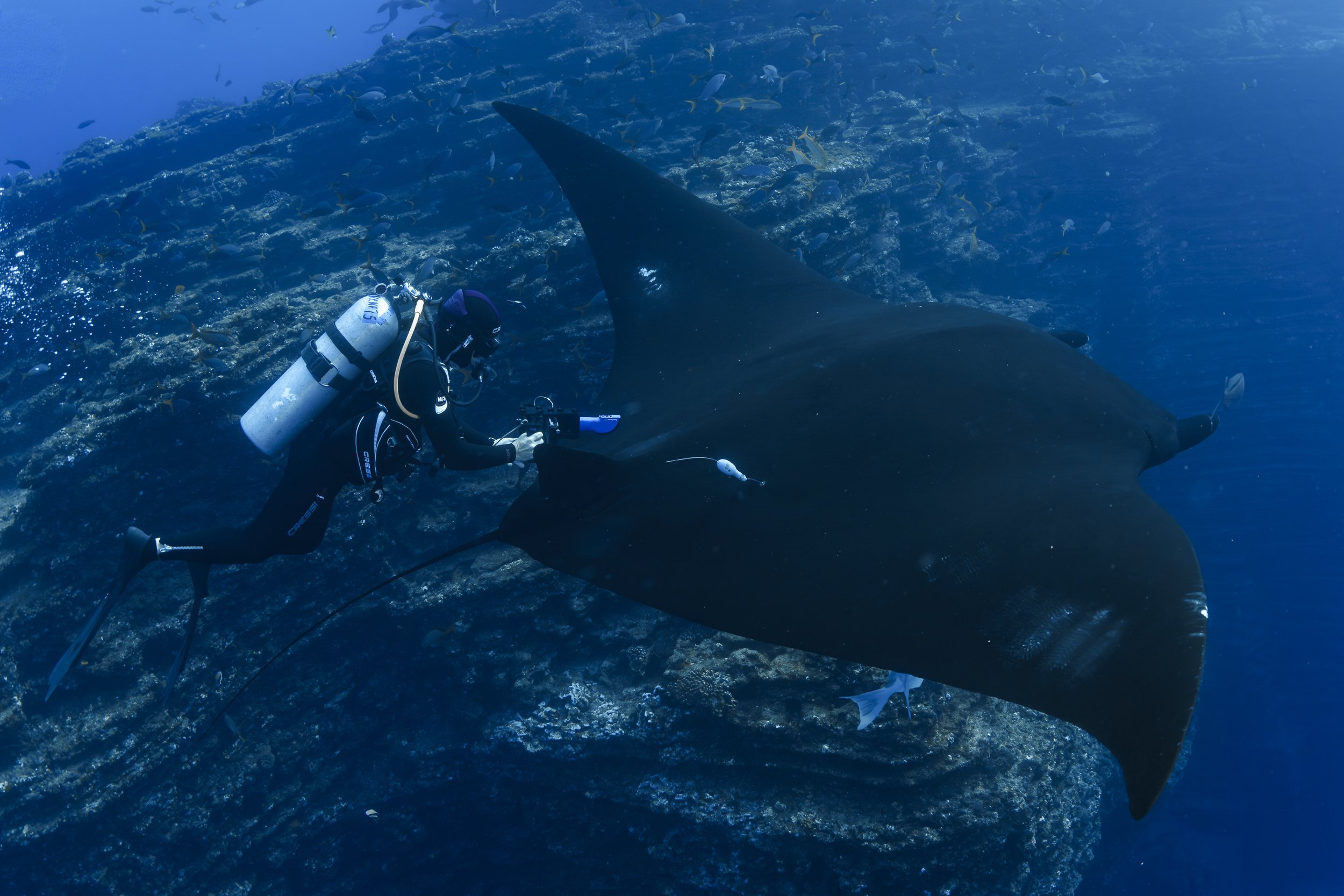
Dr. Madalena Cabral scanning an oceanic manta ray at Revillagigedo, Mexico, in June 2025. Photo: Simon Pierce
Why pregnancy is hard to see
Oceanic manta rays (Mobula birostris) are listed as Endangered on the IUCN Red List, and how they reproduce is one of the biggest gaps in what we know about them. A female carries a single pup for roughly a year, then usually waits two or more years before the next. Most of that knowledge comes from fisheries records, because pregnant females are rarely seen alive. In the water, researchers have relied on a visible bulge on a female’s back or belly, which only shows late in pregnancy.
Scanning a five-meter (16-foot) manta
The new study, published in the Journal of Fish Biology, was led by Dr. Madalena Cabral of Cuidando los Mares de México, with MMF Senior Scientist and US Country Manager Jessica Pate among the co-authors. At Revillagigedo National Park, off Mexico’s Pacific coast, Madalena let each manta see her before moving above it and holding the ultrasound probe about 5 centimeters (2 inches) from its skin. She scanned only while the rays kept swimming normally, and all three kept coming back to her during the dive, so no animal was chased.
Scans in January and March 2026 confirmed pregnancy in three females, known as Timshel, Ophelia, and Grecia. The team estimated each at 5 to 5.5 meters (16 to 18 feet) across.
What the scans showed
Timshel was at a middle stage of pregnancy. Her fetus measured roughly 56 to 60 centimeters (22 to 24 inches) across, and the scan caught it opening and closing its mouth in a steady rhythm. This “buccal pumping” is thought to help an unborn manta take in oxygen, since mantas have no placenta or umbilical cord. Yet Timshel showed no bulge from any angle.
Ophelia and Grecia were further along, and both had a visible bulge. Even so, it was hard to see on video against their dark backs, especially for Grecia, whose skin is almost entirely black.
Why it matters
If a pregnancy can’t be seen until late, surveys that count pregnant females by eye are missing some. That matters for conservation, because estimates of how quickly a population can recover depend on how often females breed. Finding three pregnant females inside Revillagigedo also suggests the park may be important habitat for pregnant oceanic mantas. The authors propose scanning more rays across the seasons and pairing ultrasound checks with satellite tracking, to learn whether pregnant females stay inside the protected area and where they give birth.
In the news
The study drew wide coverage as a preprint before it was published, including a feature in National Geographic that ran images from Jessica and MMF, a story in The New York Times, and a place in Nature’s pick of August’s best science images. You can read the preprint or the final paper.
This work was supported by Cuidando los Mares de México, the John Tolan Foundation, and the DiverMojo Foundation. To learn more about the species, visit our oceanic manta ray page, or adopt a manta ray to support new research on manta rays.