
Satellite tags show where whale sharks travel, but only for as long as they stay on. A global survey of whale shark tagging teams, backed by their tracking data, found that well-designed fin clamps can produce tracks comparable to tags bolted through the fin. Clamps can be fitted without having to hold the shark still.
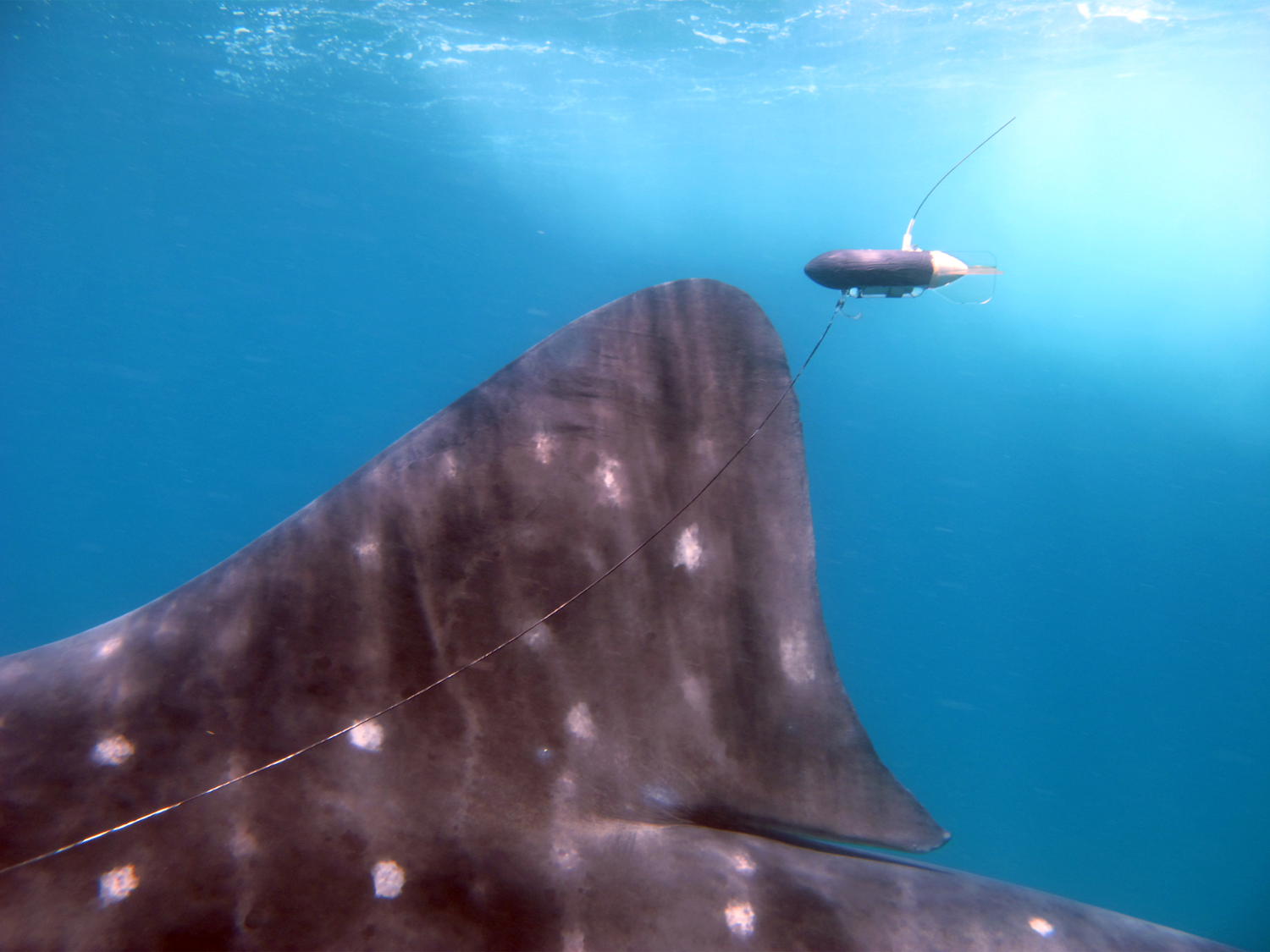
A whale shark in Mozambique carrying a satellite tag on a towed tether, one of the attachment methods compared in the study.
Three ways to attach a tag
Whale sharks (Rhincodon typus) are Endangered, and tracking them is one of the main ways researchers learn where they go. Teams have used three main ways to attach a tag. A dart can be anchored under the skin at the base of the dorsal fin (the large fin on the shark’s back) while the shark swims freely. However, tags towed behind the shark on long tethers typically last only a few months. Tags bolted through holes drilled in the fin typically stay on for more than two years, but the shark usually has to be held still first, which is rarely possible. Spring-loaded clamps that grip the dorsal fin are a third option and, like darts, can be fitted to a free-swimming shark during a brief encounter.
What the survey found
The new Animal Biotelemetry study was led by Dr. Freya Womersley of the Marine Biological Association in the UK. MMF Co-Founder and Executive Director Dr. Simon Pierce, Principal Scientist Dr. Chris Rohner, and Project Scientist Jens Paulsen are among the co-authors, along with MMF Research Associates Stella Diamant of the Madagascar Whale Shark Project and Dr. David Robinson of Sundive Research.
Twenty-three researchers answered the survey, representing 57 scientists and conservationists. Between them, they have tagged more than 1,000 whale sharks in at least 20 countries, including Mozambique, Tanzania, and Madagascar. Researchers first used clamps in 2007, and the survey respondents have since used them on more than 100 expeditions.
“This study was really about bringing together years of collective experience from researchers around the world,” Dr. Womersley said in a Marine Biological Association news release.
Good clamps and bad clamps
Results varied widely between clamp designs. Drilled tags had the longest tracks, averaging about 515 days. The two best clamp designs averaged about 234 and 400 days, with some tags still sending data, and the analysis found no clear difference between either design and the drilled tags. They also recorded locations on as many days as drilled tags or more. Poorly designed clamps did much worse: one design averaged less than 20 days.
Some clamps also damaged the fin where they gripped it. The survey linked the worst injuries to clamps that were the wrong size, placed in the wrong spot, fitted too tightly, or lined with rough materials such as sandpaper. Injured sharks that were seen again had healed fully within months. However, some sharks in long-running tagging areas have been seen with bent-over dorsal fins after long-term clamp use, and longer-term effects are hard to assess.
What the authors recommend
The authors set out a standard approach for clamps carrying long-term satellite tags. Match the clamp’s size and spring tension to the size of the shark. Avoid sandpaper and other rough surfaces. Place the clamp at a set position up the front edge of the fin, which balances a secure grip against good satellite transmission. Keep the tag from sticking out too far beyond the fin’s front edge. They also ask teams to record each clamp’s design and position, and to follow healing through photo-identification platforms such as Sharkbook.ai, which recognize individual sharks from their spot patterns.
Why it matters
Longer, more reliable tracks can reveal gathering sites, movements across national borders, and places where whale sharks overlap with human activities, which is what conservation planning needs. Because each well-attached tag yields more and better data, fewer sharks may need to be tagged.
Several of the Marine Biological Association authors were supported by a European Research Council Advanced Grant under the European Union’s Horizon 2020 program. Read the full paper, visit our whale shark page, or adopt a whale shark to support new research on whale sharks.