
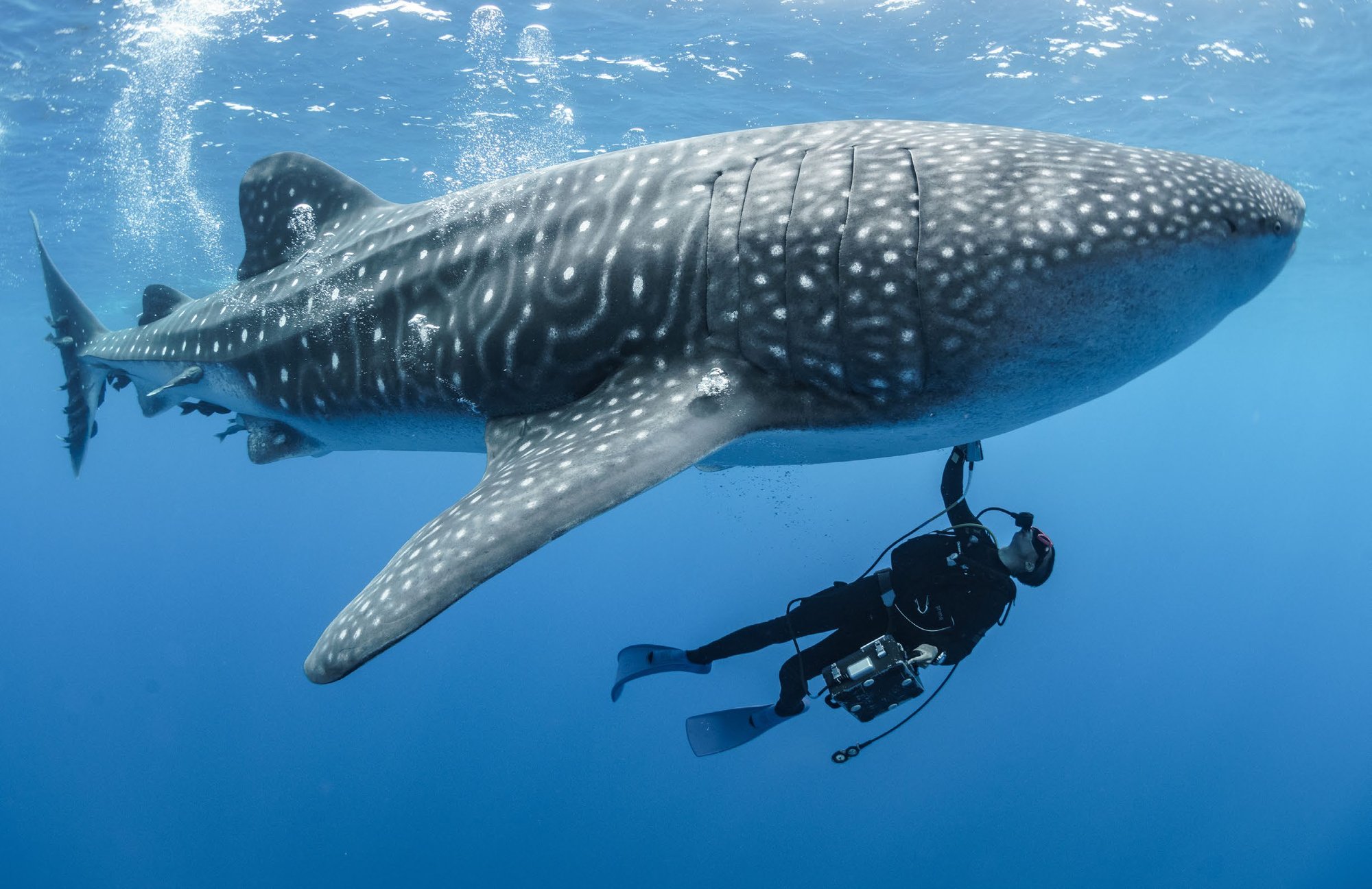
Rui Matsumoto taking an ultrasound reading.
by Dr Simon Pierce
We’re very happy to share a new scientific paper, published recently in Endangered Species Research, that describes two shiny new research techniques: the use of underwater ultrasound to study the reproduction of free-swimming whale sharks, and how we can collect blood samples from these same whale sharks in the wild. Honestly, it’s some mind-blowing stuff.
The whale shark is a relatively well-studied species… but ‘relative’ is key here. Only a single pregnant female, caught in a Taiwanese fishery back in 1995, has ever been examined by scientists – and we don’t know where the babies live, either. It’s mostly juvenile male sharks that frequent coastal areas, including tourism sites. Female whale sharks, both juveniles and adults, probably live further offshore; where they’re difficult to find, let alone study.
Darwin, the northernmost island in the Galapagos archipelago, is one of the only places we can consistently find large female whale sharks. Between June and October each year, there’s a good chance to see them swimming by the main dive site at the island, Darwin Arch, presenting a ‘huge’ opportunity to learn more about the whale shark life cycle.
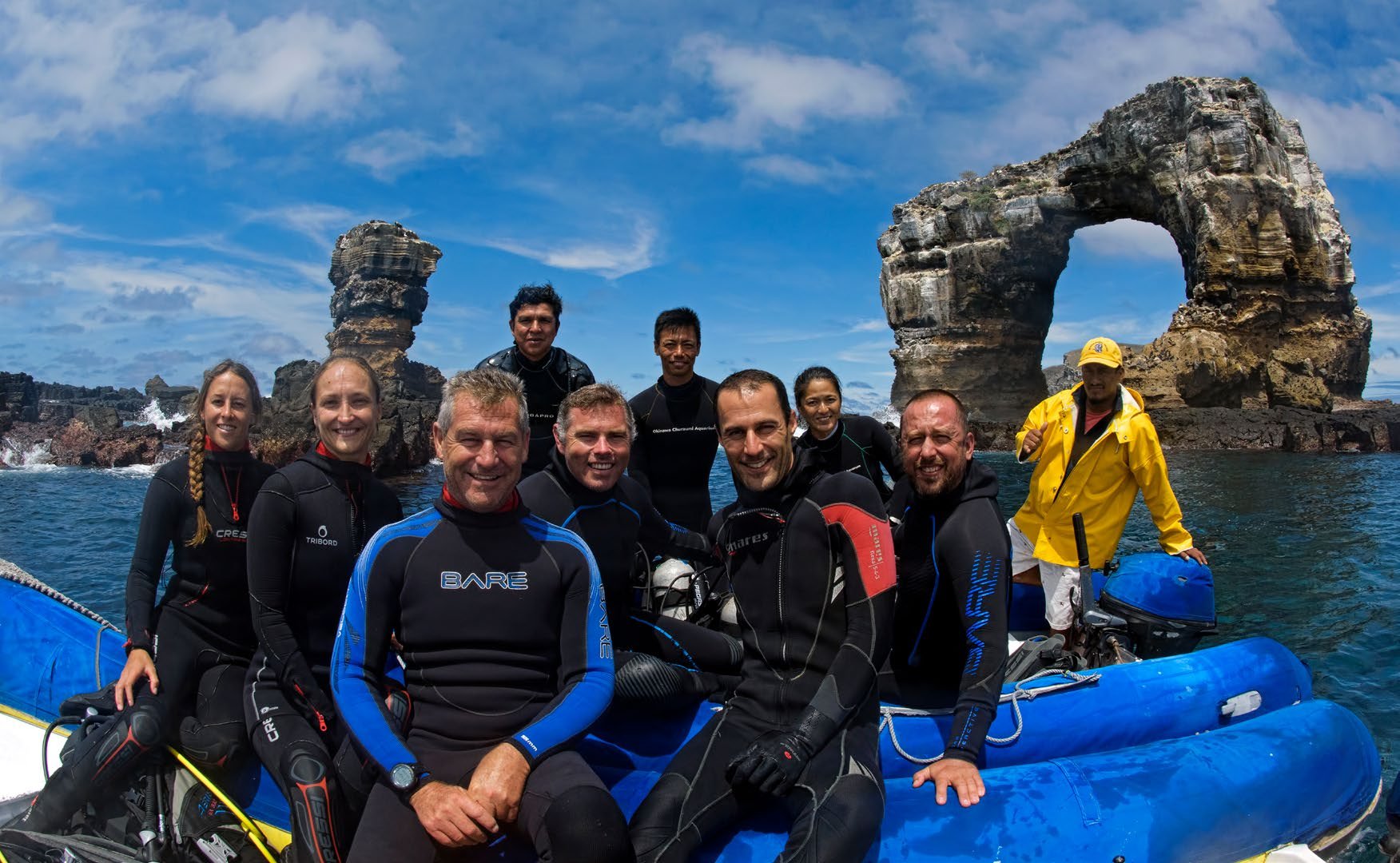
Darwin Arch, with Darwin Island at rear.
Dr Rui Matsumoto, the lead author on this new paper, has been working with his colleagues at the Okinawa Churashima Foundation in Japan to build an underwater ultrasound and blood sampling kit. The Galapagos Whale Shark Project team have huge expertise at Darwin so, together, they developed an international project to test and refine these new methods on adult whale sharks in the wild. The team also included the Dirección Parque Nacional Galápagos, Universidad San Francisco de Quito, Kumamoto University, Massey University, and Georgia Aquarium, along with Dr Chris Rohner and myself from MMF.
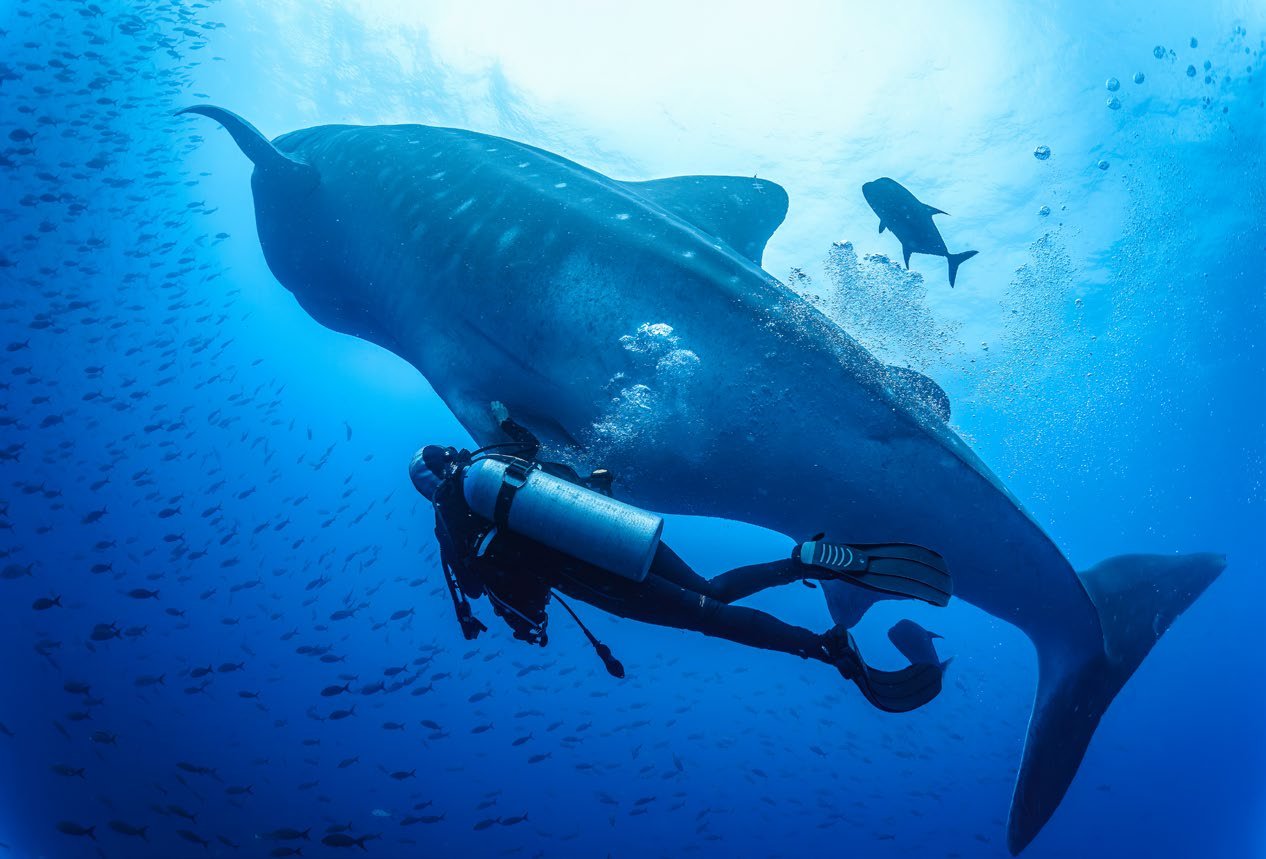
Applying these techniques was, unsurprisingly, not without some challenges. We were working at 10–30 m beneath the surface, often in strong current. Whale sharks are wonderfully placid, but they’re a lot faster than us, and emerge from the blue with little warning. We only had a short time to work with each animal. The ultrasound unit is the size of a large briefcase, so it’s far from hydrodynamic. Rui was using a ‘jetpack’ (an underwater propeller mounted on his air tank) to keep up with the sharks and scan them with the ultrasound wand, while filming the process with a GoPro to synchronize the ultrasound imagery with its position on the shark. (I felt cool by general association.)
Interpretation of the scans requires a lot of experience, too. Kiyomi Murakumo has been examining underwater ultrasound imagery in captive sharks and rays in the Okinawa Churaumi Aquarium for years now, monitoring pregnancy across species from nurse sharks to manta rays. She was able to discern the developing follicles within these greyscale images that prove that these female whale sharks are indeed adults – something that was previously only possible to determine through dissections.
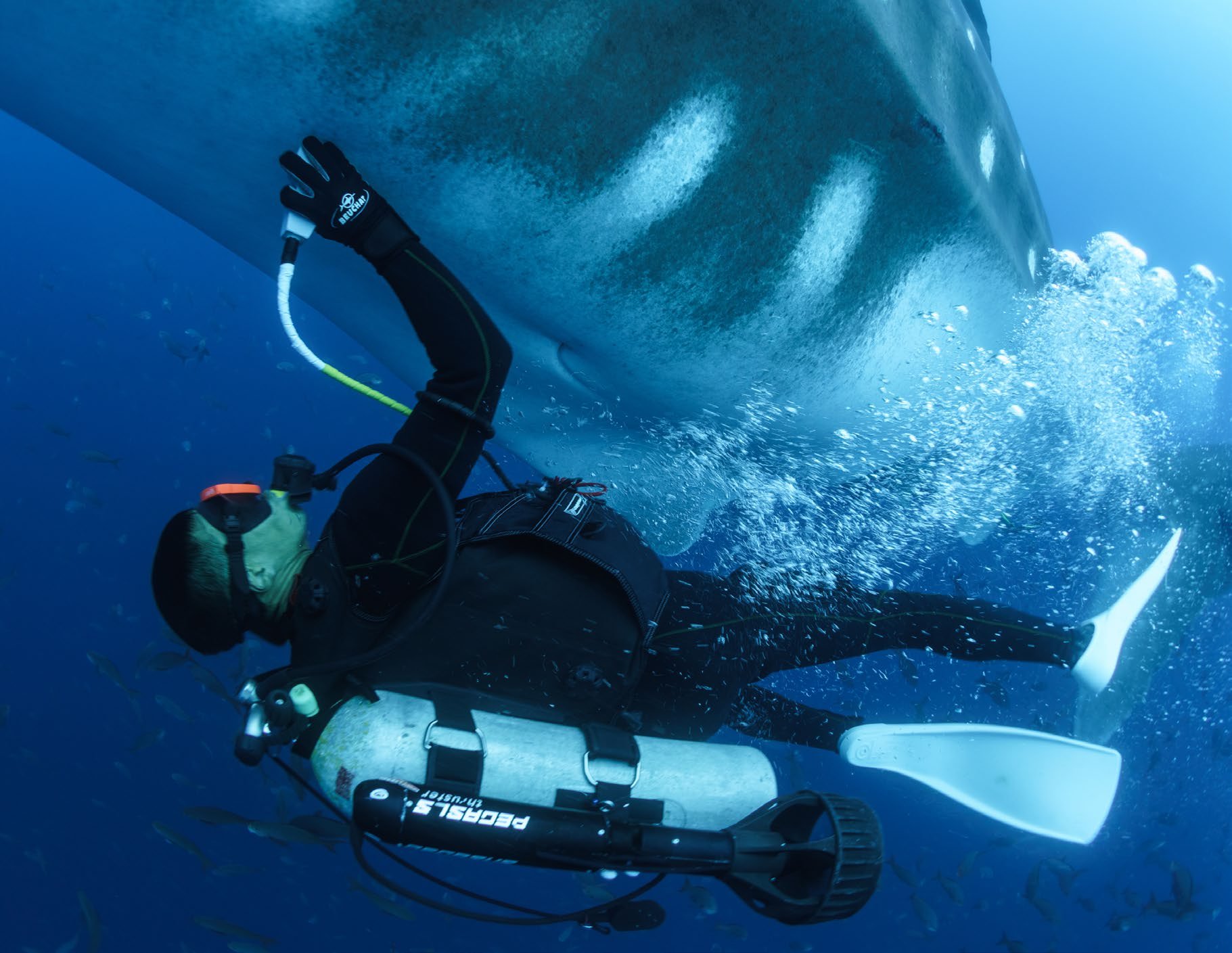
Dr. Rui Matsumoto ultrasounding a female whale shark.
Collecting blood samples from free-swimming sharks is, similarly, something that has taken a lot of trial and error to get right. Whale sharks have extremely thick skin, so we can’t reach their actual veins – instead, we’re trying to draw blood from vascularized tissue on their fins, which requires a large dose of luck. We also have to avoid contamination from seawater, which has necessitated the development of a two-syringe system, with one creating an initial vacuum, enabling the second to draw pure blood. When it was successful, though, it was possible to measure the levels of estradiol, progesterone, and testosterone in wild, adult female whale sharks for the first time. In conjunction with the ultrasound, that allows us to finally start studying the whale sharks’ breeding cycle – all while the sharks swam blithely past, happily indifferent to our excitement.
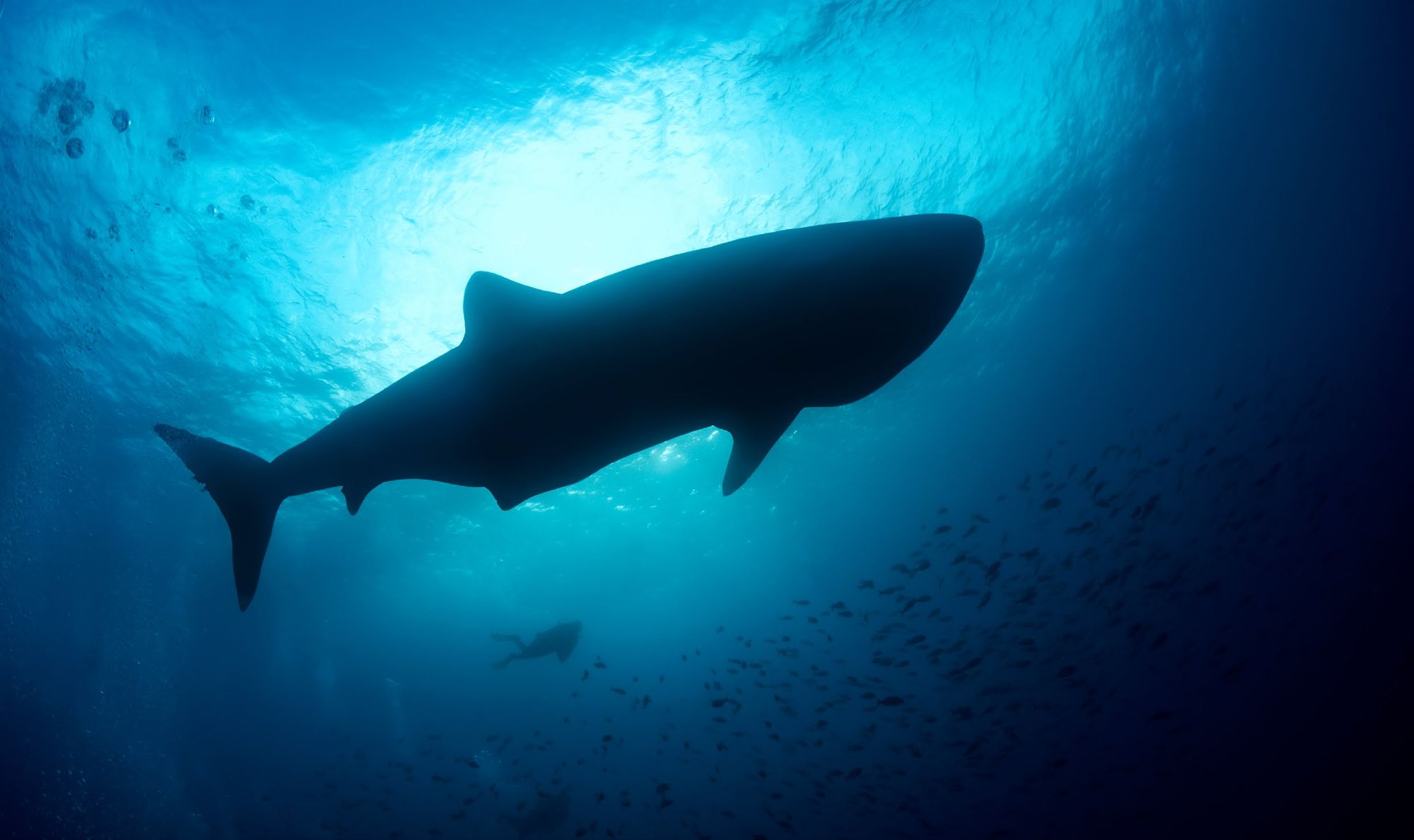
Whale shark at Darwin Arch.
This publication is just the start of that work, formally explaining the methods and their application to shark reproductive studies. There’s a ton more to do (including actually locating some of these aforementioned pregnant females). As we progress, it’ll allow for other research too, such as looking at stress and pollution levels in whale shark populations, thereby improving our understanding of their conservation needs.
Ultimately, we want to get to the point where we can do regular health check-ups on these endangered giants, identify the habitats that are most important to their life cycle, and ensure they’re well-protected. And if we have to use underwater jetpacks to accomplish that… well, I’d never call myself a hero, but people might say it about me.
The study, entitled “Underwater ultrasonography and blood sampling provide the first observations of reproductive biology in free-swimming whale sharks” was published by Endangered Species Research in March 2023.
Jonathan Green with a successful blood sample.
This study was made possible by a grant to the Galapagos Whale Shark Project from the Galapagos Conservation Trust, funding from the Planeterra Foundation to MMF, and the PADI Foundation. Chris and my contributions to this project were supported by Aqua-Firma, Shark Foundation, the Swiss Friends of Galapagos, Temperatio, and Waterlust. Thanks so much to all the GWSP and broader team for making this such a great project to work on!
This article was originally published in Ocean Giants, MMF’s magazine, Issue #07 (Spring 2023). Download the full issue as a PDF. Read more about this work on our Galapagos whale sharks project page.