
Galápagos, Ecuador · Global Whale Shark Program
Galapagos Whale Shark Project
Almost all the whale sharks passing Darwin Island are large adult females, a pattern found nowhere else in the world.
Led by Galapagos Whale Shark Project, with MMF
The Galapagos Whale Shark Project studies whale sharks (Rhincodon typus) in the Galápagos archipelago. MMF is a collaborating partner, and our involvement is focused on Darwin, the northernmost island.
The project’s research spans population ecology, tracking, and health assessment, with the aim of understanding and protecting the whale sharks of the Eastern Pacific.
What the project has done
- Identified 736 individual whale sharks, almost all of them large adult females, a demographic found nowhere else in the world.
- Satellite tagged more than 100 whale sharks, one of the largest tracking efforts on the species anywhere.
- Helped secure the Reserva Marina Hermandad, a 60,000 km² (23,000 square miles) expansion of Ecuador’s marine protection declared in 2022, which raised the share of Ecuador’s ocean under protection from 13% to 18.9% and increased protected whale shark habitat from 27% to 34%.
- Pioneered the first application of underwater ultrasound and blood sampling to study the reproductive biology of whale sharks in the wild.

Support our whale shark research
Each shark identified and each tag that transmits data adds to what we know about whale shark movements. Your gift supports MMF's whale shark research, from photo-identification and satellite tracking to health assessments of wild sharks.
Our work on whale sharks in the Galápagos
Research at Darwin Island
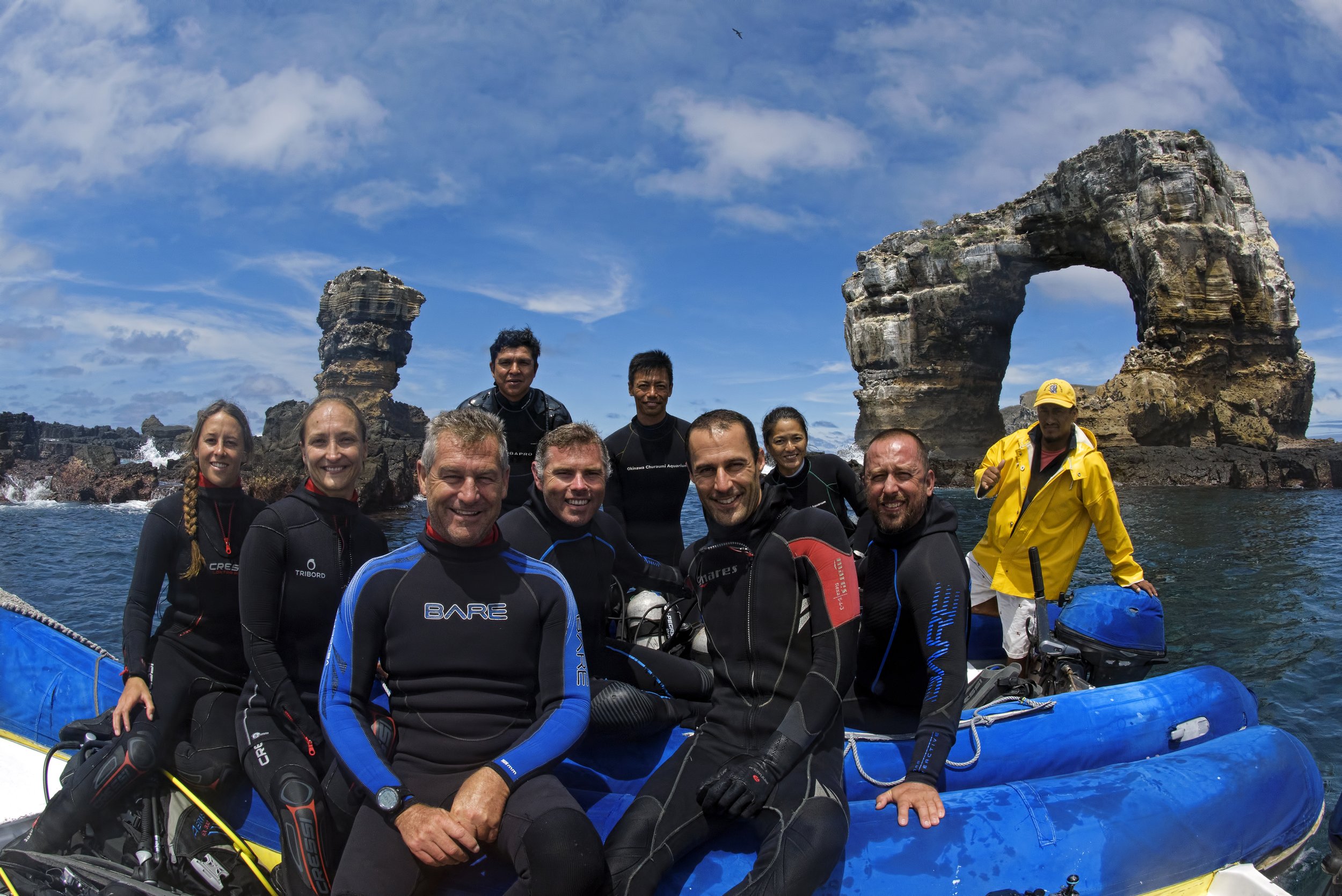
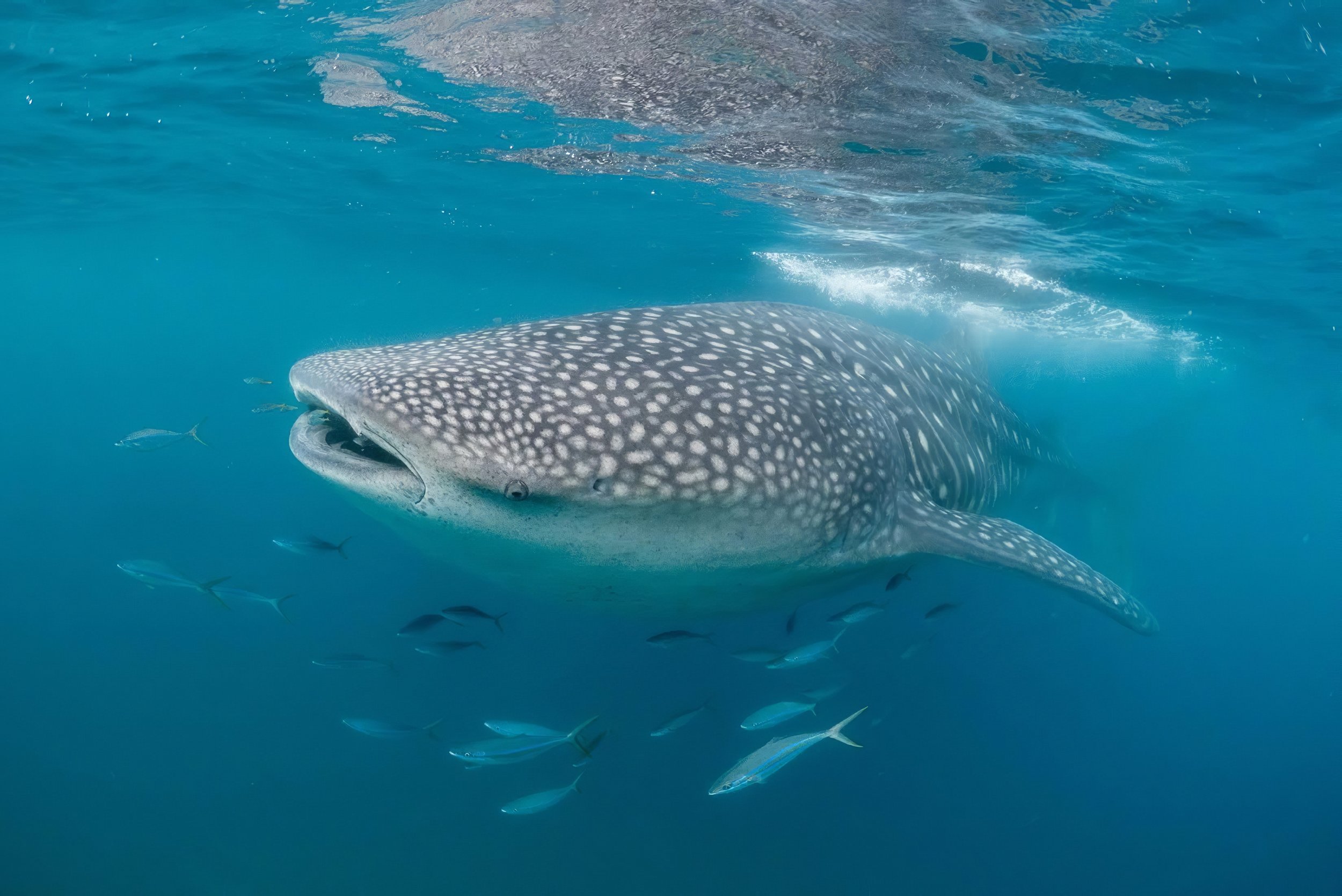
Darwin, the northernmost island in the Galápagos, is a global hotspot for adult whale sharks, almost all of them female. It therefore offers a unique opportunity to study their movement ecology and reproduction, and it is where MMF’s work with the Galapagos Whale Shark Project is focused. (Photo: Jonathan Green.)
Population ecology
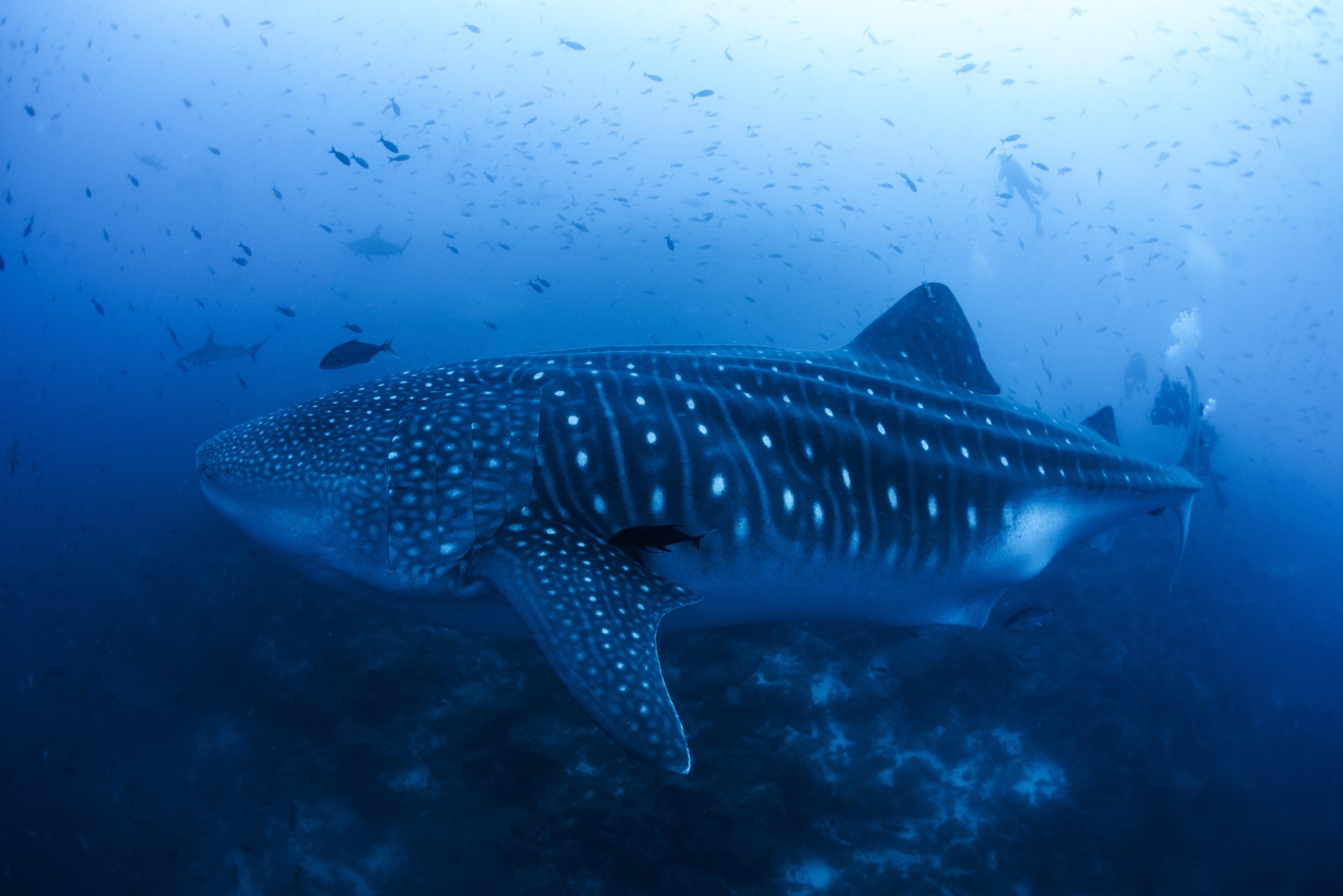
Photo-identification from each shark’s unique spot pattern, carried out during dedicated research trips and bolstered by contributions from dive guides and visiting divers, has documented 736 individual whale sharks transiting past Darwin Island, mainly between June and October each year. Over 95% are adult females, typically 10–14 m (33–46 ft) long; in contrast, almost every other known whale shark aggregation is dominated by small juvenile males. Twenty individuals have been re-sighted in more than one year, some with records spanning 13 to 14 years. However, individual sharks remain for only about two days, which suggests that Darwin is a waypoint on a migration rather than a place where the sharks reside.
Satellite tracking
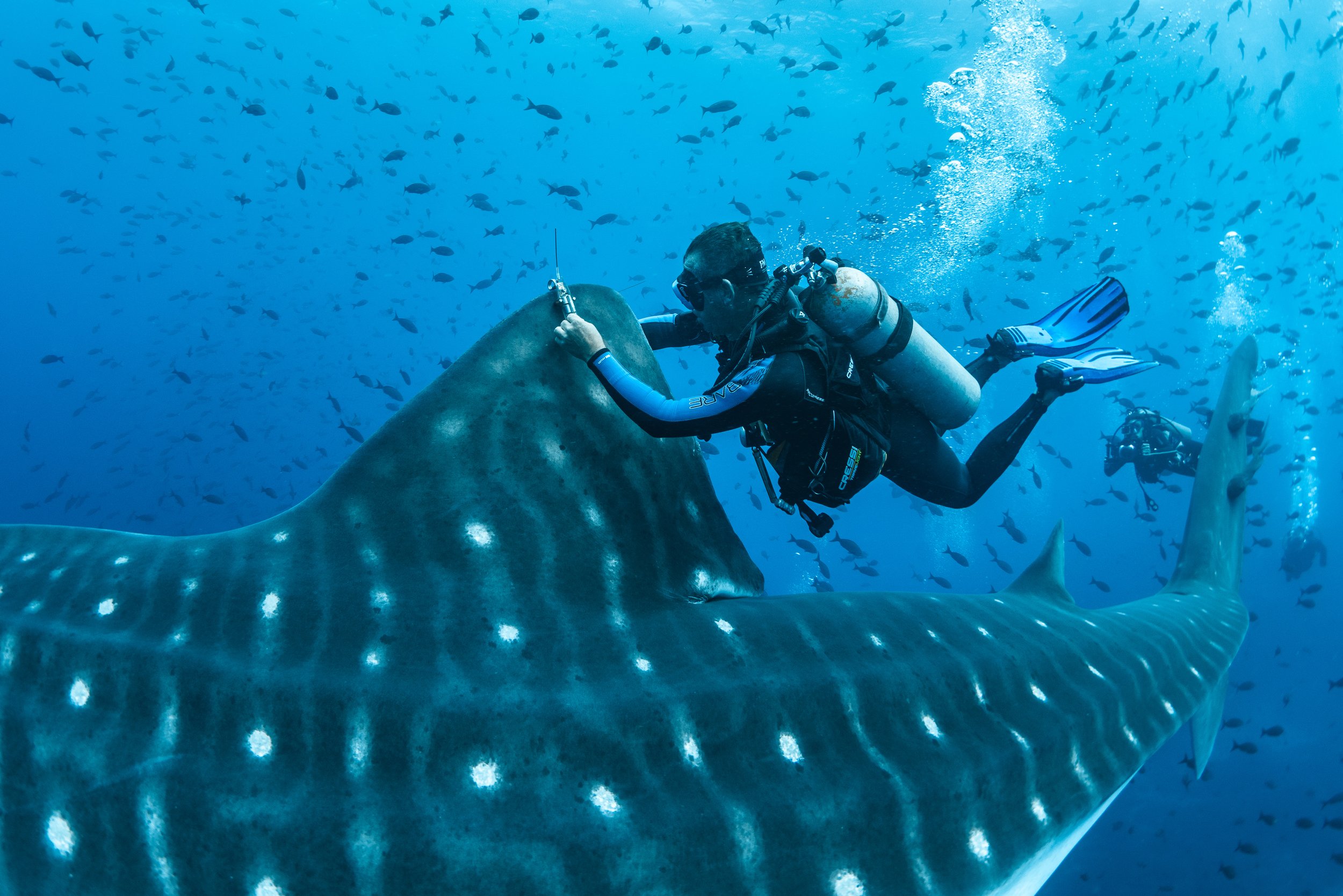
More than 100 whale sharks have been satellite tagged since the project began, making this one of the largest tracking efforts on the species anywhere. Sharks tagged in July move west into the open Pacific, whereas those tagged in September and October turn toward the South American coast, and many converge off Peru between December and February, pointing to an important feeding area far beyond Ecuadorian waters. Individual tracks have extended up to 2,747 km (1,707 miles) from Darwin.
Protecting a moving target
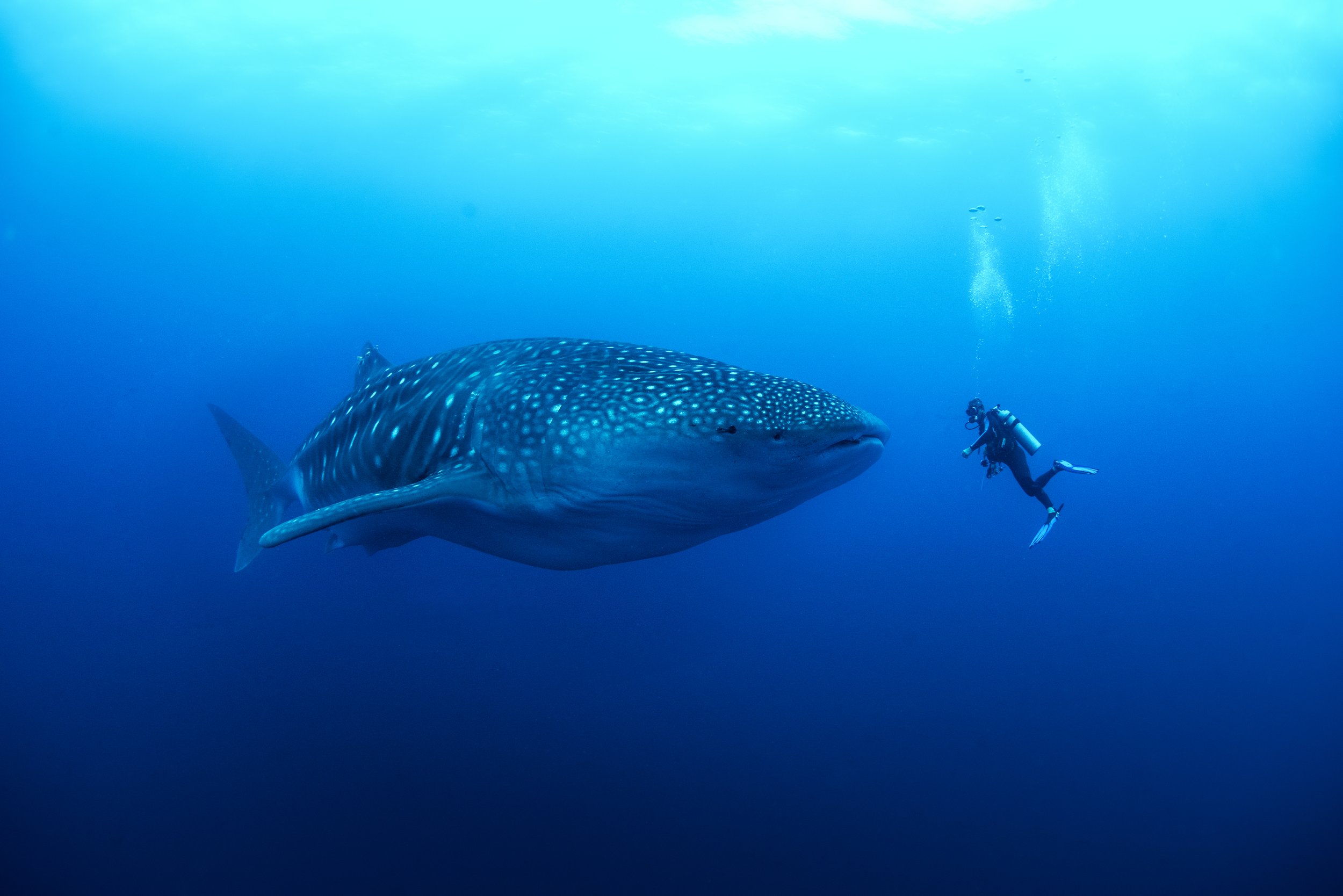
One shark was tracked to Cocos Island in Costa Rica, precisely the kind of evidence that underpins the Cocos–Galapagos Swimway and the wider Eastern Tropical Pacific marine corridor agreed by Ecuador, Costa Rica, Panama, and Colombia. The sharks also follow the fronts where cool upwelling meets warm tropical water; as a result, protecting them means protecting moving oceanographic features, not just fixed places.
Reproductive and health assessment
Darwin is one of the only places where adult female whale sharks can reliably be found, providing a rare opportunity to study their reproductive ecology. Working with a team from Okinawa, the project team used a purpose-built underwater ultrasound to scan free-swimming whale sharks for the first time, and drew blood from living wild sharks to measure their reproductive hormones, also a first for the species. The scans found developing follicles (structures containing immature eggs) in two females of 11–12 m (36–39 ft), confirming that these animals are mature without the need to examine a dead shark. Equally important, they found no sign of embryos or egg cases, which challenges the long-standing assumption that the swollen abdomens seen on large Galápagos females indicate pregnancy. Only one pregnant whale shark has ever been scientifically examined anywhere in the world; where these females go to give birth therefore remains one of the biggest open questions in marine biology.
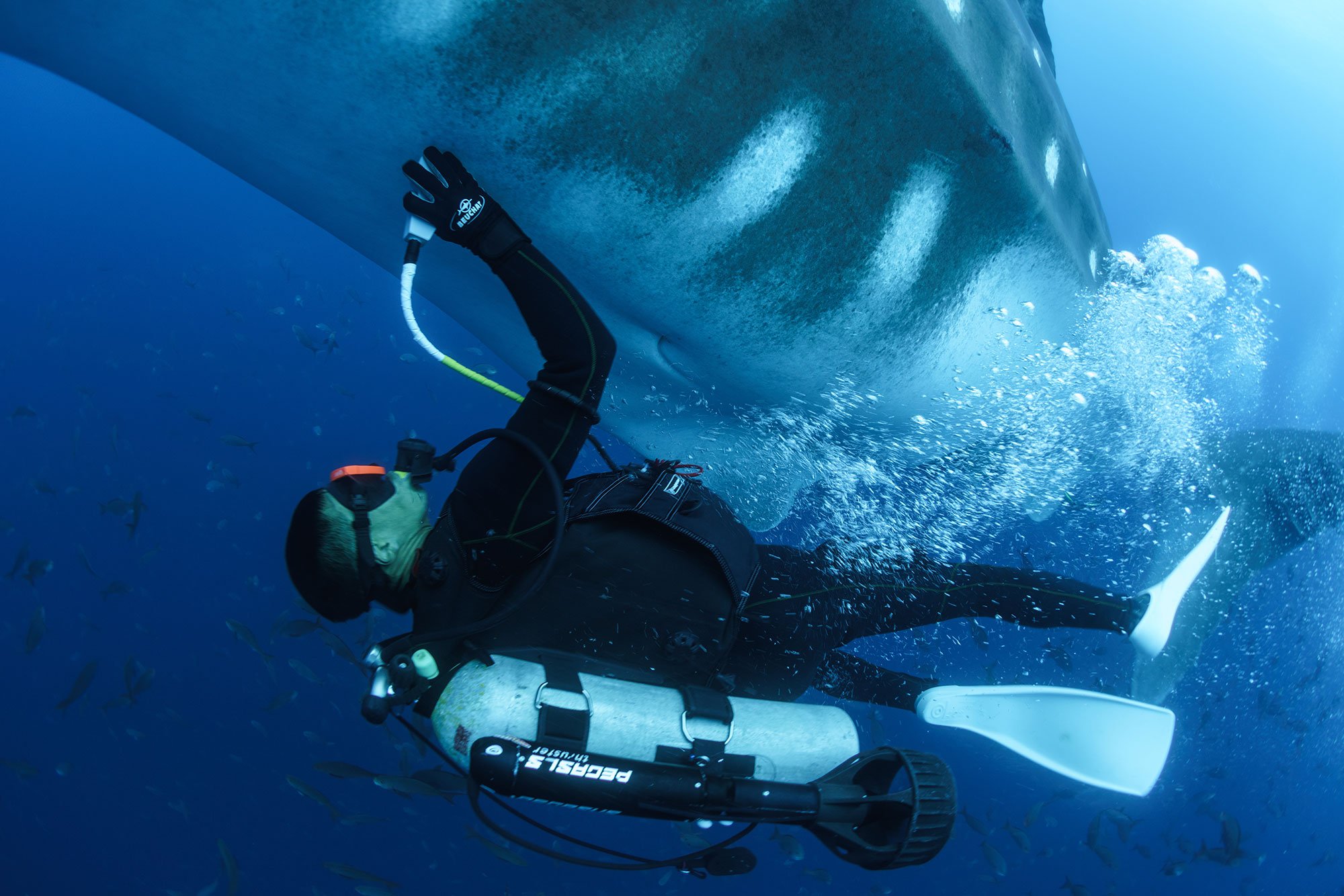
The first ultrasound scans of wild whale sharks
The team conducted underwater ultrasound scans, collected blood samples, and attached satellite transmitters to large female whale sharks to investigate their reproduction and movements.
MMF Project Team
 Dr. Simon Pierce
 Dr. Chris Rohner
 Dr. Clare Prebble
Recent research
- 2023Underwater ultrasonography and blood sampling provide the first observations of reproductive biology in free-swimming whale sharks
- 2022Diving into the vertical dimension of elasmobranch movement ecology
- Improving sightings-derived residency estimation for whale shark aggregations: A novel metric applied to a global data set
- Global collision-risk hotspots of marine traffic and the world’s largest fish, the whale shark
- 2017Undersea constellations: The global biology of an endangered marine megavertebrate further informed through citizen science
In the news
Coverage of this work.
 Coral Sea Whale Shark Project
 Madagascar Whale Shark Project
 Microplastics & Megafauna
 Mozambique Whale Shark Project