
Some adult bull sharks are based in Mozambique’s Bazaruto Seascape and were recorded there in every season. Others stop in for a few days on journeys that stretch as far as South Africa’s Western Cape. A new study shows that both groups use the same reefs.
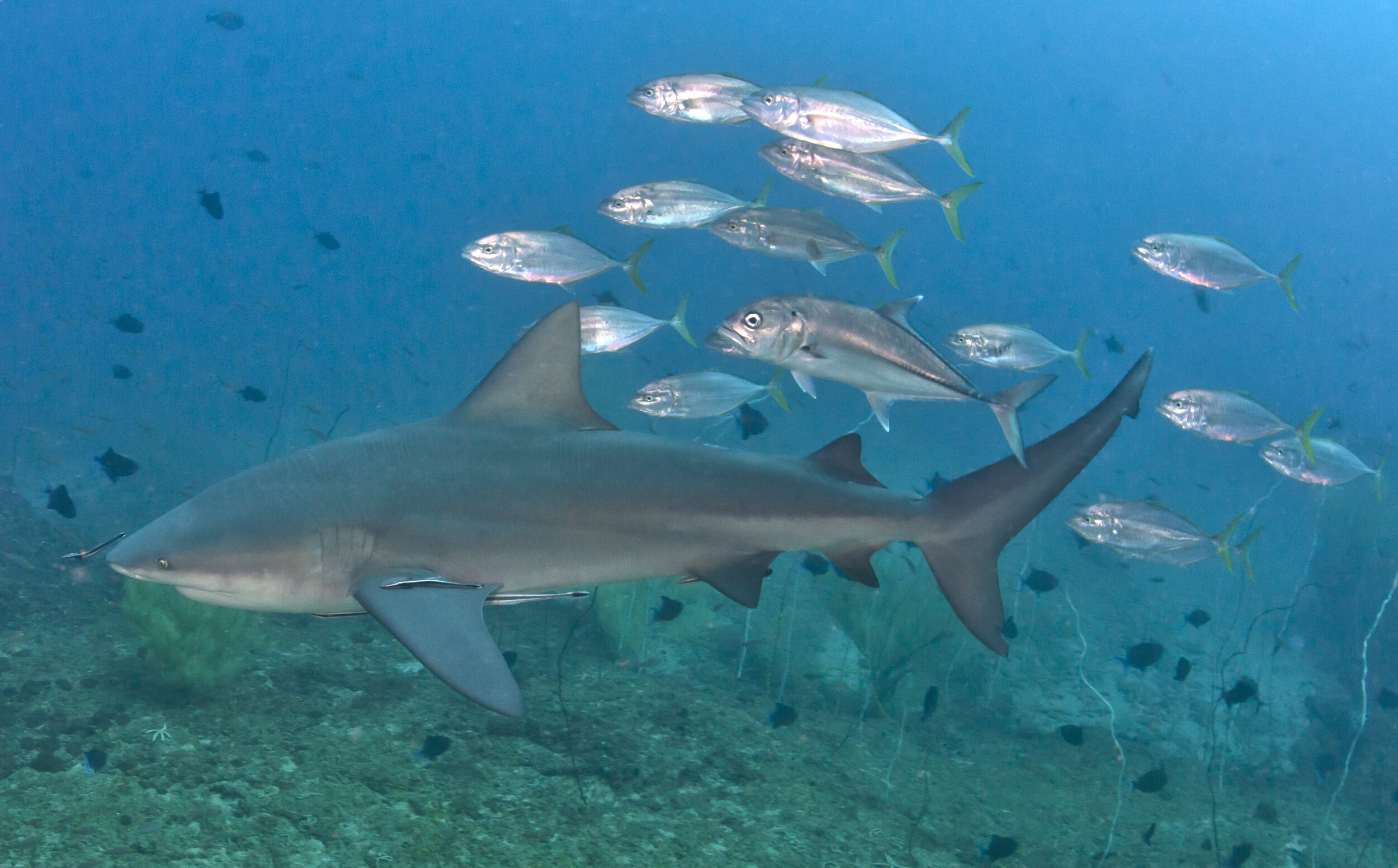
Tracking a wide-ranging predator
Bull sharks (Carcharhinus leucas) are listed as Vulnerable on the IUCN Red List. They can live in rivers, river mouths, and offshore reefs, and some travel thousands of kilometers. Most of what is known about their movements in this region comes from sharks tagged in South Africa and southern Mozambique. How they use the coast farther north has been poorly understood.
The new study, published in Fishes, was led by MMF Senior Scientist Dr. Stephanie Venables. She worked with colleagues from MMF, Ocean Wildlife Project, the South African Institute for Aquatic Biodiversity, the Oceanographic Research Institute, and Van Hall Larenstein University of Applied Sciences in the Netherlands.
Between April 2019 and May 2022, the team tagged 17 adult bull sharks in the Bazaruto Seascape, 16 of them female, with acoustic tags: small sound transmitters placed inside the body. Each tag sends out a unique code, and underwater receivers at 25 sites across the Bazaruto Archipelago and off the San Sebastian Peninsula recorded the sharks when they swam within range. The team combined these records with detections from a wider network of receivers spanning about 2,300 kilometers (1,400 miles) of coast between South Africa’s Western Cape and Bazaruto. That network also picked up bull sharks tagged elsewhere in South Africa and southern Mozambique.
Residents
The Bazaruto sharks stayed close to home. Overall, the 16 sharks with enough data were detected in the seascape on 45% of the days they were tracked, and one shark on 84% of days. As a group, they were detected year-round, with more detections from April to September. The areas they used most were the reefs along the ocean-facing side of the Bazaruto Archipelago and inshore waters off the San Sebastian Peninsula.
Visitors
Twenty-two bull sharks tagged elsewhere, from the Breede River in South Africa to Ponta do Ouro in southern Mozambique, also turned up at Bazaruto. Most of their visits were short, with 81% lasting less than five days before the sharks moved on. Most visits fell between May and November, although that pattern came largely from a few frequent visitors. They used the same reefs as the resident sharks. Male bull sharks tagged in the Breede River came back to Bazaruto year after year, and two of them were detected in the seascape every year after they were tagged.
One resident female made a much longer trip. Tagged at Bazaruto in 2020, she was detected off Toliara in southwest Madagascar in January 2024, at least 865 kilometers (537 miles) from Bazaruto. She was back in the seascape by June 2024.
Building on existing protection
An estimated 82% of the areas the Bazaruto sharks used most lies inside the Bazaruto Archipelago National Park and the Vilanculos Coastal Wildlife Sanctuary. More receivers sat inside these areas than outside, and few covered deeper water offshore, so that figure is a guide rather than a precise measure. That still gives managers a practical place to start. However, fishing is allowed in most of the protected zones these sharks use. Important reefs also lie just outside the park and sanctuary boundaries, including reef systems 1.5 to 2 kilometers (1 to 1.2 miles) off the San Sebastian Peninsula.
The authors recommend extending the boundaries of both protected areas seaward to include these reefs, restricting gillnets, which can entangle sharks, around key reefs, and coordinating management between the park and the sanctuary. Because many of these sharks travel the length of the coast, they also recommend stronger national fishing rules and joint bull shark management between Mozambique and South Africa.
This research was funded by the Blue Action Fund and the Shark Conservation Fund through WILDTRUST’s WILDOCEANS program. Further funding came from Ocean Wildlife Project e.V., SHARKPROJECT GERMANY e.V., ElasmOcean e.V., and Wageningen University’s Marine Animal Ecology department.
Read the study, learn about our bull shark research in Mozambique, the Bazaruto Seascape, and the bull shark, or support our work in Mozambique.