
Killer whales hunt and interact with sharks and rays around the world, but these encounters are hard to witness, and records of them are scarce. A new, freely available dataset brings 320 photos and videos of them together in one place.
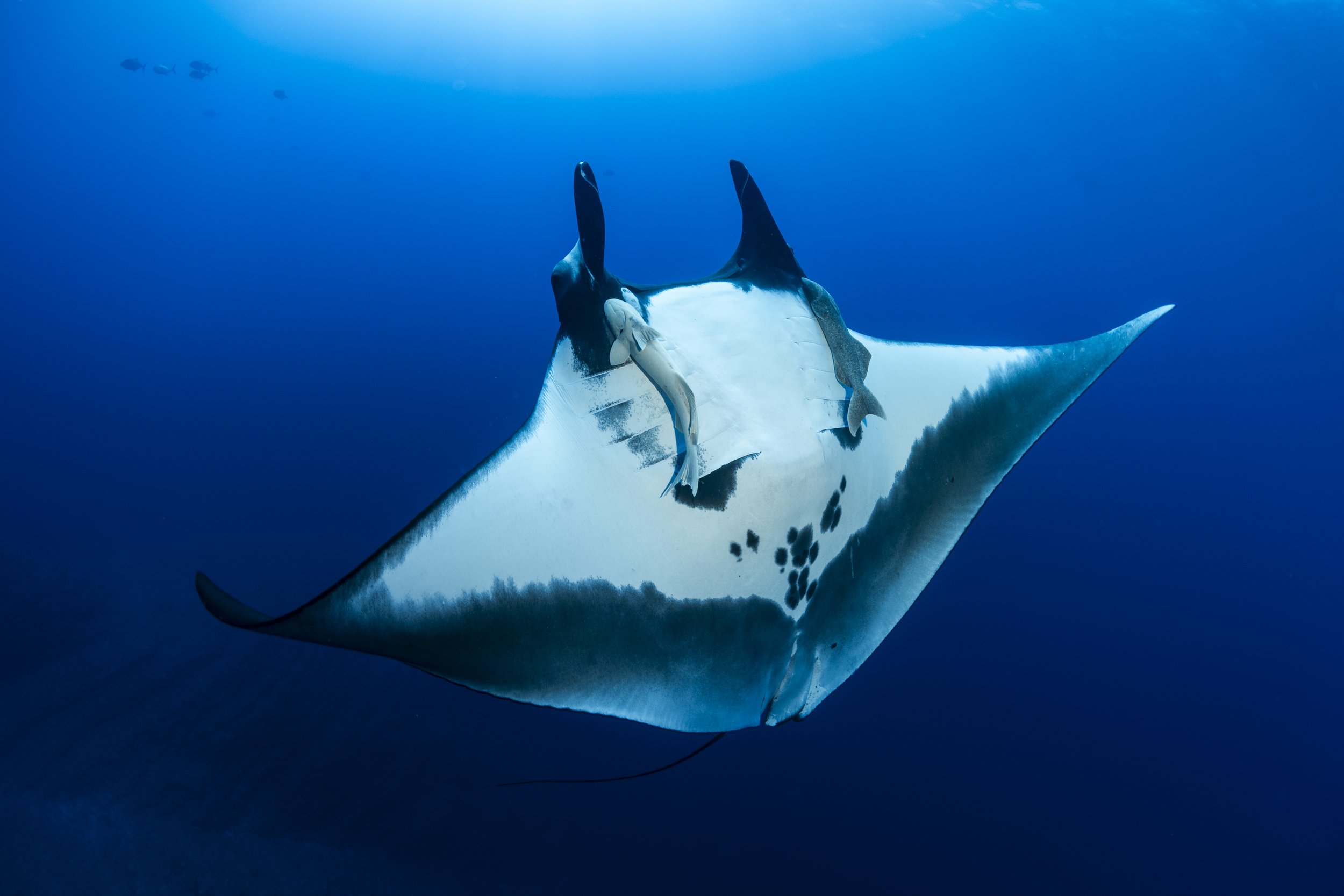
An oceanic manta ray in the Revillagigedo Islands, Mexico. Manta and devil rays (genus Mobula) were the rays most often recorded in the new dataset.
Building a shared record
Killer whales (Orcinus orca) are top predators found throughout the world’s oceans, and they interact with many other species, including sharks, skates, and rays. These encounters are hard to observe, so the evidence has mostly been scattered and anecdotal.
The new Scientific Data paper was led by Emma Luck of the University of Alaska Fairbanks, with MMF Senior Scientist Dr. Stephanie Venables among the co-authors. Emma Luck, Isabella Reeves, and Lauren Meyer conceived the project, with Meyer supervising it. Stephanie helped check the records and reviewed the manuscript.
The team called for images through a marine mammal research email list and on social media, and contacted 74 marine tourism companies in 12 countries. Contributors included killer whale and shark researchers, whale-watching and tour operators, and members of the public.
What the images show
The dataset holds 320 photos and videos from 82 separate interactions in 12 countries and territories: Australia, Brazil, Ecuador, the French Southern and Antarctic Territories, Japan, Mexico, New Zealand, Panama, Portugal, South Africa, the United Kingdom, and the United States. The team identified at least 18 species of sharks and rays from 16 genera (groups of closely related species), ranging from cookiecutter sharks (Isistius) to the whale shark (Rhincodon typus).
Cookiecutter sharks were the sharks recorded most often, in 13 interactions; some of those records are photos of the bite scars they leave. Requiem sharks (genus Carcharhinus) followed with nine. Manta and devil rays were the rays recorded most often, in 10 interactions.
The team sorted the encounters into 10 types. Some involve predation, from attacks to kills where the prey was eaten. Others involve no predation, such as one animal changing course to avoid the other, following it without making contact, stealing its food, or taking catch from fishing gear.
Each record notes the date and place where available, the identity of the killer whales where known, and how confident the team is in the shark or ray identification. Locations are marked as exact or estimated. The team cross-checked every entry against the contributors’ original notes and resolved any differences with them.
A resource for future research
The authors say the dataset can help researchers study how killer whales hunt and how sharks and rays behave around them. It could also help identify individual killer whales that specialize in hunting sharks and rays. The encounter records and watermarked images are freely available.
The paper cites earlier reports, including a 2024 study led by Maeva Terrapon, also a co-author of the new dataset, and co-authored by Stephanie. It documented killer whales preying on an oceanic manta ray (Mobula birostris), a sicklefin devil ray (Mobula tarapacana), and a tiger shark (Galeocerdo cuvier) in the southwest Indian Ocean.
The paper acknowledges the Playford Trust Foundation and the Australian Government for scholarship support, and the Australian Research Council for funding. Read the full paper, visit our oceanic manta ray page, or adopt a manta ray to support new research on manta rays.