
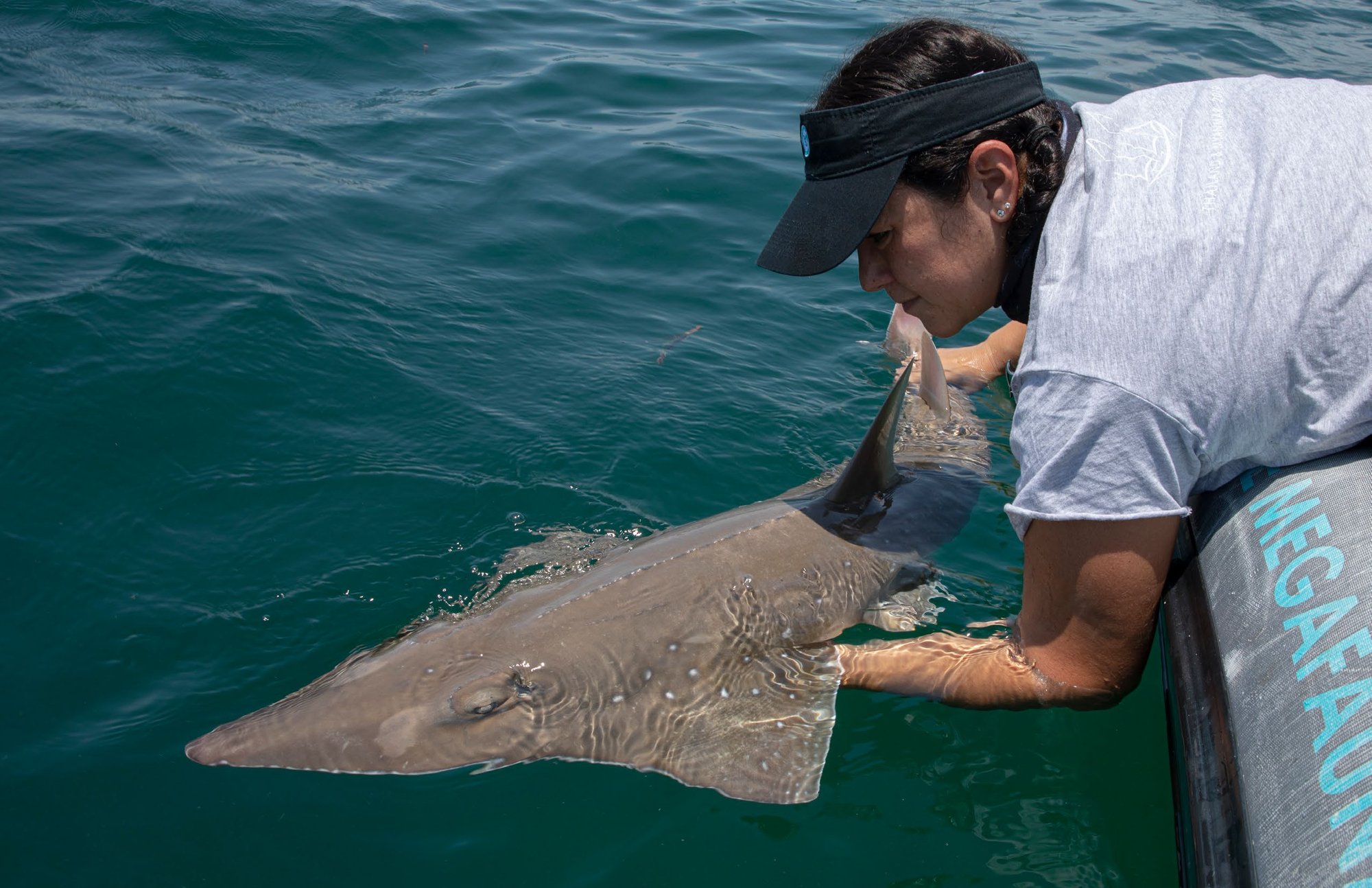
Andrea releasing a tagged bottlenose wedgefish.
Dr. Andrea Marshall is a founder and Principal Scientist at MMF, where she leads the global manta ray research and conservation program. In recent years, she has also started a project on some lesser-known, but even more endangered ocean species – the rhino rays of Mozambique. In conversation with Simon Pierce.
What is a rhino ray?
I’ve been called an ‘obsessive specieologist’ for many years, as I’ve been super focused on manta and devil rays. But, while they’re fabulous of course, I’ve always been intrigued by other species as well. I’ve been working in Mozambique for the past 20 years, and we see many animals that are not being studied, but we know that they’re in significant trouble on a global level. It’s hard not to want to learn a bit more, and to contribute where we can.
I’m still a ray girl. A lot of the species that I’m focusing time and energy on are rays. At the moment, I’m focused on the species found in Mozambique that are listed as either Endangered or Critically Endangered on the IUCN Red List. One of the groups that we’ve been spending our attention on is the wedgefish. A lot of people aren’t familiar with them. In Southern Africa, wedgefish are generally known as sand sharks. I can understand why people call them that: the front end looks like a ray, but the back end looks very much like a shark, and they spent a lot of time over the sand. Confusing things even further, one species is broadly known as the sharkray, or bowmouth guitarfish. Those are really unique and cool animals, with awesome spikes all over them, and they do look like weird sharks too.
Rays and sharks are related, but there are a few characteristics that separate the two groups. All rays have their gills on the underside of their head, but that’s not super obvious to most people. A very visible distinction is that all rays have their pectoral fins, the big fins on the side of the body, fused into their heads. The wedgefish got their name because the pectoral fins join the head to form a wedge, like a slice of pie.
There’s a subfield in conservation now, referred to as ‘conservation marketing’. It focuses on how people perceive animals and their need for conservation, and how marketing techniques can be used to draw attention to the species that need more help. With all the confusion surrounding this group, we’ve updated their collective name to be ‘rhino rays’. People know about rhinos, and they know they need conservation efforts to ensure they survive. We can borrow from that awareness to help these awesome rays too. Sharkrays also kind of look like a fishy rhino.
So the overall group we’re working on is called rhino rays, and our specific focus is on the wedgefish species that are found in Mozambique.
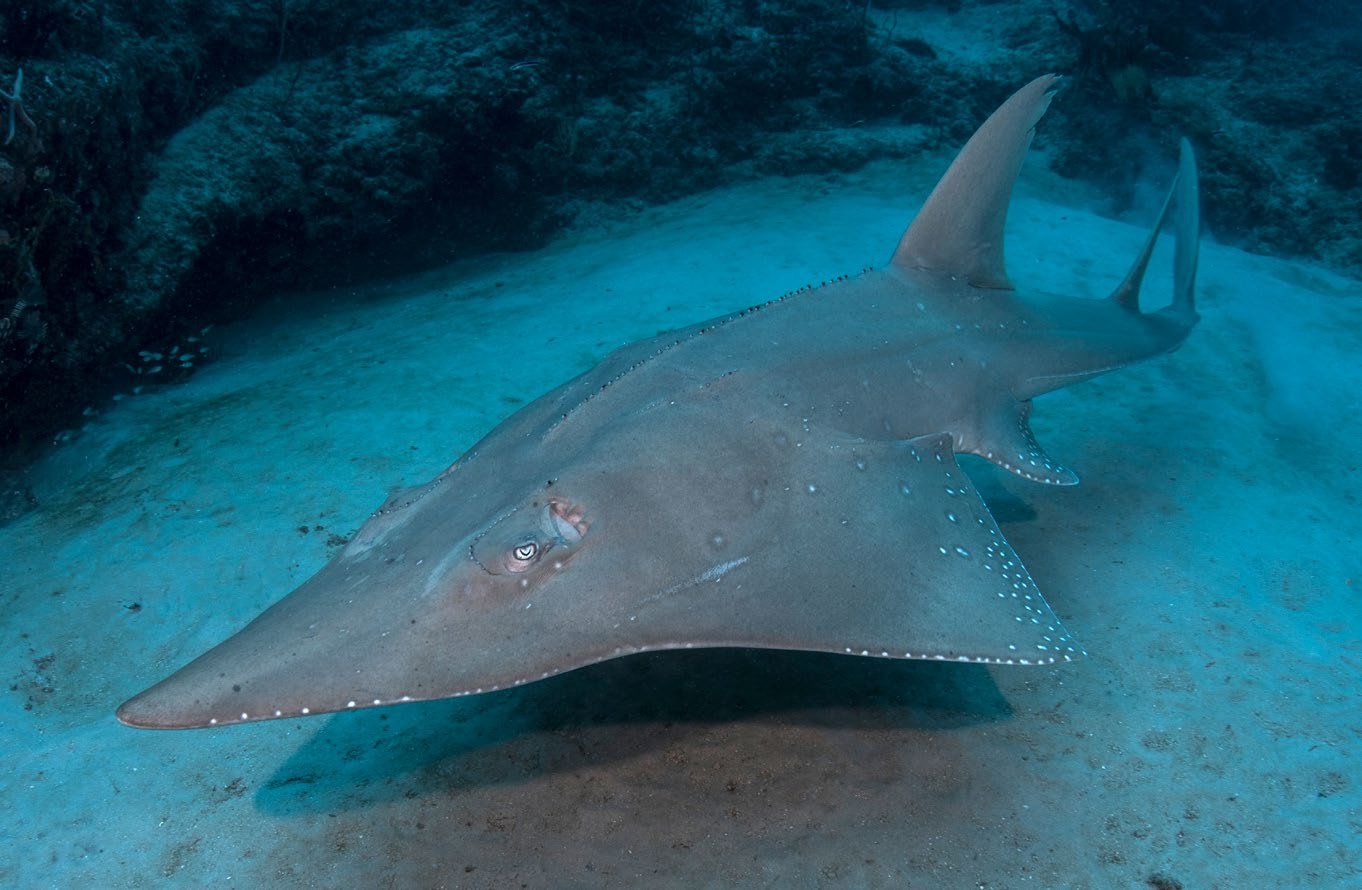
The unique sharkray, or bowmouth guitarfish.
Endangered species
The rhino rays are a tricky group to work with, so they haven’t been a major research focus until the past few years. For one thing, many of the species look quite similar, or have been poorly described, so there’s been confusion about how many species actually exist, and where they’re found. Ray research starts with taxonomy first, as you always have to figure out who you’re looking at, and that’s been a challenge with these animals.
People are scrambling to study rhino rays across the world now, though, as it’s become clear that huge numbers are being caught in fisheries. Fishing pressure is the largest threat to most sharks and rays, and that’s absolutely the case for wedgefish as well. They’re being targeted for their incredible fins – both their large first and second dorsal fins, even the tail fin is big. Although they’re a ray, their fins look like shark fins, and they’re sold in the global shark fin trade where they’re worth a lot of money.
Whether people were looking at fish markets in Indonesia, India, or the Middle East, they were seeing these animals brought in for export. I’ve heard that they’re actually the most expensive of any shark or ray, with their fins being sold for almost $1,000 per kg in Asia. There’s an enormous amount of money in fishing for these animals. In addition, they’re awkwardly shaped – they have the wedge-shaped head, and large dorsal and caudal fins, which makes them vulnerable to being caught accidentally in coastal net fisheries. Because they’re so valuable, they’re retained, even though they’re not the target.
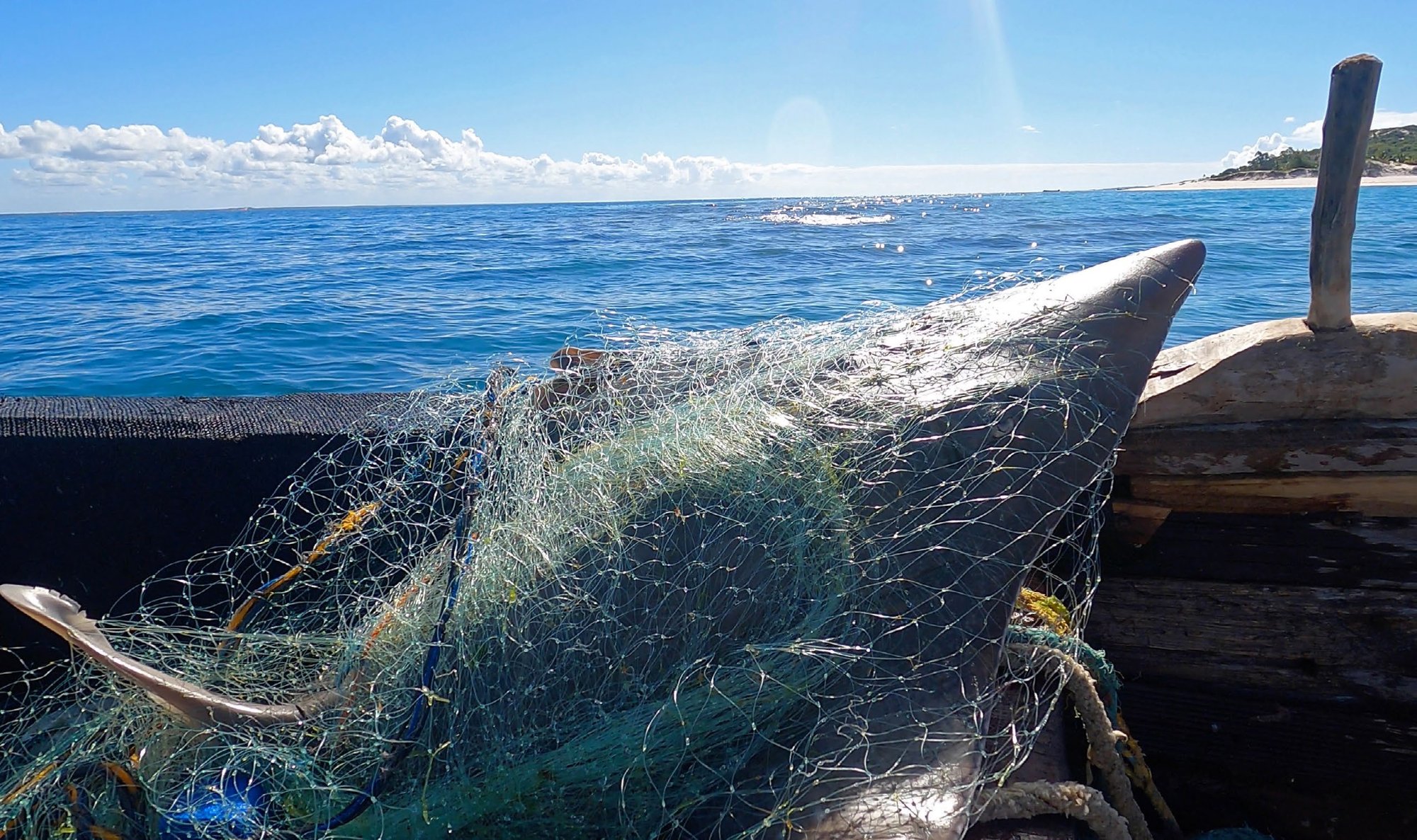
An entangled wedgefish in Mozambique (subsequently released).
Rhino rays are also suffering from the loss or degradation of their coastal habitats. We’re still trying to figure out their specific habitat preferences on a species-by-species basis but, generally speaking, they like shallow waters. The wedgefish seem to be using shallow reef environments a lot, and they’re also using sandflats, bays, river mouths, and potentially some mangrove areas. All of these areas are under threat from coastal development and can be disrupted by human activities.
Like most sharks and rays, wedgefish have very conservative life histories. They just can’t withstand all the threats that we’re throwing at them right now. There are multiple focus areas with this group – we have to resolve their taxonomy, we have to get a better handle on the fisheries catch, and we have to understand their habitat preferences and lifestyles so we can actually protect the wild populations.
First, find your ray
These rays are elusive. First, we had to find them. We’ve dived a lot in Mozambique without seeing many wedgefish and, when we did, it seemed quite random. I badly wanted to work on the group though, and we knew there were at least some around, so we decided to really go looking for them.
Since we weren’t often seeing the rays while diving on the reefs, we knew that they must prefer other habitats. We also knew that, down in South Africa, a lot of fishermen target wedgefish, because they apparently put up a really good fight, and they’re really interesting and odd animals to catch too. These fishers often catch wedgefish off sandy beaches and spits. We don’t really dive these areas, because there’s not much there.
Aerial surveillance seemed like the fastest way to cover these habitats. My husband Janneman is a pilot. He does a lot of flying for us, and he’s started using drones more over the years too. We started doing both flights and drone surveys over these areas and started seeing wedgefish quite often. We expanded the search even more, through bays and estuaries, around the mangroves, all these places that we don’t explore while diving. We’ve really gone out looking for these animals.
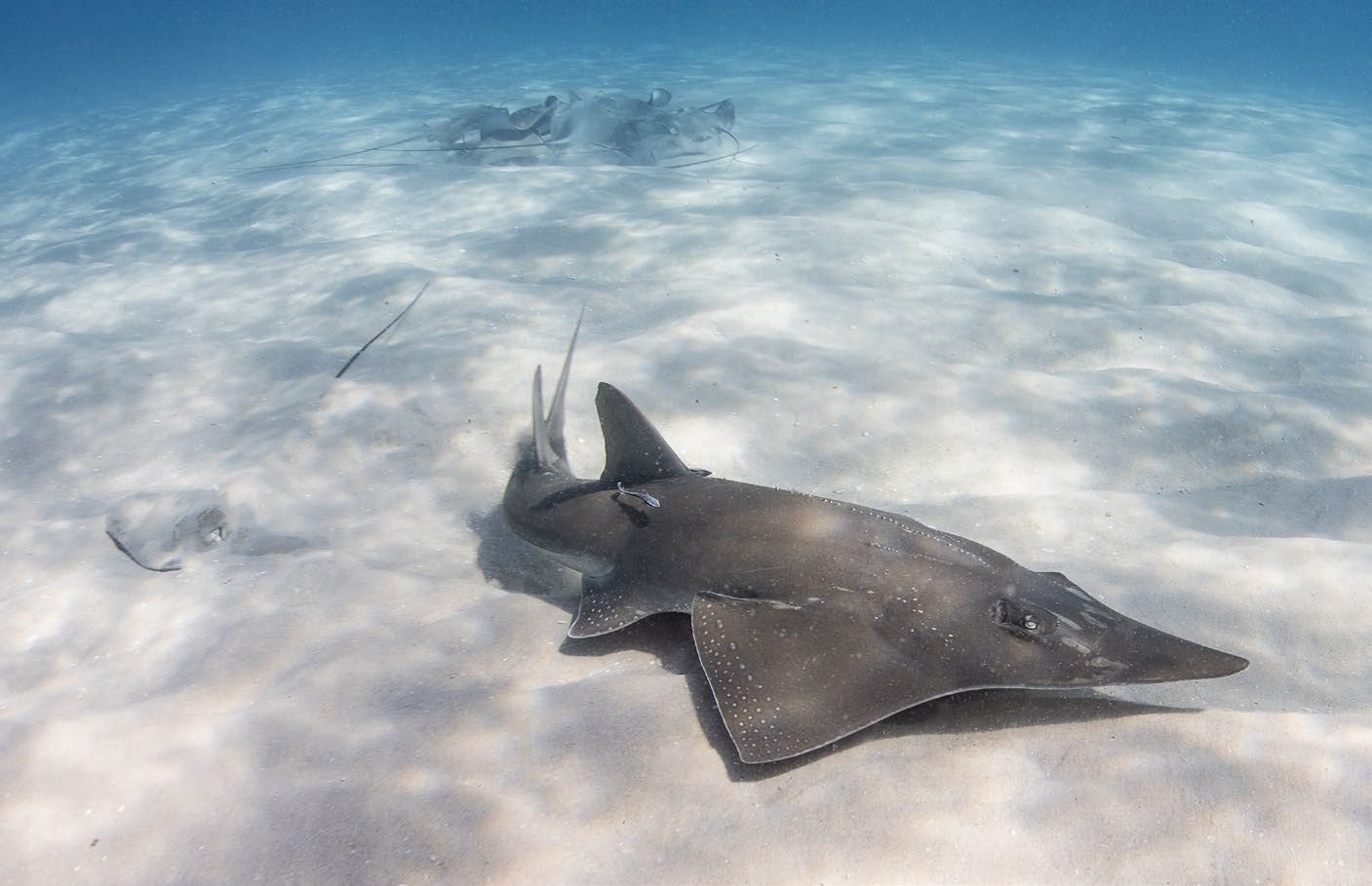
Wedgefish and whiprays in the shallows of Bazaruto.
Working out their habitat preferences has been a slow process, but it’s actually helped us a lot because it’s given us a much broader perspective of what’s going on overall. We’ve been really biased towards reef species, because those are the areas we knew, whereas the wedgefish have forced us to look in these other places that we hadn’t focused on before.
We started by collecting identification photos of each ray. All the local species have some white spots on them, so we started thinking through the relevant questions: are the spot patterns different enough to distinguish individuals and, if they are, what’s the best area on the body to standardize the photos? On manta rays we use the belly, whereas with whale sharks we use the left side, so we were trying to work out the best area to use with wedgefish.
It’s not just about checking where the spot pattern is the most unique, it’s also about using the area from which we can get the largest number of high-quality photos. Especially as it’s good to factor in the potential for citizen science contributions – Janneman and I are good at stalking the rays now, but it’s really hard for less experienced divers to get close. Then, the biggest question with photo-identification is always ‘are their patterns consistent over time?’ Do the spots change as the animal grows, or does the skin pigment darken and make the spots hard to distinguish?
The jury is still out on that. Many of the wedgefish we see are almost black, so they might indeed get darker over time. Photo-identification is a great way to track individual sharks and rays over long time periods, so we’re hoping that we can use photos to monitor individuals, but we’re not sure yet.
A lot of the individual wedgefish have scars, too, which people have proposed as an identification tool. The challenge there is that wedgefish, like most elasmobranchs, have extraordinary wound-healing ability. We’ve seen some of the photo-identified wedgefish recover from injuries surprisingly fast, so we might not be able to go that route either. External marker tags are a common identification method for similar-looking fish, but we already know they have a high shedding rate. It’s all a bit tricky.
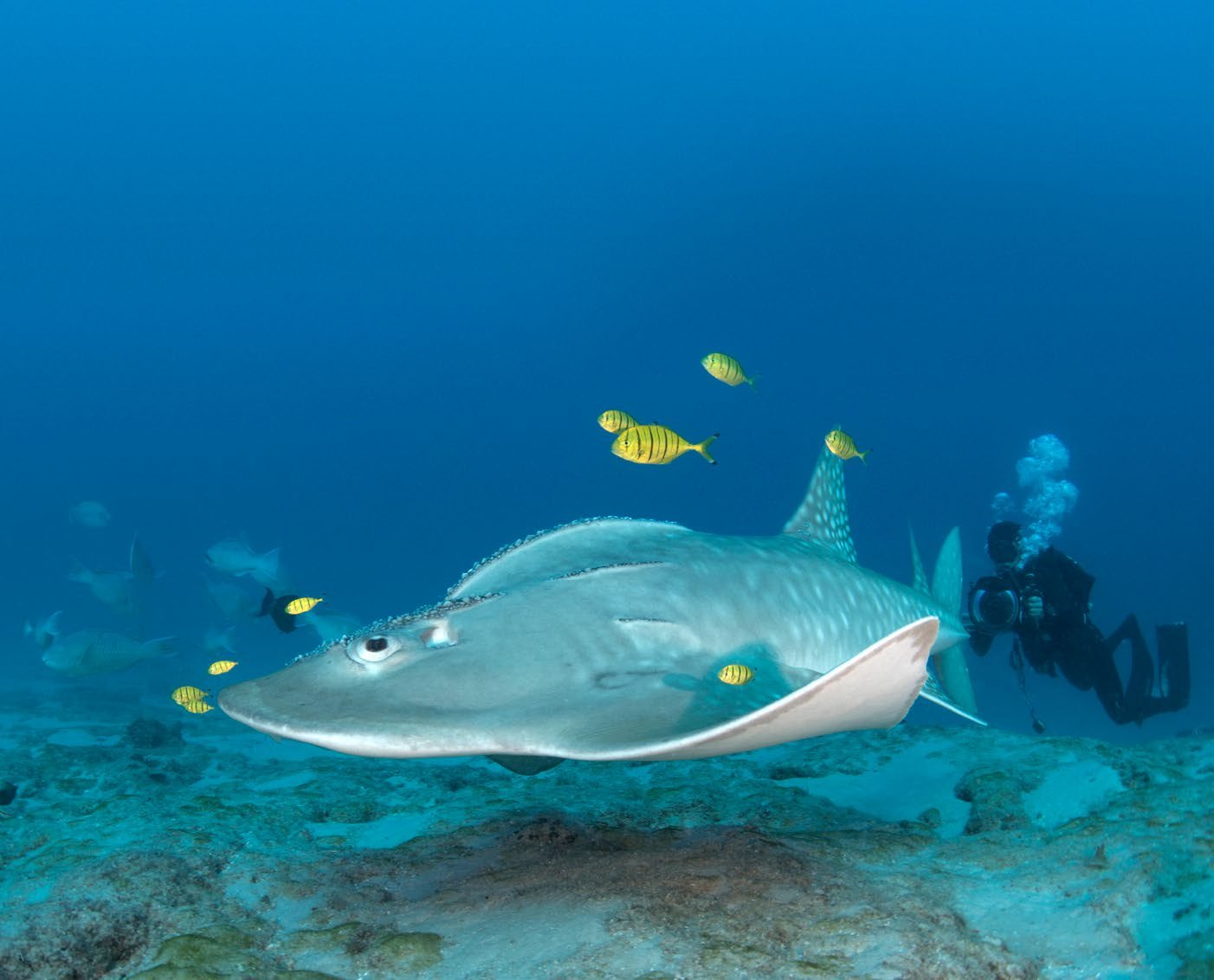
Janneman filming a sharkray, with accompanying golden trevally.
Compounding the challenge, wedgefish are also really shy. That makes them tricky to work with. They’re not like manta rays or whale sharks, which are pretty accommodating. These guys swim fast, and they don’t like being approached by divers. We’ve gotten good now at stalking across the bottom to get close to them while they’re cleaning. If I control my bubbles and inch my way across the sand, I can get a bit closer and have a look at them.
As I said before, the taxonomy of this group has not been fully resolved, so an important starting point was to collect genetic samples, by sneaking close to the wedgefish to get a little skin sample. I thought that, if that worked, it would give us hope that we could proceed to in-water tagging. It did work, but it was really hard. We were able to do it though, and we deployed some external acoustic tags on sharkrays. It was really exciting to tag them but, overall, we could see it was going to be difficult.
They can also get really cheeky. I remember talking to someone from an aquarium once, years ago, who told us that their sharkrays would headbutt them if they didn’t get fed first. We’ve seen something similar over here, in the wild. Not just the sharkrays, but the wedgefish too, they’ll actually charge us. That can be pretty intimidating. Even my husband, who’s well over six feet tall, got smashed into the reef by one. He was busy filming, and this wedgefish decided to ram him straight into a coral head. They’re a species to be reckoned with, for sure. The name rhino ray really does suit them.
Developing research techniques
With wedgefish being so difficult to work with, it’s not surprising that there’s been little field research done with the group previously. As we worked to develop the project, we realized that – while I knew we could do it – it was going to be really hard to work with them underwater. It would just take a really long time. And these animals don’t have a long time. I don’t want to take the next 15 years to tag the animals; we want to have some solid results in 2–3 years, not decades from now.
We had to have a conversation about strategy. MMF has generally focused on in-water research, as species like manta rays and whale sharks lend themselves well to external tagging. ‘Fishing science’, where we catch the animal and use internal tags, is a big departure from that previous work, and I’m not much of a fisher myself. But we thought that, if we’re going to make this work, we should try it. There are big advantages to that approach, too. When you catch an animal, you can use internal tags in the body cavity, which have a much longer lifespan, and collect blood samples and other data.
So I thought, well, we’re gonna have to learn how to fish. I was really intimidated by that though, so we were super excited to be able to collaborate with Dr. Ryan Daly and Dr. JD Filmalter from South Africa, who are both incredible fishing scientists and very good friends. They came up to Bazaruto and gave us some lessons on how to catch these animals and work with them.
We started with beach fishing, like the South African anglers do. I was surprised to find that wedgefish are reasonably easy to hook. There’s specific bait that you can use, and specific places you can go. But the thing is, they fight really hard, and really, fishing for science, we don’t want the animal to exert itself. I want to get things done as fast as possible. I didn’t want to release them in an exhausted state. So we did catch a couple, so we could investigate that method, but I still thought – there’s got to be a better way.
Fishing is also hard, by the way. It’s not easy. I mean, we’re diving all day, then the fishing was mostly at night. We were going to fish at 10 pm, getting home at 3 am. And I’m thinking, stuff this, this is not a solid life choice. I just wanted to be underwater. And the guys were encouraging, “You’re doing a great job, carry on”. But I was determined to figure out how to get back underwater. Ryan and Janneman were thinking about it, and Ryan said, “you know, you could probably hook them underwater.” And it piqued our interest.
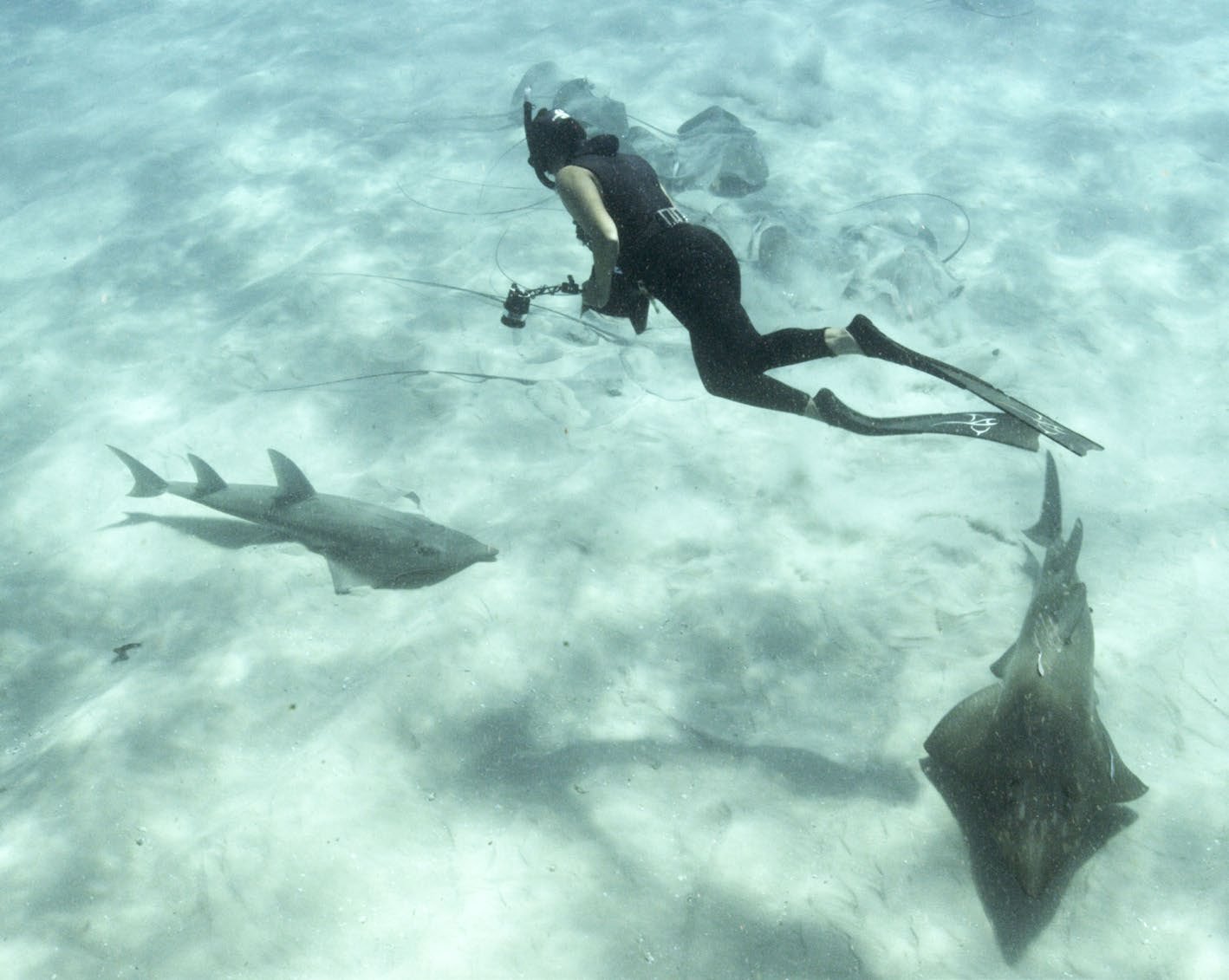
Andrea photo-identifying wedgefish.
We decided that we’d create this really long pole with a little hook on the end of it. We’d go down to the dive site, sneak up on the wedgefish, and hook them in the front part of their pectoral fin. When we found a wedgefish, though, we could be very choosy about which individual we actually caught. When you’re fishing, you can put their favorite bait on the end of a hook, but you don’t know what you’ll catch. If you’re targeting large rays, you may catch a lot of small ones before you get that large one. If you’re targeting females, you don’t know what sex you’re going to get. Whereas when you’re in water, you can select the individual that you want, and that’s exactly what we’re going for. We really want to select very specific sized individuals, and to have similar numbers of males and females in the study.
I actually found it to be so much better than fishing for the animals. Once they realized they weren’t getting away, they relaxed, and we were able to put them into tonic immobility really quickly. We could bring them straight up to the boat, then we could either do quick surgery to implant an acoustic tag or affix a satellite tag on their dorsal fin. In less than 10 minutes, they’re back doing their thing where we’d caught them. Because we’re set up to dive, we could check how they recovered following release, watch them swim away, and feel really good about it.
I’m really excited that we worked through the options and arrived at the technique that I feel most comfortable with. I think some people assume that biologists just whack tags on, that we’re just interested in data. And that’s not true at all. I think, especially at MMF, we care really deeply about these animals. It’s incredibly important to learn, to try different techniques, and try different equipment, until we feel most comfortable with how we’re tagging these animals.
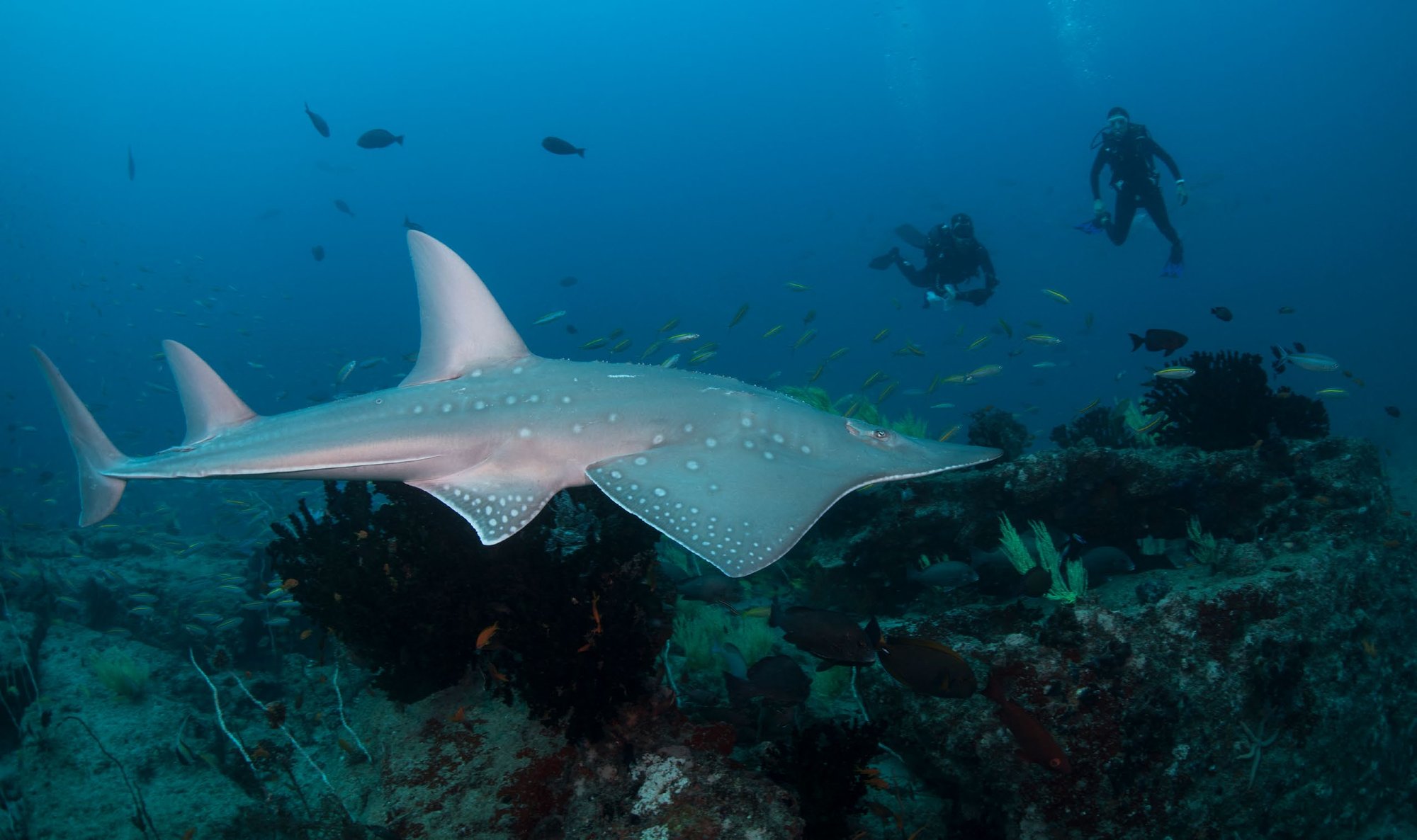
Wedgefish and divers on a deeper reef.
The importance of Mozambique
We’re getting amazing data back from the acoustic tags already, which shows that we’re placing the receivers in the right areas. We’ve obviously identified critical habitats, because we’re seeing really high residency. The animals are using those areas a lot. That said, there’s also a lot of movement between the different habitats and areas that we’ve identified. We won’t have covered their whole home range with our listening station array, of course, so we can get to work filling in those gaps over time.
That’s where the satellite tags come in – as we get those results back, it might show us that another area along the coast is important to them, so we can focus more research there. Telemetry really opens up the door. It gives us much more information. I’m really pleased with how it’s going, even though the project has only been underway for about two years now.
Going forward, we can monitor these areas over long periods of time, and use that information for management. Some of the critical habitats that we’ve identified actually sit just outside the boundary of the protected areas, parks, and sanctuaries that we’re working with. That provides great justification for extending those boundaries out to cover these habitats, so the managers are really excited to see the new data pouring in.
We’re documenting these reefs and other habitats that are obviously important for the rhino rays, including important cleaning stations and aggregation areas. I think that we’re starting to identify the pathways that a lot of these megafauna species are using to move between these areas, too. I think those are going to be equally as important. We have to protect the animals as they’re swimming from site to site, not just point A and point B. Some of these migratory pathways can look like open, seemingly barren open ocean areas. I think that, in the next couple of decades, we’re going to learn that we’ve been overlooking a lot of important movement corridors.
Rhino rays are really good ambassadors for all these habitats that have been overlooked by a lot of scientists and managers, largely because they’re so hard to work in. We have really good habitat diversity in Mozambique, lots of sandy bays, flats, tidal zones, and mangroves, that the wedgefish like to live in. We do have dugongs in Mozambique, but they’re now found in a very limited area, and we haven’t really had another charismatic poster species for these important habitats, like seagrass beds, that can help to justify their protection.
It seems from our preliminary work that wedgefish, especially the juveniles, spend a lot of time in seagrass beds. Because these fish are Critically Endangered, that provides us with a clear rationale for pushing for more protection for their habitats. That’s really good news for all the animals that share these areas.
I’m going to go out on a limb and say that I think that Southern Africa is going to turn out to be a global hotspot for rhino rays. Not just in terms of the numbers that we have, but because of the species diversity here. We’re only just getting started with this work, and I’m very proud to be helping to drive that forward with our field research in Mozambique. I think we’re going to really help tell the story of African wedgefishes over the next 5–10 years.
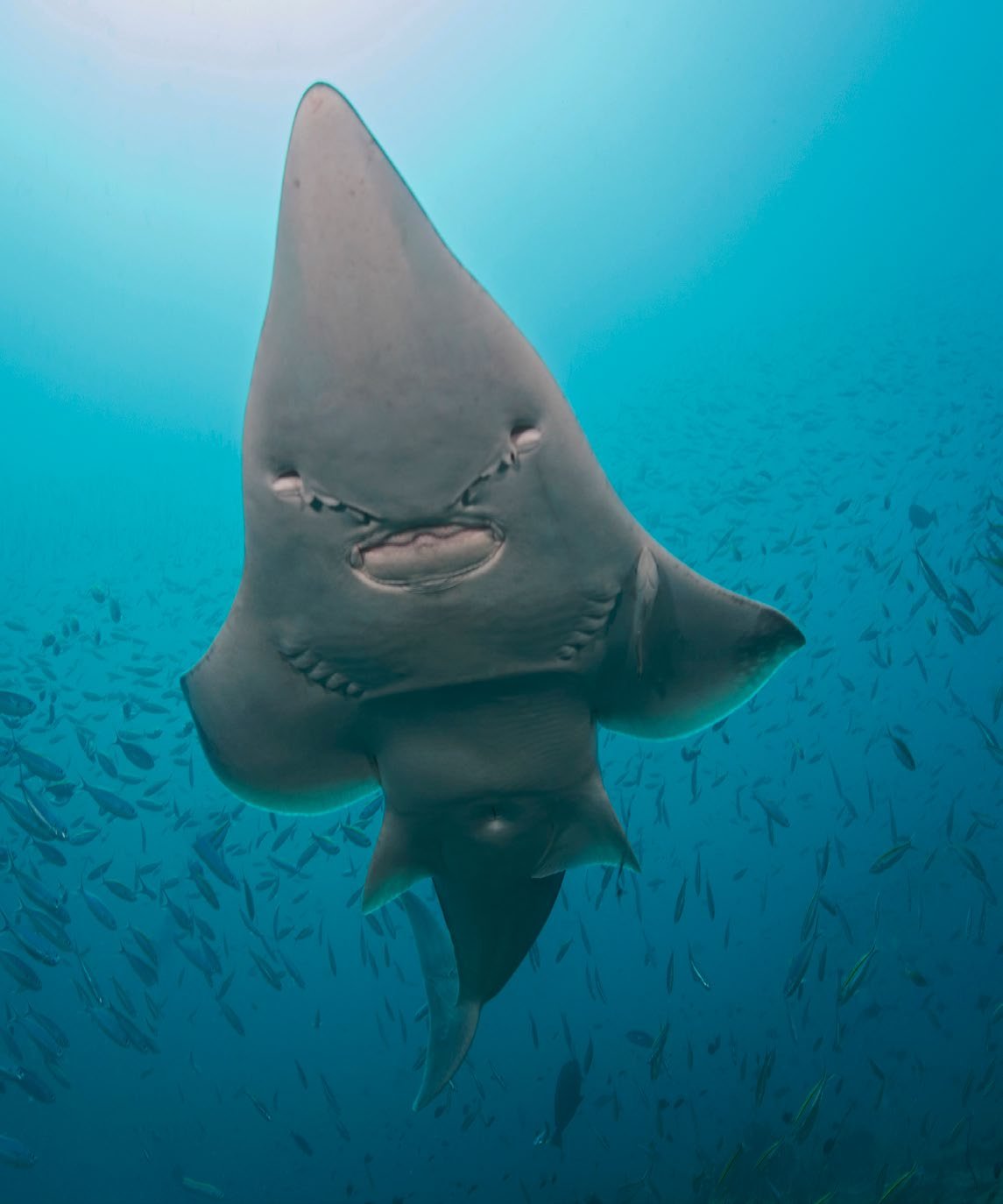
Wedgefish swimming overhead.
This article was originally published in Ocean Giants, MMF’s magazine, Issue #05 (Summer 2022). Download the full issue as a PDF. Read more about this work on our rhino rays project page.