
Two spotted whiprays in the Southwest Indian Ocean look so alike that they are often mistaken for each other. A new study of their DNA adds evidence that they are separate species, and gives researchers a new DNA reference for telling them apart.
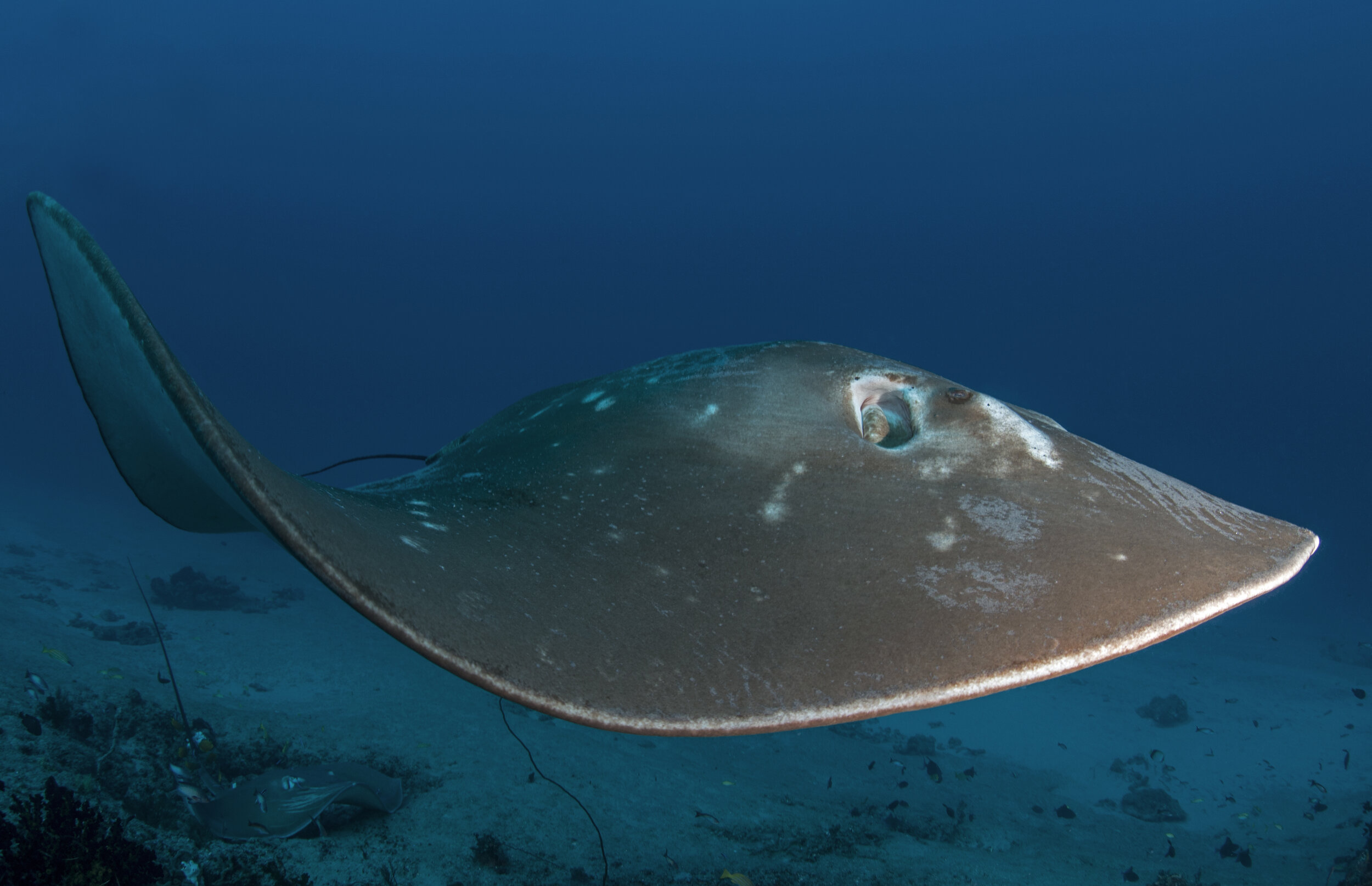
A smalleye stingray in Mozambique’s Bazaruto Archipelago National Park. It belongs to the same family of stingrays as the whiprays in this study.
Why names matter
The leopard whipray (Himantura leoparda) and the reticulate whipray (Himantura uarnak) are bottom-dwelling stingrays of tropical and subtropical coasts. Like many rays, whiprays grow slowly, mature late, and have few young, so they recover slowly from fishing. Several whipray species are listed as Endangered on the IUCN Red List, which assesses species’ extinction risk.
Because the two species are so similar, they are frequently misidentified. That matters for conservation: assessing a population, or setting rules to protect it, depends on knowing which species is being counted.
A mitochondrial genome is a small set of DNA that an animal inherits from its mother. Researchers compare it between animals to work out how closely related they are. Until now, a complete mitochondrial genome was available for just one whipray in this group (the genus Himantura): a leopard whipray from outside the region.
What the team found
The new study, published in Mitochondrial DNA Part A, was led by Karla Redelinghuys of Stellenbosch University in South Africa. Its co-authors include Rhett Bennett of the Wildlife Conservation Society and MMF’s Dr. Andrea Marshall and Senior Scientist Dr. Stephanie Venables. MMF contributed tissue samples from whiprays in Mozambique, alongside samples from South Africa and Tanzania.
The team read the mitochondrial DNA of six whiprays, three of each species, and combined each species’ three samples into a complete reference sequence. The reticulate whipray sequence is the first ever published for that species. The researchers then compared the six rays with published mitochondrial DNA from dozens of other stingray species. The two whiprays formed clearly separate branches of the family tree. That supports recognizing them as two distinct species in the region, despite their similar appearance. The region’s leopard whiprays were most closely related to the leopard whipray sequenced elsewhere in the Indian and Pacific oceans, though the results suggest the two populations have been drifting apart genetically.
What it means for conservation
The authors conclude that until there is a reliable way to tell these rays apart by eye, conservation and fisheries monitoring should not rely on appearance alone. Identifications should be confirmed with DNA checks, particularly where both species are caught together. The new reference sequences give researchers a way to do that, and a foundation for future studies of whipray populations in the Southwest Indian Ocean.
This work was supported by the National Research Foundation of South Africa and the Wildlife Conservation Society. Read the full study. Learn more about our shark and ray research in Mozambique, or make a donation to support new research on the region’s rays.