
Remoras are famous for riding on the outside of manta rays. A new study shows they sometimes ride on the inside, too: researchers have recorded remoras tucked into the cloacas of all three manta ray species.
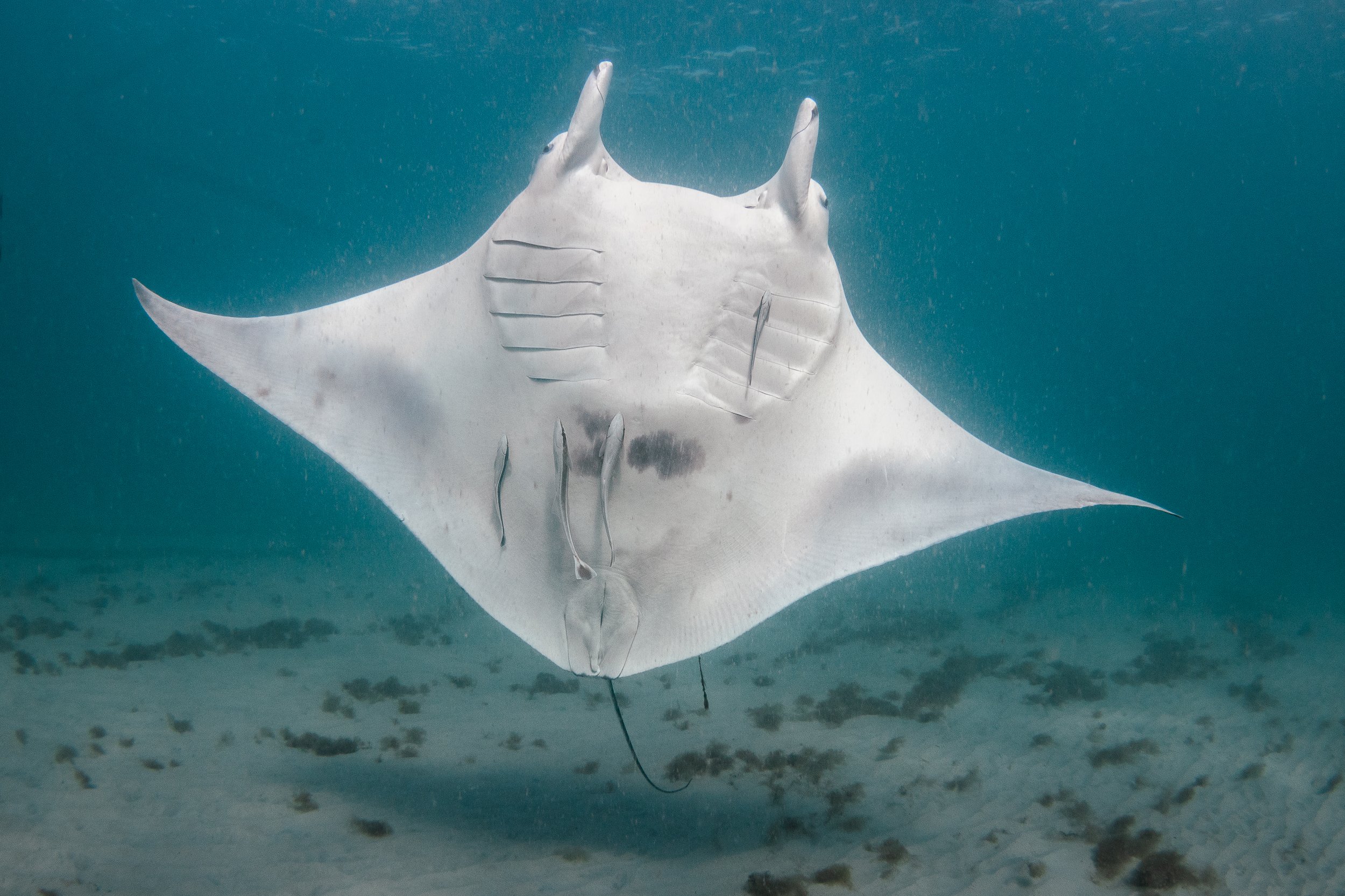
Remoras riding on the underside of Skye, a juvenile male manta ray from south Florida. Photo: Bryant Turffs
A hitchhiker with a hiding place
Remoras are fish that hitch rides on larger marine animals, such as sharks, whales, turtles, and rays. A disc on top of the fish works like a suction cup. It holds the remora onto the animal carrying it, known as its host. Some remoras clean parasites off their hosts, and they also eat food scraps and feces. But a remora can injure its host. It can also add water resistance, or drag, making the host work harder to move through the water.
Sometimes these passengers turn up inside their hosts. A manta uses its cloacal opening for mating, giving birth, and passing waste. Remoras had already been seen entering the gill openings and cloacas of whale sharks. One earlier study also recorded a white suckerfish, a type of remora, entering a reef manta ray’s cloaca.
The new study, published in Ecology and Evolution, brings together observations of remoras inside their hosts’ cloacal and gill openings. The authors describe it as the largest set of such observations so far.
Seven sightings in 15 years
The study was led by Emily Yeager of the University of Miami’s Rosenstiel School of Marine, Atmospheric, and Earth Science. Her co-authors include MMF Senior Scientist and US Country Manager Jessica Pate and Bryant Turffs, of our Florida Manta Project. Guy Stevens of The Manta Trust and Catherine Macdonald of the University of Miami are also co-authors. Jessica helped develop the study and led the organization of the study records. Bryant led work on the paper’s figures, which include his photos of remoras leaping out of the water alongside manta rays.
Between 2010 and 2025, MMF and The Manta Trust carried out thousands of manta ray surveys in southeast Florida, the Maldives, and Závora in Mozambique. The teams used drones and divers, some on scuba and some holding their breath. Researchers recorded a remora inside a manta’s cloaca on seven of those surveys, less than 1% of the total. Often only the tip of the remora’s tail was showing.
- Two sightings involved oceanic manta rays (Mobula birostris) in the Maldives in 2010, recorded by The Manta Trust.
- Two involved reef manta rays (Mobula alfredi) at Závora, Mozambique, in 2017, recorded by MMF.
- Three involved Atlantic manta rays (Mobula yarae) off southeast Florida between 2021 and 2025, recorded by our Florida Manta Project in a known nursery area for young mantas.
Together, the sightings cover all three known manta ray species, young and adult rays, and both the Atlantic and Indian oceans.
Caught on camera
One Florida sighting was caught on video. On July 13, 2023, a freediver approached an adult Atlantic manta ray from behind. A medium-sized remora (Remora remora) was near the small fins by the manta’s tail. As the diver passed beneath the ray, the remora seemed to startle and quickly pushed itself into the cloaca. The manta briefly shuddered, then swam on with the remora still inside.
In February 2011, the team also photographed a remora lodged deep in an injured oceanic manta ray’s gill opening in the Maldives. Only its tail was visible. Several reef manta rays at Baa Atoll in the Maldives had gill injuries that remoras may have caused. Other causes, such as parasites, can’t be ruled out.
Why would a remora do that?
The authors suggest several possible reasons, none of them confirmed yet. Diving inside could be a way to hide from predators, as the startled remora in the video suggests. It could be about food, since remoras eat their hosts’ feces and the parasites that live on gills. Tucking inside could also reduce water resistance compared with riding on the outside.
There could be costs for the manta. A medium-sized remora that stayed in a cloaca for long periods could get in the way of mating, giving birth, or passing waste. Nobody yet knows how long these visits last. A manta’s gills contain complex filters, so damage to them could have lasting effects.
Our researchers have seen manta rays flick their fins and leap clear of the water, apparently to shake remoras off. The remoras can reattach quickly, and sometimes they even leap out alongside their host.
The authors conclude that the relationship can help or harm the manta, depending on the situation. In some situations, remoras may be more of a burden than scientists realized. With little more than a tail tip showing, these hidden passengers are also easy to miss, so the behavior may be more common than the records suggest.
In the news
The study was covered by The New York Times, Smithsonian Magazine, and Scientific American, among others. “Oftentimes when we think of nature, we like to put these relationships into pretty discrete boxes so we can define them easier,” Yeager told CBC Radio’s As It Happens. “But what this has taught me is that these relationships probably exist on a spectrum, just like any relationship in your life.”
You can find more coverage on our media page, or read the full paper, which is free to access.
The Florida Manta Project’s boat surveys were funded by the Kansas City Zoo and the Disney Conservation Fund. Emily Yeager’s work was supported by the Florida Sea Grant Guy Harvey Fellowship and the University of Miami’s Maytag Fellowship. To learn more about Florida’s mantas, visit our Atlantic manta ray page, or adopt a Florida manta ray to support new research on manta rays.