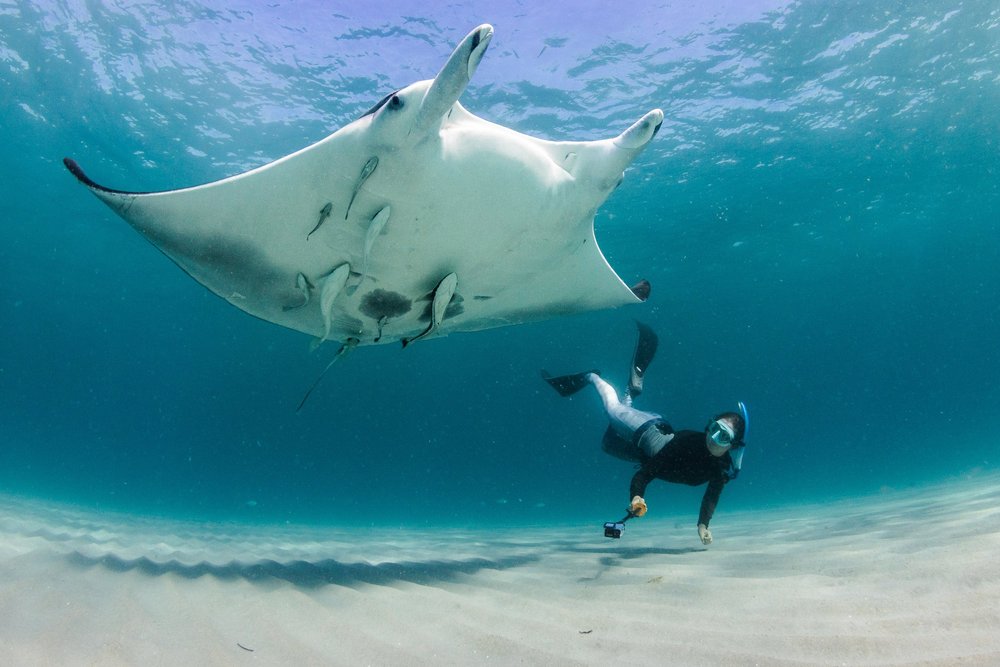
BryantTurffs.jpg)
SAVING OCEAN GIANTS.
Atlantic manta ray
Mobula yarae
Not EvaluatedThe newest manta ray: named as its own species only in 2025, from a type specimen our Florida team collected, and still missing almost every number a conservation plan needs.
Key facts
- The Atlantic manta ray was formally described in July 2025, making it the world's newest manta species. MMF co-founder Dr. Andrea Marshall and our Florida lead Jessica Pate are among the 15 authors.
- The specimen our Florida team collected is the type material for the species, and is now held at the Smithsonian Institution.
- Scientists suspected it for 16 years. Dr. Marshall flagged a probable third manta in the Atlantic in 2009, and until 2025 it was written up as "Mobula cf. birostris".
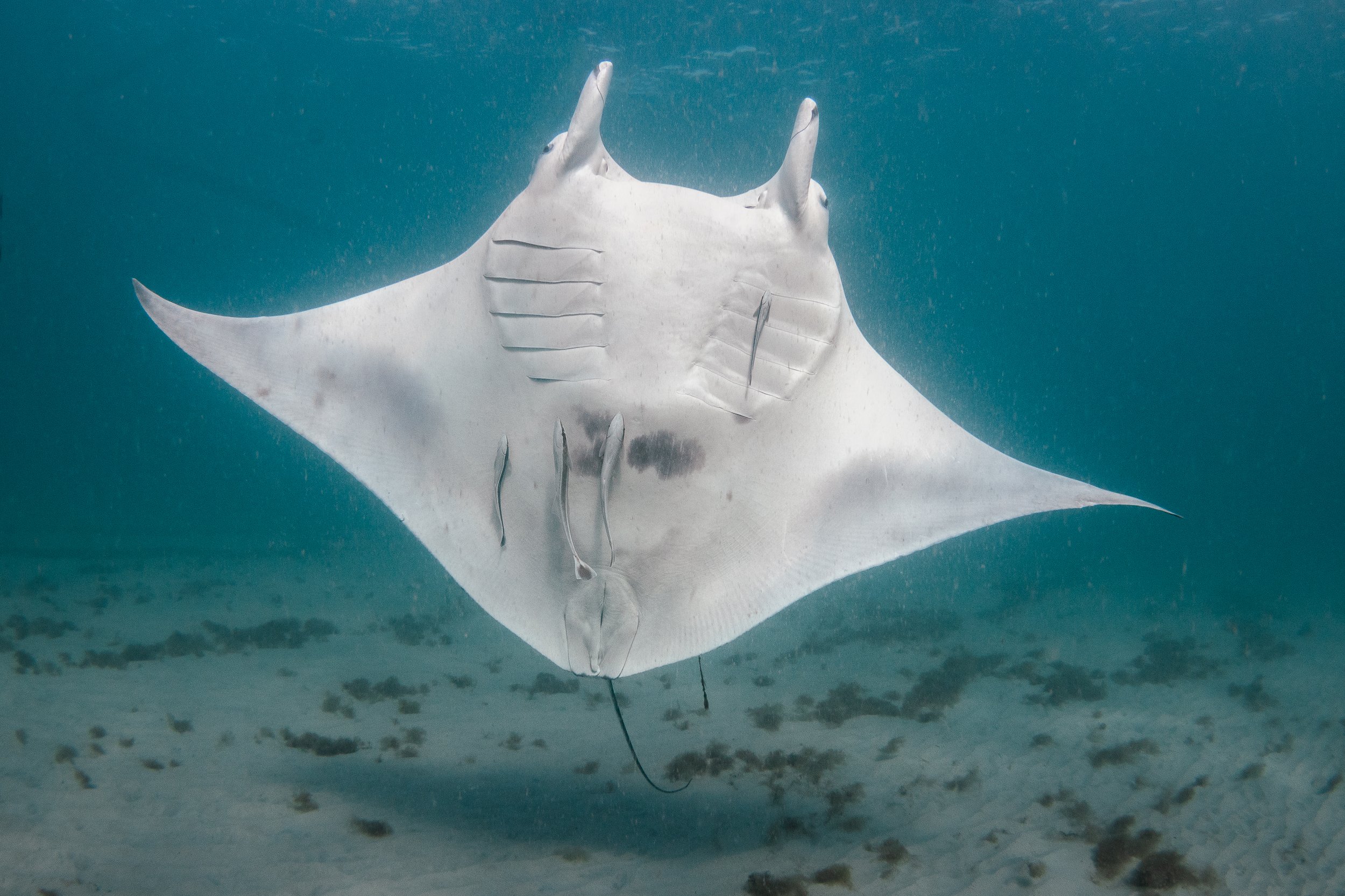
- It differs from the oceanic manta ray in its ventral spot pattern, the V-shaped patches on its shoulders, its star-shaped skin denticles, its tooth rows, and its DNA.
- It lives only in the Atlantic, from the eastern United States and the Gulf of Mexico through the Caribbean to Brazil, including estuaries and river mouths.
- Southeast Florida holds a nursery. Every male we identified there in our first study was immature, and so were 96% of the females.
- Florida's juveniles use water that is startlingly shallow, averaging 2.7 meters (9 feet) deep, over sandy bottom within sight of high-rise condominiums.
- Almost nothing is published on its life history. Size at maturity, gestation length, size at birth, and lifespan are all unknown.
- Living beside a developed coastline costs them: 27% of the mantas in our first Florida study carried fishing-line entanglement injuries, alongside propeller wounds.
- There is no IUCN Red List assessment for the species yet, and it is not itself listed under the US Endangered Species Act.
Meet the Atlantic manta ray
In July 2025 the manta rays we study in Florida became a species of their own. A team of 15 authors led by Nayara Bucair, including MMF co-founder Dr. Andrea Marshall and our Florida lead Jessica Pate, described the Atlantic manta ray, Mobula yarae, in Environmental Biology of Fishes. The specimen that anchors the description was collected by our Florida team and is now held in the Smithsonian Institution’s collection, which means the permanent physical reference for the world’s newest manta is a Florida animal. The name honors Yara, the mother of waters in Tupí-Guaraní legend.
Telling it apart from the oceanic manta ray (Mobula birostris) takes more than a glance. The description separates the two on the ventral color pattern, the V-shaped patches above the gills, the stellate (star-shaped) skin denticles with unbranched ridges, a caudal bulb carrying a residual spine, the number of tooth rows (9 to 13), and body proportions, backed by genetics. In practice the ventral spots are the working field character, and they are more variable than the first descriptions of this animal suggested.
The case built slowly. Dr. Marshall’s 2009 paper splitting reef and oceanic mantas already flagged a probable third manta in the Atlantic. Seven years later, genetic work on animals off Isla Holbox in the Yucatán found a distinct group of mitochondrial haplotypes, 0.78% divergent from the recognized manta species, diverging less than 100,000 years ago, with gene flow still running from M. birostris into it. Genome-wide markers then produced robust evidence for a new manta species in the Gulf of Mexico. For a decade and a half the animal appeared in the literature as “Mobula cf. birostris” — a placeholder that made it almost impossible to protect. Every paper on this page published before 2025 uses that name.
Where Atlantic mantas live
The species is Atlantic-only, and the description records it around oceanic islands and archipelagos as well as in coastal and estuarine waters. Confirmed and probable records run from the eastern United States and the Gulf of Mexico, through the Yucatán and the Caribbean, to Brazil.
Off the eastern United States, decades of pooled sightings and survey effort show mantas concentrating at nearshore and shelf-edge upwelling zones between about 20 and 30°C, peaking nearshore off northeastern Florida in April, moving north past Cape Hatteras from June to October, and gathering around the Mississippi River delta in spring and again in autumn. An earlier analysis of three decades of records found a strong cluster off North Carolina, Virginia, and Maryland along the edge of the Gulf Stream. Both studies were run before the split, so they mix the two manta species — untangling them is now a live research question. Further offshore, Flower Garden Banks National Marine Sanctuary in the northwestern Gulf holds a manta population in which 95% of animals measured over 25 years were smaller than the size at maturity, and includes both species.
Brazil is the southern half of the range. Mantas are seen year-round at Fernando de Noronha, where 69% of individuals were under 3 meters across and all were immature — a second possible nursery. They turn up stranded in tide pools and caught by artisanal fishers along the Amazon coast, and they breach through the summer in the Paranaguá estuary, the only estuary in the world where this behavior is known to be seasonal. Further south, nine years of diver photographs at a marine protected area off São Paulo showed manta rays arriving predictably each austral winter. A national review has since compiled 6,450 mobulid records for Brazil.
The Florida nursery
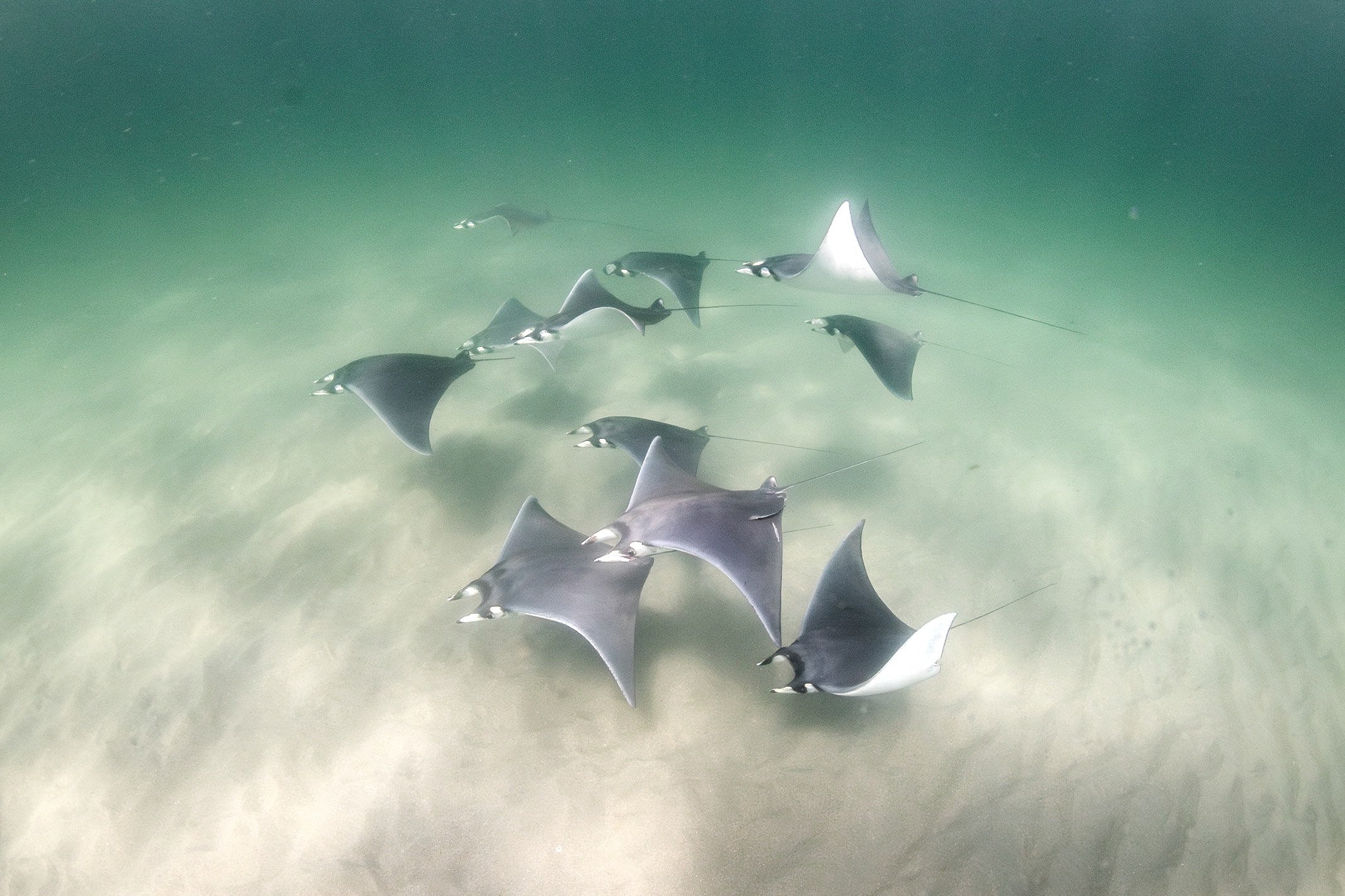
Our Florida Manta Project has surveyed this coast since 2016. The first published study of the population, covering 2016 to 2019, identified 59 individual mantas between Jupiter Inlet and Boynton Beach Inlet in Palm Beach County. Every one of the 31 males was sexually immature, and 96% of females were immature too. Twenty-five individuals (42%) were re-sighted, eight of them across multiple years. The rays were using water averaging 2.7 meters (9 feet) deep — as shallow as 0.8 meters — at around 28°C, mostly over sand. Juveniles, repeat sightings, and multi-year fidelity are the three criteria that define elasmobranch nursery habitat, and this stretch of coast meets all three. Satellite tags since then show the habitat is larger than the area we survey.
It is also one of the most developed coastlines in the United States, and the animals show it. Twenty-seven percent of those mantas carried fishing-line entanglement injuries, and propeller wounds were common, though they healed fast — some within 25 to 44 days. Most of the entanglement is accidental. We surveyed 198 shore-based anglers and found 65% did not know it is illegal to harvest a manta ray in Florida and 66% could not name a threat to them, while 82% supported manta conservation and 96% had no interest in catching one. That gap between goodwill and information is what our outreach signs and angler videos are for.
Feeding, courtship, and company
Adult Atlantic mantas gather off central Florida each spring, and that is where the first behavioral records for the species came from. Between 2021 and 2024 we documented 18 courtship events, 83% of them involving just two animals, spanning four of the recognized courtship stages, alongside breaching on almost every survey day when courtship was seen. The same paper gave the first look at what they eat at the surface: zooplankton samples dominated by copepods, with bivalve and echinoderm larvae and chaetognaths, at biomass between 23.9 and 39.6 mg per cubic meter. Courtship in this family follows a seven-stage sequence documented across eight mobulid species, which gives us a framework to compare against as more Atlantic records accumulate.
Mantas travel with company. Nine years of freediver surveys in south Florida analyzed 465 encounters and found four groups of hitchhiking fishes, most often remoras, riding mainly on the underside toward the right rear of the ray. Drone work has measured how fast the rays swim and beat their wings while traveling, feeding, and resting, including a resting behavior in which they hold station facing into inlet currents.
Reproduction and life history: what we don’t know
This is the honest gap. Size at maturity, gestation length, size at birth, how long juveniles stay in a nursery, and lifespan are all unpublished for Mobula yarae. What we can say is that mobulid rays share the lowest population growth rates of any sharks and rays — one pup at a time, long pregnancies, years between litters — so a depleted population takes decades to recover, and even modest extra mortality matters. Applying those numbers to the Atlantic manta is inference from its relatives, not measurement. Establishing them for this species is objective six of our Florida research plan.
How many are there, and how are they doing?
Nobody knows, and that is the point of the current work. There is no published population estimate for the species anywhere in its range, and no trend. There is no IUCN Red List assessment either: the oceanic manta ray is Endangered and the reef manta Vulnerable, but the Atlantic manta has not yet been assessed. Habitat modeling for the wider western central Atlantic found only 24% of predicted suitable manta habitat falls inside the regional network of marine protected areas, crossed by heavily used shipping lanes. Our Florida photo-identification catalog and aerial surveys are being built toward the first defensible abundance estimate.
Current research
Photo-identification, aerial and drone surveys, satellite and acoustic tags, direct measurement of animals rather than estimation, and zooplankton sampling all run out of the Florida Manta Project, which now works both the south Florida nursery and the central Florida adult aggregation. Four questions drive the next few years: mapping the full extent of the nursery; establishing whether M. yarae and M. birostris overlap in Florida waters and whether they interbreed, through whole-genome sequencing; connecting the Florida animals to the Gulf of Mexico, the Bahamas, and the Caribbean; and producing an abundance estimate from mark-recapture and aerial surveys corrected for the animals we cannot see. We are extending the same work into the Gulf of Mexico and the Northwest Atlantic canyons, and our Atlantic mobula ray research covers the devil rays that share this water, whose distribution across the western Atlantic and Caribbean we recently mapped. Our Hawaii oceanic manta project works on M. birostris, a different species in a different ocean — worth saying, because the two are easily mixed up.
Tourism is one finding we have acted on ourselves. Drone footage of 27 identified juveniles found that these mantas spent 37% of their time in avoidance behavior when divers were present, and none at all when divers were absent, with some individuals avoiding for 70% of an encounter. The authors concluded that this small juvenile population is not suitable for tourism development, and that shapes how we and our partners work around these animals.
Threats and protection
Boat strikes and fisheries bycatch are the two threats we document most, and both currently sit outside effective regulation in US waters. Observer coverage in the Gulf shrimp trawl fishery is minimal, and the northern Gulf purse seine fishery has none. Off central Florida, recreational anglers find cobia by looking for mantas and casting at them; interviews with experienced anglers describe a fishery that risks entangling, injuring, and disturbing mantas, driven partly by inexperienced participants, with those same anglers proposing best practices and willing to work with us. In Brazil, mobulids have been legally protected since 2013, yet a review of 270 manta records found 70 animals with injuries from human activity and 29 killed, most of them after protection came in — enforcement, not legislation, is the binding constraint. Globally, manta and devil rays are traded for gill plates and meat, with significant landings in 43 countries and gill plates fetching up to US$1,260 per kilogram, while live mantas support tourism worth an estimated US$140 million a year.
The legal position is unresolved, and the taxonomy is why. The giant manta ray, Mobula birostris, was listed as Threatened under the US Endangered Species Act in January 2018, when the Atlantic manta was not yet a named species; no critical habitat has been designated, for lack of data. In 2023 NOAA issued a technical correction updating the giant manta’s scientific name from Manta to Mobula birostris, stating explicitly that it changed no protections. The 2025 split raises a harder question that the correction did not touch: whether Florida’s mantas, now a separate species, are covered by that listing at all. Florida is one of only two US states, with Hawaii, that protect all mobulid rays in state waters. Our team attends Florida Fish and Wildlife Conservation Commission meetings and has presented directly to commissioners, and we are contributing data toward both an IUCN assessment and any future federal listing for the species. The approach is deliberate: set out the problems clearly and consistently, rather than push one regulatory fix before its legal consequences are understood.
For more on how the three manta species differ, see our manta ray facts page and the oceanic manta ray. You can support this work by adopting a Florida manta ray.
Where we study them
 Atlantic Mobula Rays
MMF's devil ray research in the western Atlantic: range extensions, the 2025 three-species distribution study, and the newly described Mobula yarae.
- The Florida Manta Project
The first dedicated study of Florida's manta rays, from a rare urban nursery for young Atlantic manta rays to a seasonal aggregation of adults off central Florida.
Publications
2026
2025
- Stability and spatial variance of Mobula yarae-associated fish aggregates in south Florida
- Using drone footage to analyze the effect of diver presence on juvenile manta ray behavior
- An integrative taxonomy investigation unravels a cryptic species of Mobula Rafinesque, 1810 (Mobulidae, Myliobatiformes), from the Atlantic Ocean
2024
In the news
259 Key Shark and Ray Habitats Mapped Across North America
September 25, 2026
Remoras Caught Hiding Inside Manta Rays
May 11, 2026