
Mexico · Global Whale Shark Program
Pacific Mexico Whale Shark Tracking
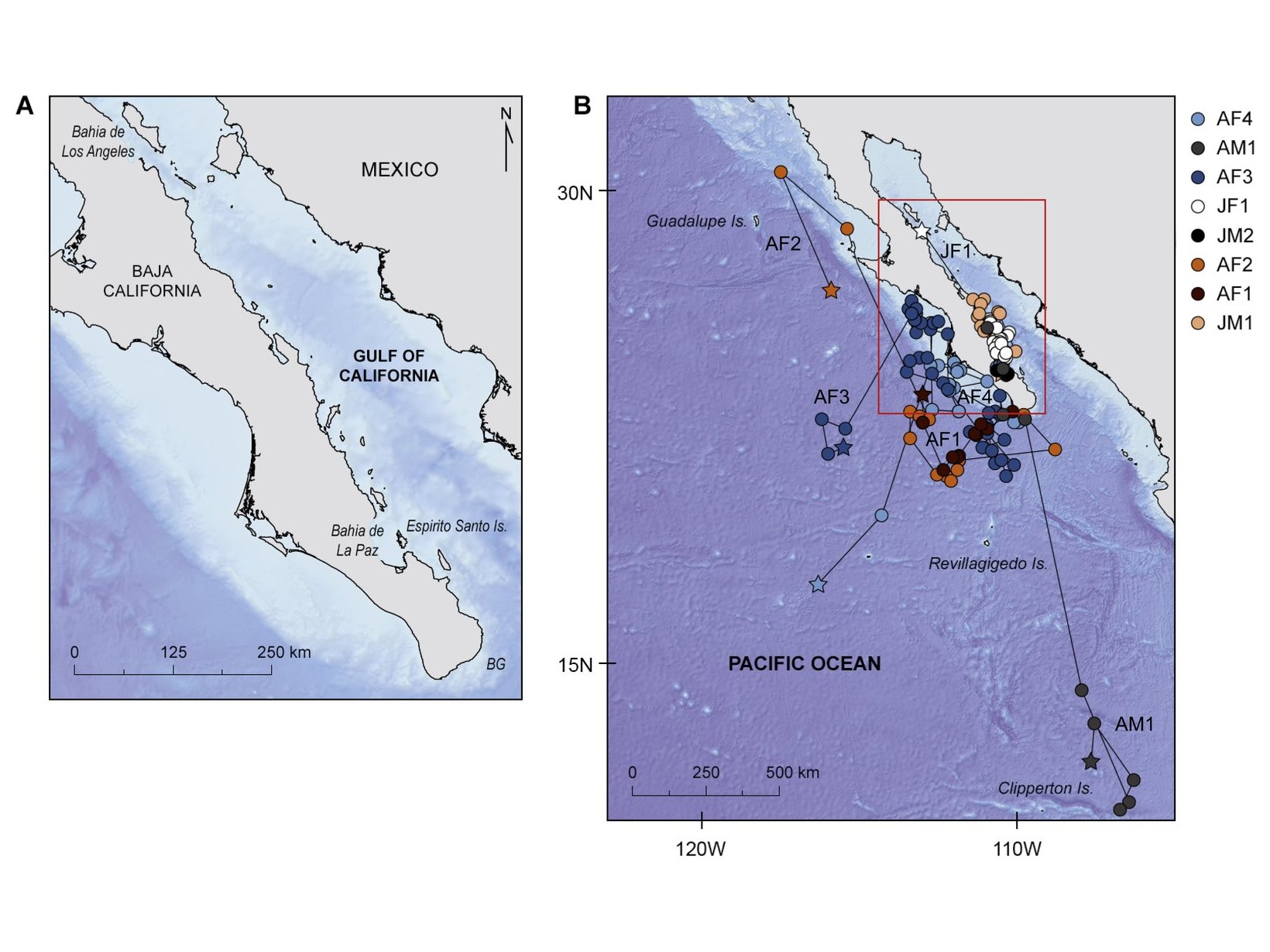
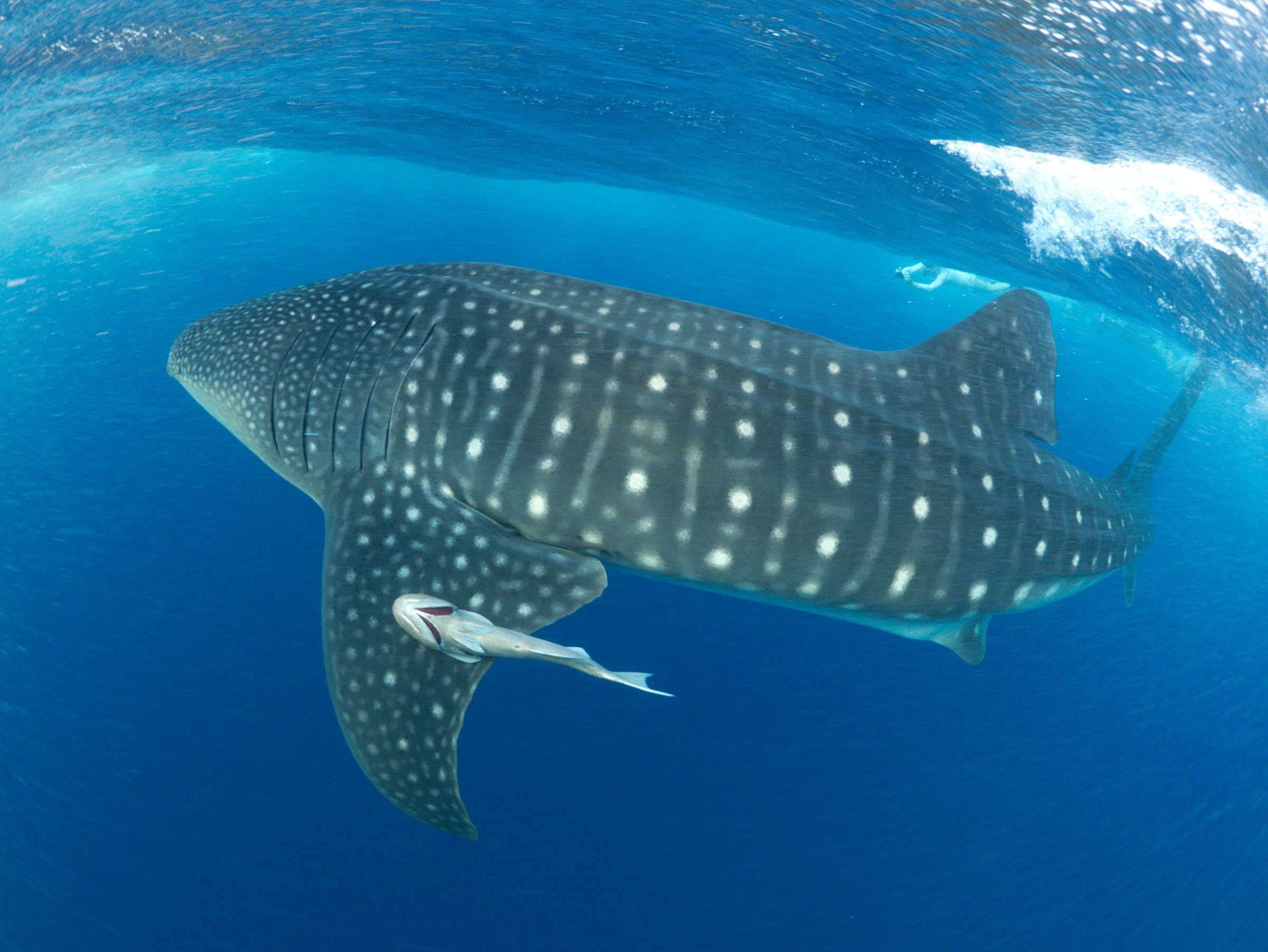
Satellite tags showed that the juvenile whale sharks tracked stayed inside the Gulf of California, while the adults, most of them apparently pregnant females, moved into the open Pacific.
Led by Whale Shark Mexico, with MMF
The Gulf of California is one of the few places where both young whale sharks (Rhincodon typus) and large adult females are seen regularly. A satellite-tracking study led by Dr. Dení Ramírez-Macías of Whale Shark Mexico, with MMF as a contributor, showed that the two groups use very different parts of the ocean.
At most coastal sites where whale sharks gather, the sharks are juveniles, and most of them are male. Adult sharks, and adult females in particular, are rarely seen, so where they live has been one of the main gaps in our knowledge of the species. In the southern Gulf of California, juveniles feed in the shallow water of Bahía de La Paz, while large females, almost all of them with the swollen abdomen that suggests pregnancy, appear seasonally over deeper water near Espíritu Santo Island and at Banco Gordo.
Between 2008 and 2012, Dr. Ramírez-Macías and her team fitted 17 of these sharks with satellite tags. MMF’s Dr. Simon Pierce contributed to the writing of the study, which was published in PeerJ in 2017 with colleagues from the Marine Biological Association of the United Kingdom and the University of Porto.
What the project has done
- Fitted 17 whale sharks, between 5 and 12 m (16 and 39 ft) long, with pop-up satellite tags; eight of the tags returned data.
- Mapped the movements and diving behavior of five adults and three juveniles.
- Photographed each shark for identification, which later confirmed where several of them were seen again.
- Published the results in PeerJ in 2017.
Support our whale shark research
This study is complete. Your gift supports our current whale shark research in Mozambique, Tanzania, Madagascar, Oman, and the Galápagos.
What the study found
Tracking sharks from the Gulf of California
Near Espíritu Santo Island, the team located adult sharks from a spotter airplane and tagged them from a small research vessel. Each tag recorded depth, temperature, and light every two minutes, and was designed to release from the shark, float to the surface, and transmit its data by satellite. Eight of the 17 tags reported. All eight detached earlier than programmed, after between 14 and 134 days, so the study describes the sharks’ movements over weeks to months and not over a full year.
Adults offshore, juveniles on the coast
The difference between the age groups was clear. The three juveniles remained inside the Gulf of California; two stayed in Bahía de La Paz, where they had been tagged, and the third swam north toward Bahía de Los Ángeles. All five adults left the Gulf soon after they were tagged and moved into the open Pacific. The four females traveled south and then north, off the west coast of the Baja California peninsula, while the only adult male swam directly south. The sharks spent more of their time along ocean fronts, the boundaries between water masses, which here were associated with the upwelling of cooler water.
One female, tagged at Banco Gordo in May 2012, was photographed six months later at Roca Partida in the Revillagigedo Islands, still apparently pregnant. Where whale sharks give birth is unknown. The authors suggest that these females may do so in the open ocean off the Gulf of California, although they note that eight tracks are too few to be certain.
Diving to the limit of the tags
Even over deep water, the six sharks that left the tagging area spent about two-thirds of their time within 6 m (20 ft) of the surface. All of them also made deep dives. Two sharks, a juvenile female and the adult male, reached the greatest depth the tags could record, 1,286 m (4,220 ft). Most dives below 200 m (660 ft) took place during the day, particularly in the early morning and late afternoon.
What it meant for protection
Combined with years of photo-identification, the tracks connected the sites these sharks use, including Bahía de La Paz, Espíritu Santo Island, Banco Gordo, Bahía de Los Ángeles, and the Revillagigedo Islands. The study recommended that the sharks’ coastal feeding areas and their offshore habitat be considered together, given the importance of this region to whale shark reproduction. Bahía de La Paz was also among the sites highlighted in a 2024 global study of shipping and whale sharks, co-authored by MMF scientists, as needing measures to reduce the risk of collisions.
MMF Project Team
 Dr. Simon Pierce
Collaborators and Partners

Recent research
- 2024Identifying priority sites for whale shark ship collision management globally
- 2023Emergent community architecture despite distinct diversity in the global whale shark (Rhincodon typus) epidermal microbiome
- 2022Global collision-risk hotspots of marine traffic and the world’s largest fish, the whale shark
- 2017Undersea constellations: The global biology of an endangered marine megavertebrate further informed through citizen science
- Oceanic adults, coastal juveniles: Tracking the habitat use of whale sharks off the Pacific coast of Mexico
 Yucatan Whale Shark Research
 Galapagos Whale Shark Project
 Utila Whale Shark Project