
Honduras · Global Whale Shark Program
Utila Whale Shark Project
Twelve years of photographs identified 95 whale sharks at Utila and showed that they belong to a single population that ranges across the western Caribbean.
Led by Utila Whale Shark Research, with MMF
Utila, at the southern end of the Mesoamerican Barrier Reef, is one of the few places in the Caribbean where whale sharks (Rhincodon typus) can be seen in any month of the year. Working with Utila Whale Shark Research and regional partners, we documented the identity and movements of these sharks.
Utila is a small island 30 km (19 miles) off the Honduran mainland, close to the edge of the continental shelf; the seabed drops to 1,000 m (3,300 ft) just 6 km (4 miles) off its north coast. Between 2011 and 2013, Dr. Simon Pierce spent six weeks on the island running whale shark research weeks with Deep Blue Resort and helping Steve Fox of Utila Whale Shark Research analyze more than a decade of sightings. That work was published in 2013 and contributed to two larger studies of whale shark movements across the western Atlantic and around the world.
What the project has done
- Analyzed 479 whale shark sightings at Utila between 1999 and 2011 and identified 95 individual sharks from their spot patterns, publishing the results in the Journal of Fish Biology in 2013.
- Estimated the sharks’ residency at Utila and how often they return.
- Contributed Utila’s sightings to a 2017 study of whale shark connectivity across the western Atlantic, and to a 2017 global study of whale shark biology built from citizen science photographs.
Support our whale shark research
This study is complete. Your gift supports our current whale shark research in Mozambique, Tanzania, Madagascar, Oman, and the Galápagos.
What the study found
Size, sex, and seasonality
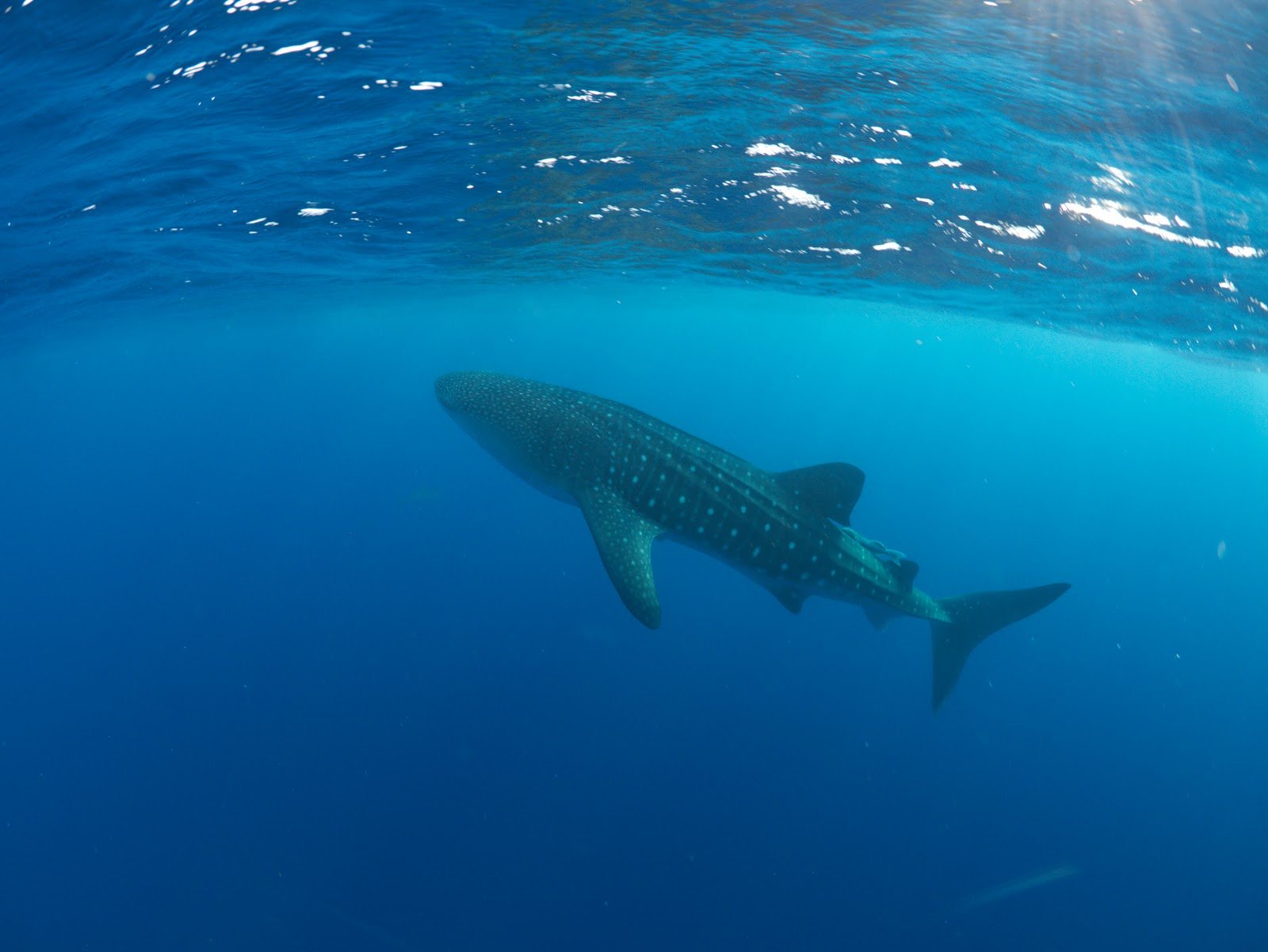
During boat surveys around the island, snorkelers photographed each shark’s left flank and recorded its sex, and each shark’s length was estimated. Of the 95 sharks identified, 65% of those whose sex could be determined were male. They ranged from 2 to 11 m (7 to 36 ft) long, and most were juveniles. Sharks were seen in every month, with a peak in March and April; however, there was no clearly defined season, and numbers varied considerably from year to year. Three sharks carried large propeller scars.
Feeding at tuna boils
Utila’s whale sharks are not usually feeding on plankton. Instead, most were found at “boils” of blackfin tuna, where the tuna drive small baitfish to the surface. The whale sharks either hang vertically below the boil, suction-feeding on the fish, or swim through it with their mouths open. Up to three sharks fed at a single boil, alongside silky sharks, mobula rays, dolphins, and seabirds. Boat crews locate the boils by watching for jumping tuna and circling terns and boobies.
Residency and return
Most sharks were transient: 78% were seen in only one year. Our model suggests that about four or five sharks were present around Utila at any one time, each remaining for about 12 days before departing for about three months. Some returned year after year, and one male was photographed again seven years after it was first seen.
One population across the western Caribbean
The 2017 western Atlantic study combined more than 4,000 encounters from Mexico, Belize, Honduras, the United States, and elsewhere. Movements were most frequent between Honduras and Belize and between Honduras and Mexico, and sharks seen in Honduras or Belize in spring were often seen in Mexico a few months later. Two sharks traveled 1,600 km (1,000 miles) or more between Honduras or Belize and the US Gulf coast. One shark first cataloged at Utila was recorded in four countries over 14 years. The 2013 paper recommended that Honduras, Belize, and Mexico manage these sharks as a single population, and suggested limiting the speed and access of large vessels where the sharks feed, along with a code of conduct for whale shark tourism.
MMF Project Team
 Dr. Simon Pierce
Collaborators and Partners


Recent research
- 2017Undersea constellations: The global biology of an endangered marine megavertebrate further informed through citizen science
- Long-term assessment of whale shark population demography and connectivity using photo-identification in the Western Atlantic Ocean
- 2013Population structure and residency of whale sharks Rhincodon typus at Utila, Bay Islands, Honduras
 Coral Sea Whale Shark Project
 Galapagos Whale Shark Project
 Madagascar Whale Shark Project
 Microplastics & Megafauna