
About 30% of the reef manta rays tracked in a new study crossed the border between Mozambique and South Africa. One traveled roughly 950 kilometers (590 miles) along the coast in four months.
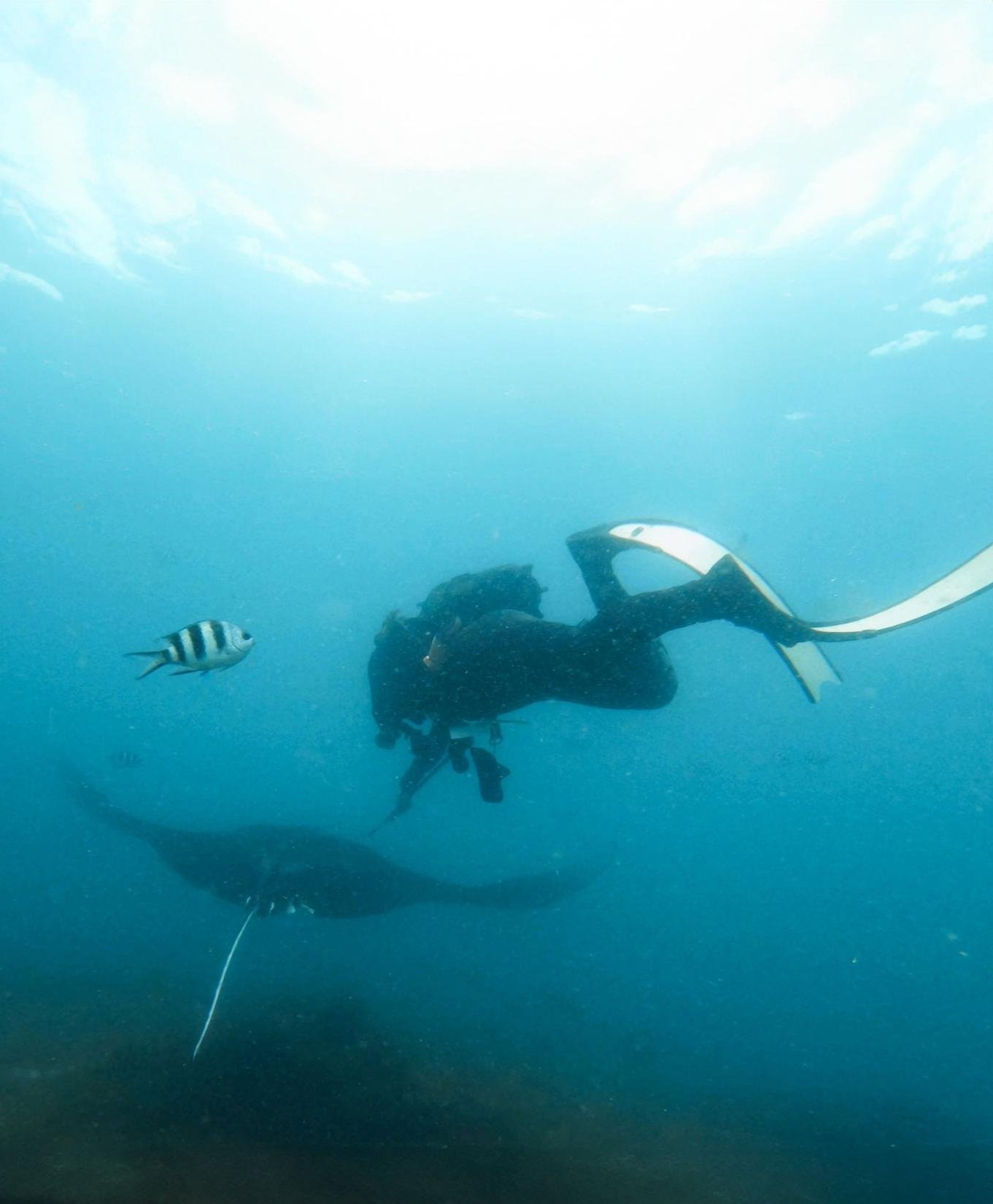
Dr. Nakia Cullain tagging a manta ray.
Listening for manta rays
Reef manta rays (Mobula alfredi) are listed as Vulnerable on the IUCN Red List. Sightings at the main sites where they gather in southern Mozambique have fallen sharply over the past two decades. Protecting them depends on knowing where they go.
The new study, published in Endangered Species Research, was led by MMF Senior Scientist Dr. Nakia Cullain as part of her PhD at Dalhousie University in Canada. MMF co-authors include Dr. Stephanie Venables, Dr. Christoph Rohner, Edward Bevan, Emily Eaton, and Nilza de Catarina. They worked with partners from the Oceanographic Research Institute, the South African Institute for Aquatic Biodiversity, Shark Spotters, the University of Cape Town, and Dalhousie University.
Between May 2022 and November 2024, the team fitted 48 reef manta rays with small acoustic tags, which send out sound signals. They tagged rays at two sites: the iSimangaliso Wetland Park in South Africa and Závora in Mozambique. Each tag sends out a unique code, and underwater receivers record it when a tagged ray swims within range. A network of 162 receivers, stretching from Plettenberg Bay in South Africa to the Bazaruto Archipelago in Mozambique, listened for the rays until August 2025. The Acoustic Tracking Array Platform runs the South African receivers and those in Mozambique’s Maputo National Park, and MMF maintains the rest of the Mozambican receivers. Together they produced the first tracking data set to follow this population across both countries.
Long journeys and return trips
Of the 46 rays with enough data to analyze, 14 crossed the border at least once. Eight rays tagged in iSimangaliso made repeated round trips to Ponta do Ouro, just across the border in Mozambique. One ray traveled from Durban to Morrungulo in Mozambique, about 950 kilometers (590 miles), within four months. Another, tagged at Závora, swam to iSimangaliso and back, a round trip of about 1,100 kilometers (680 miles), in just over a month.
Most rays were only ever detected in the country where they were tagged: 65% of those tagged in South Africa and 80% of those tagged in Mozambique. The South African rays spent much of their time in the iSimangaliso Wetland Park, especially its offshore wilderness zone, where there is no fishing, boat traffic, or recreational diving. In both countries, the rays were detected most often during the southern winter, from about May to September.
A gap in protection
The tracking showed a clear contrast between the two countries. In South Africa, 95% of the rays detected were picked up inside marine protected areas. In Mozambique, 90% were detected outside them, at largely unprotected sites such as Závora, Tofo, and Morrungulo. The authors caution that where the rays were tagged likely shaped part of that difference. A ray can also be inside a protected area without passing close enough to a receiver to be detected. Even so, there is a clear gap: Mozambique has a long stretch of coast between Maputo National Park and the protected areas around the Bazaruto Archipelago with no marine protected areas.
The rays’ heavy use of iSimangaliso suggests they may benefit from its strict protection, and the authors suggest the park could serve as a model elsewhere in South Africa and Mozambique. They recommend protecting key gathering sites such as Závora and Tofo, and considering seasonal closures at the busiest sites during the winter peak. They also call for joint monitoring between the two countries, and for bringing reef manta rays into existing cross-border agreements such as the Ponta do Ouro–Kosi Bay Transfrontier Marine Protected Area. Two recent designations give that cooperation a strong starting point. The iSimangaliso Wetland Park and Maputo National Park now share a joint UNESCO World Heritage listing, and the Thongaland Transboundary Corridor is recognized as an Important Shark and Ray Area.
This work was supported by Milkywire, the Pure Ocean Fund, the Ocean Tracking Network, and the Acoustic Tracking Array Platform. Financial support came from the Natural Sciences and Engineering Research Council of Canada and the Jarislowsky Foundation.
Read the study, learn about our manta ray research in Mozambique and the reef manta ray, or adopt a manta ray to support new research on manta rays.