
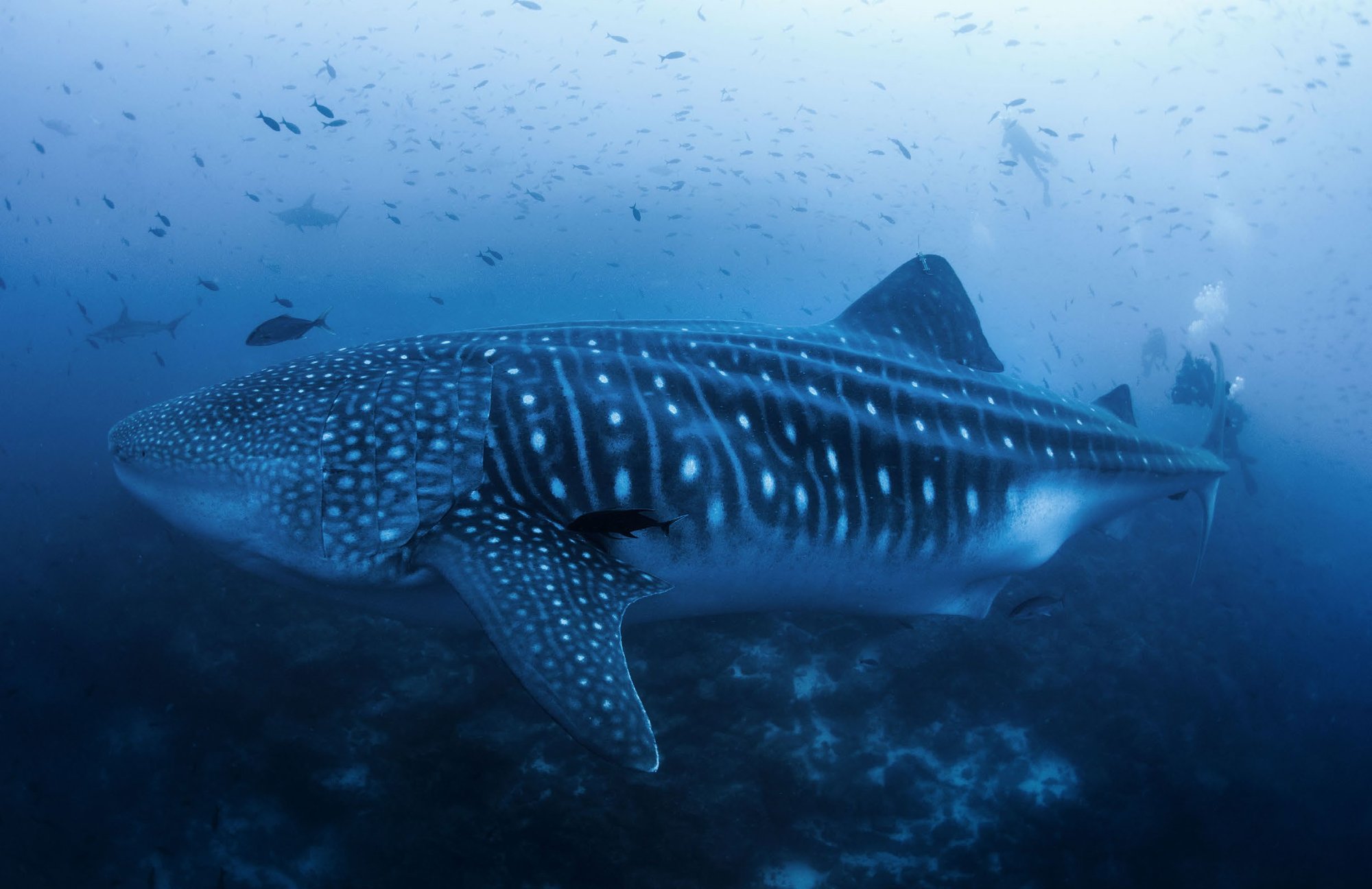
A satellite-tagged whale shark in the Galapagos Islands.
By Dr Simon Pierce
Writing a textbook on whale sharks gave me plenty of time to reflect on all that we know – and don’t know – about the world’s largest fish. I thought it’d be fun to share some of the mysteries that still remain!
Whale sharks are awesome. They grow from 50 cm at birth to become the largest fish that has ever lived. They dive to at least 1900 m. They swim over 10,000 km a year, often without approaching a coast. And they manage all this with a big goofy grin and a general ‘oceanic Labrador’ vibe. These gigantic spotted himbos really are quite endearing.
I fell in love with whale sharks the first time I got to work with them, way back in 2005. At that stage, little was known about their lives and habits. We’ve learned a lot more in the years since (cue sound of our 340-page textbook thumping on the table), but some interesting mysteries still remain. Journey with me, gentle reader, as we travel into these uncharted waters…
We’ve only found part of the population
Whale sharks were only discovered by Western scientists in 1828. Until the 1980s, there had only been a few hundred reported encounters with the species. Even Jacques Cousteau only ever saw two. We know now that the key is finding places with high densities of their preferred prey, zooplankton and small fishes. Whale sharks have permanent munchies. In some areas, like off the Yucatan coast of Mexico, several hundred sharks can be seen feeding at once, gathering in sharky constellations to exploit mass tuna spawning behavior.
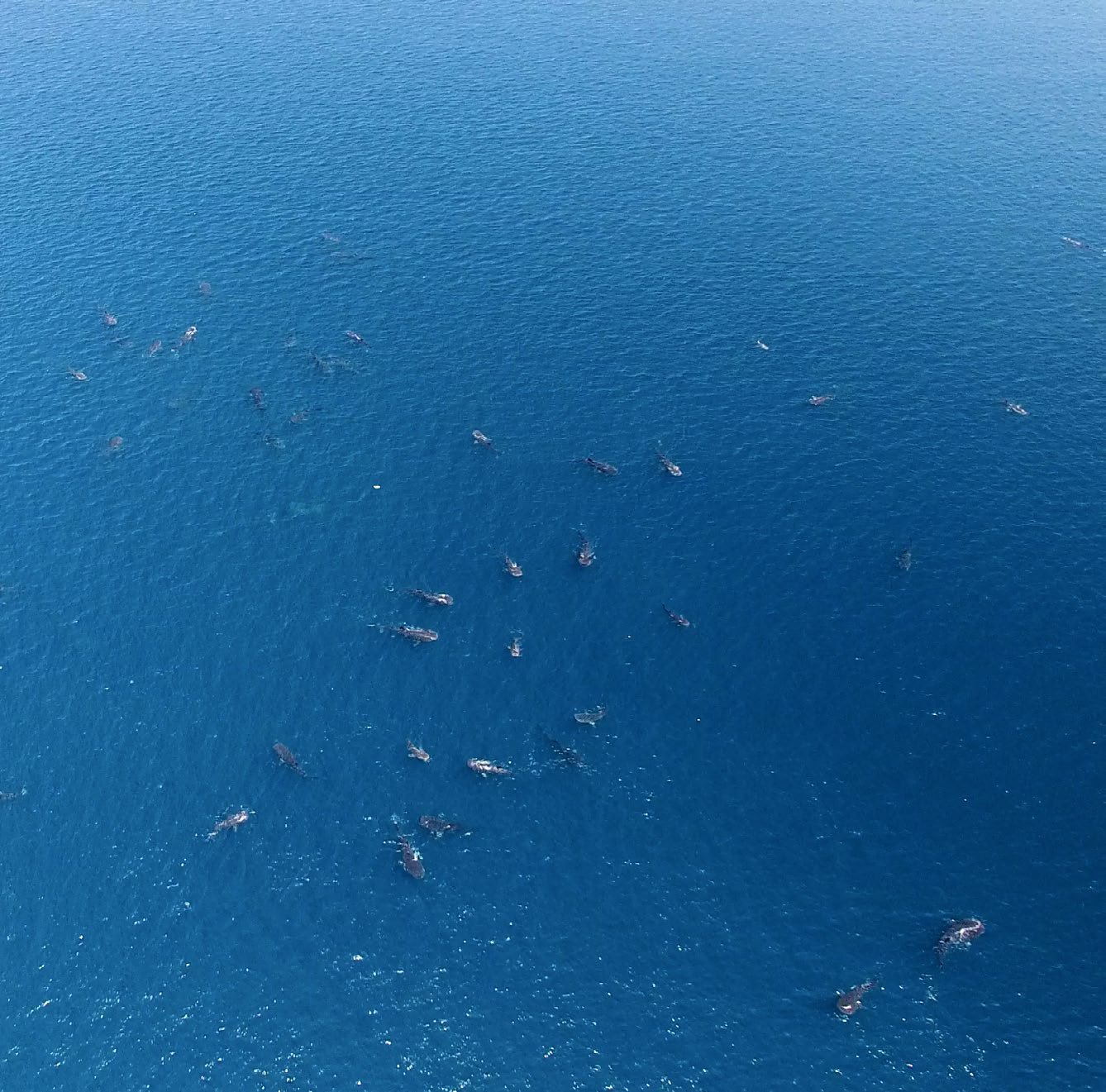
Whale shark aggregation off Qatar.
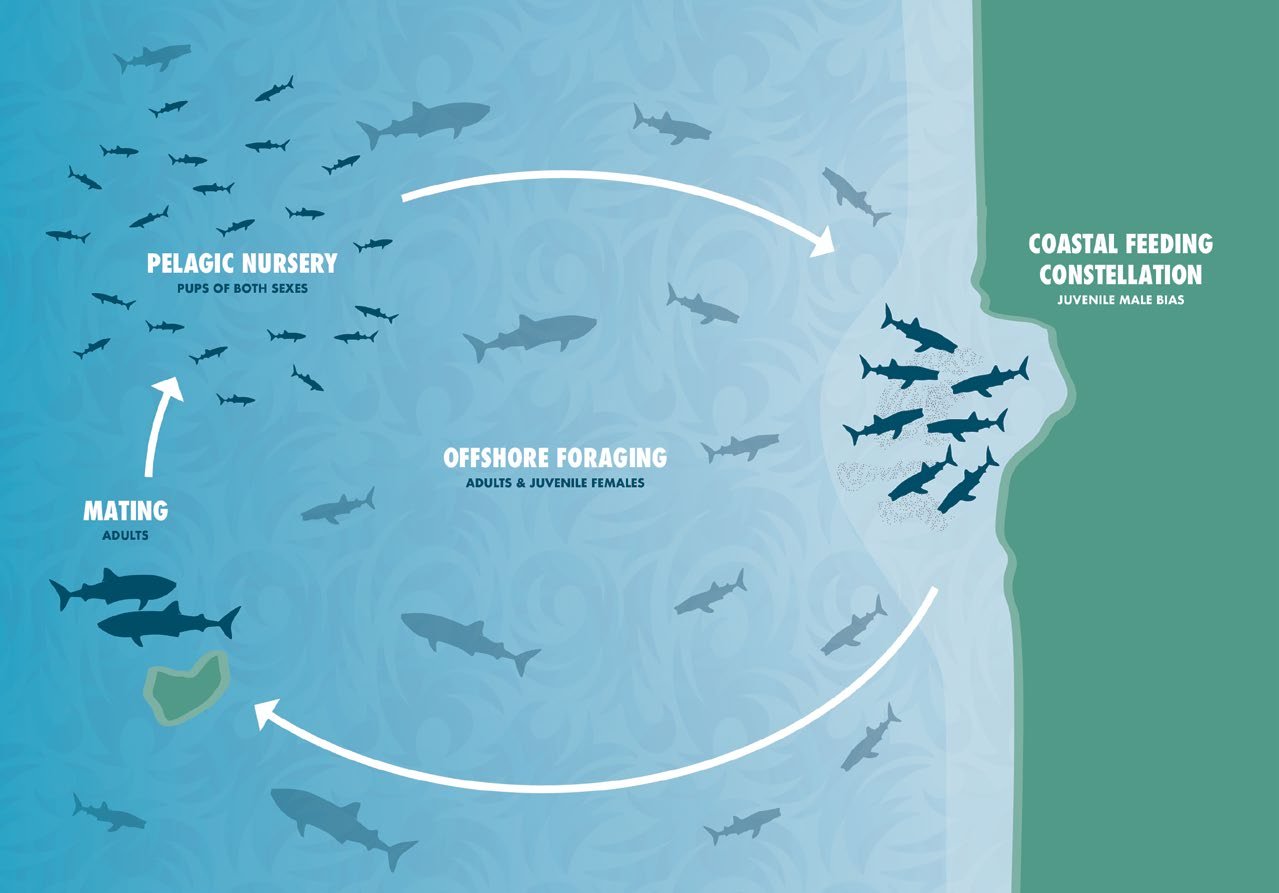
That’s interesting in itself, but not particularly mysterious. The odd thing is that it’s almost exclusively male whale sharks that frequent these areas. It’s almost a cliché now that the sites associated with whale shark tourism – think Ningaloo Reef in Australia, South Ari in the Maldives, Mafia Island in Tanzania, and others as well – are dominated by juvenile male whale sharks. The occasional juvenile female is certainly present, but it’s rare to see adult 9–10 m females at any of these locations.
‘Sexual segregation’, as this situation is referred to, is common in sharks and rays. Normally, though, the ‘segregated’ part of the population hasn’t proven hard to find. In whale sharks, for the most part, we still don’t know where the females live. They seem to be using completely different areas.
Why aren’t female whale sharks taking advantage of these predictable buffets? Well, adult and subadult male sharks will both harass juvenile females (also each other, boats, whale shark researchers, etc.), so that’s one possible reason for the females to avoid them, but this segregation persists even in places where no large males are present.
Perhaps productive feeding areas attract more whale shark predators? For males, the main aim is just to eat lots and grow fast to reproductive size; rich, but risky, habitats might be worth it. Females benefit (in evolutionary terms) by playing the long game – growing slower to a larger size – so they may prefer to live in safer areas elsewhere. Smart.
I think it’s most likely that females are feeding on slightly different prey, and presumably offshore; otherwise, we’d be seeing them more often. The best way to answer this conundrum will likely be through long-term tracking studies that allow us to compare and contrast habitat preferences between the sexes directly. We can also use biochemical techniques to look at long-term diet and habitat use across populations. Early work using these methods hasn’t seen many clear differences emerge between the sexes yet, but… most of our data is from males, because we know where they are. Le sigh.
Where are the pregnant whale sharks?
The few exceptions to the ‘rule’ outlined above are now key study sites for the species. Whale sharks are a globally endangered species, and large juvenile and adult female sharks are the most important individuals for population recovery (i.e., they can produce more whale sharks). It’s frustrating that we know so little about them.
The northern Galapagos Islands is one area where adult female sharks are regularly seen, and it’s one of my favorite places to work. Most of the sharks we see there are 10–12 m in length, and almost all are females. It’s not a feeding area, and they don’t stick around – most sharks are only there for a day or so at most. When I first saw these sharks, apart from being gobsmacked by their sheer size, I was flabbergasted by the junk in their trunk. These sharks had a massive ‘bump’. They were clearly pregnant.
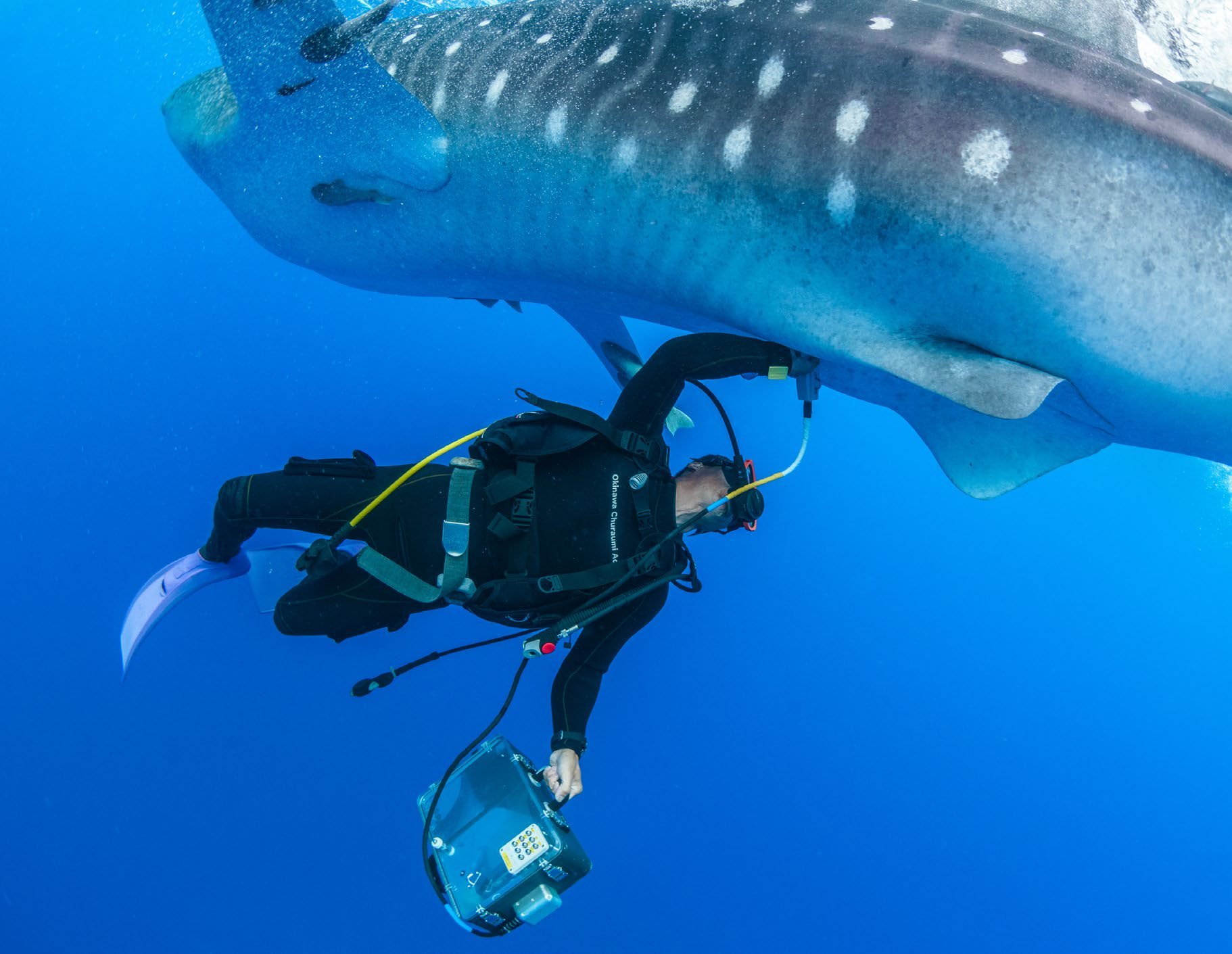
Dr. Rui Matsumoto ultrasounding a female whale shark.
Finally, in 2018, we were able to recruit the Okinawa Churaumi Aquarium research team to join us for an expedition. These Japanese scientists are the world leaders in using waterproofed ultrasound units for reproductive assessments. They collected ultrasounds from multiple sharks, and… no babies. Whale sharks have extremely thick skin, so it’s difficult to be definitive about it, but it seems likely now that females close to adulthood develop a pronounced butt – but it doesn’t necessarily mean they’re carrying pups. Confusing, but that’s why they say never to work with animals.
For the moment, anyway, we’re back to having only one confirmed pregnant whale shark to talk about. That 10.6 m ‘megamamma’, caught off Taiwan in 1995, contained around 300 cute little bonsai pups. It’s very rare to see adult female whale sharks close to the coast, so we assume they’re living in the open ocean. That makes them hard to study. There aren’t many places where we can intercept them, so offshore islands and seamounts are going to become increasingly important whale shark research sites.
Adult female whale shark showing off her pronounced ‘butt’.
Where are the babies?
If bus-sized pregnant sharks have proven challenging for us to find, imagine trying to find a 40–60 cm baby. Only 30–40 newborn whale shark pups have ever been found, scattered across the world. Pups are born free-swimming, and likely get no further assistance from their mother.
My working hypothesis (= arm-waving speculation) is that we don’t see them because the mothers are giving birth well offshore, away from coastal predators, and the babies are following the daily vertical migration of plankton from the depths to the surface when darkness falls. I could be embarrassingly wrong though. It wouldn’t be the first time.
Exploring the abyss
Whale sharks are incredible deep-divers – probably to over 2000 meters (whereupon the pressure crushes our tags). The open ocean may be boring at the surface, but there’s plenty going on in the mesopelagic depths just a few hundred meters beneath. Literally trillions of lanternfishes, probably the most abundant vertebrate on the planet, live in this twilight zone. They’d make an excellent snack for a hungry whale shark. But why keep going deeper?
Well, there are lots of good reasons not to go deeper. There isn’t much food in the deep ocean, it’s lower in oxygen, and it’s very cold, with whale sharks occasionally facing near-freezing 2ºC temperatures. They aren’t just diving for the fun of it, as they have to spend time warming up at the surface afterward. We’re not sure what the purpose of these deep dives is yet, but an intriguing possibility is that it’s a part of the shark’s geomagnetic navigation strategy – they can likely get a better fix on the Earth’s magnetic field closer to the crust, much as we might go outside to get a better GPS signal.
At the moment, whale sharks are showing us the limits of our technology depressingly, and expensively quickly, so the reasons behind these behaviors remain unknown.
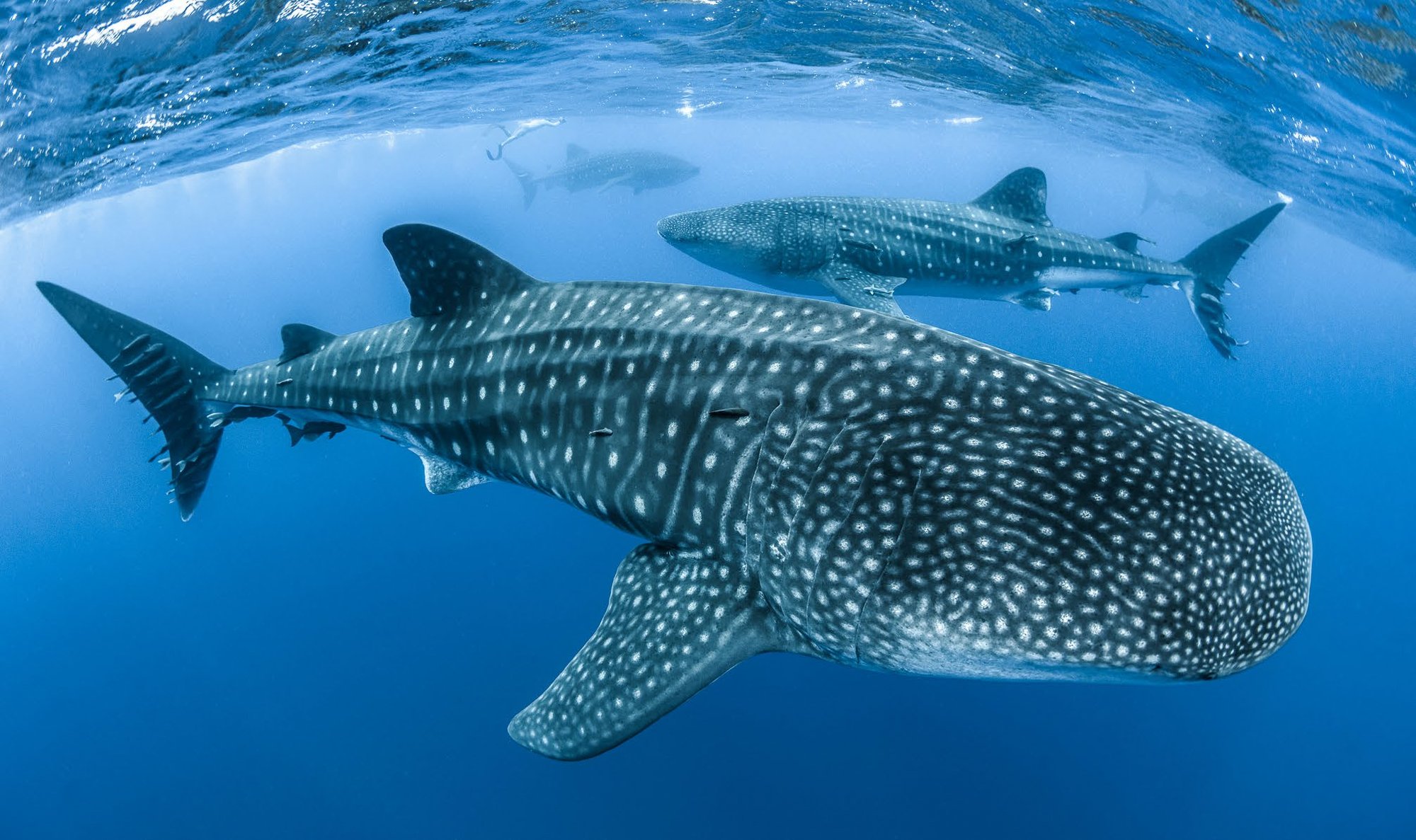
Whale shark aggregation at St Helena Island.
How old do whale sharks get?
Whale sharks become adults at about 7–9 m length in males, and about 9–10 m in females. Age-wise, our best guess is that those sizes correspond with about 25 yrs for males, and 30–40 yrs in female whale sharks. We know that the largest whale sharks ever recorded have been in the 18–20 m range. Working out their maximum lifespan should therefore be a simple exercise in extrapolation then, right?
If only it were that easy. Shark skeletons are made of cartilage, not bone. The ‘centra’ in their vertebral column continually grow as cartilage accretes through time. Like a tree, the centra forms a dark (dense) band during times of slow growth, and a lighter band when the shark grows faster. Each band pair can represent a year, as in trees. Unfortunately, whale sharks – and you can trust me on this, I’m a doctor – are not trees. They swim, a lot. Whale sharks feel no obligation to suffer through winter. If it gets cold, they just… go somewhere else. That means the band formation may not be annual.
But wait, there’s more. Once they get to around their adult size, whale shark growth slows dramatically, so the relationship between the shark’s size and age breaks down completely. Two whale sharks, Stumpy and Zorro, have been returning to Ningaloo Reef in Australia for over 20 years now. The research paper describing their sighting histories notes that “their growth has been negligible over the past two decades.” They may still form bands in the centra, but there’s a good chance they’ll be indivisible even under a microscope.
So how old do whale sharks get? We don’t know. Most large shark species are long-lived and slow-growing. Greenland sharks, living in the cool Arctic and deep waters, grow less than 1 cm per year and can be over 6 m at full size. A 5 m female was estimated to be 392 years old. Female white sharks only become adults at about 33 years and are estimated to live to at least 73. Even small spiny dogfish are thought to live for at least 80 years. There’s a good chance that the whale sharks’ maximum lifespan will easily exceed our own.
Embracing the unknown
Whale sharks are a genuinely special species. They’re gigantic. They’re iconic. They’re also globally endangered. Their large size, placid nature, and the existential threat to their very survival keeps motivating us to develop new and improved research techniques to learn more about them, and how best to protect them.
Many of the non-invasive study techniques that were first pioneered on whale sharks, like photo-identification, are now standard methods in shark research, and we’re pushing forward to integrate artificial intelligence with image processing so we can work faster. Some of the first satellite-linked tags were designed for and deployed on whale sharks to track their movements across vast distances. Whale shark scientists are continuing to trial new techniques like ultrasound on free-swimming sharks, as above, underwater blood draws, even in-water semen collection which… yeah. That may have been a one-off. (No judgment, though. For science!)
We’ll keep solving mysteries – but that certainly doesn’t make their lives any less interesting. Colossal as these sharks may be, their very existence embiggens us all.
This article was originally published in Ocean Giants, MMF’s magazine, Issue #06 (Winter 2022). Download the full issue as a PDF.