
Ecuador · Global Manta Ray Program
Ecuador Giant Manta Rays
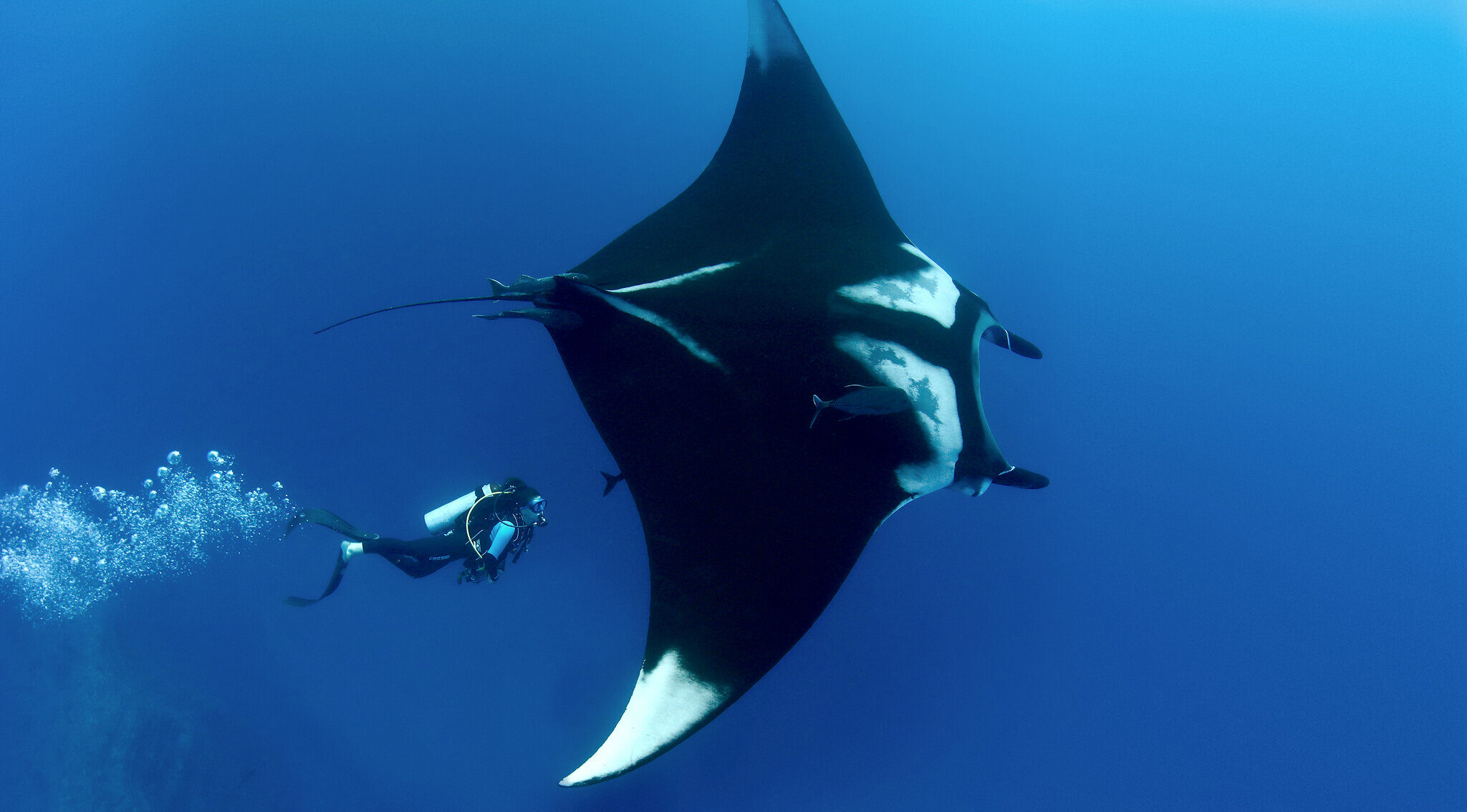
Fourteen years of photographs from Isla de la Plata and Bajo Copé identified 2,803 individual giant manta rays, the largest known population of the species anywhere.
 (opens in a new tab)
 (opens in a new tab)
 (opens in a new tab)
 (opens in a new tab)
 (opens in a new tab)
- Fundación Megafauna Marina del Ecuador
 (opens in a new tab)
 (opens in a new tab)
The coast of Ecuador holds the largest known population of giant manta rays (Mobula birostris), also known as oceanic manta rays. We helped build the 14-year photo-identification record that revealed it, and our diet studies suggested that most of what these mantas eat comes from deep water.
Each year, mainly in August and September, giant mantas aggregate at Isla de la Plata, an island in Machalilla National Park, and at Bajo Copé, a seamount 59 km (37 miles) to the south. For several years, MMF scientists took part in intensive seasonal fieldwork there. Our team’s work included a University of Queensland PhD on the mantas’ feeding ecology and management of the photo-identification database. The population study, led by Kanina Harty of the Manta Trust, was published in Marine Ecology Progress Series in 2022 (opens in a new tab), and we reported its findings the same year.
What we've done
- Contributed to a photo-identification record of 2,803 individual giant mantas from 3,322 sightings between 2005 and 2018, and co-authored the 2022 study that described the population (opens in a new tab).
- Found through stable isotope analysis that prey from the mesopelagic zone, the dimly lit midwater layer, likely makes up most of these mantas’ diet (Burgess et al. 2016 (opens in a new tab)), a finding supported by their fatty acid profile (opens in a new tab).
- Carried out the first study to use stable isotopes in epidermal mucus (opens in a new tab) to investigate the feeding ecology of a shark or ray.
- Worked with the Government of Ecuador to champion the listing of giant manta rays on the Convention on Migratory Species (CMS) in 2011.
- Freed entangled mantas from fishing lines, hooks, and nets during fieldwork.
Support our manta ray research
This study is complete. Your gift supports our current research on manta rays and the threats they face.
You can also donate stock or cryptocurrency, recommend a grant from your donor-advised fund, or leave a gift in your will.
What the research found
The world’s largest known population
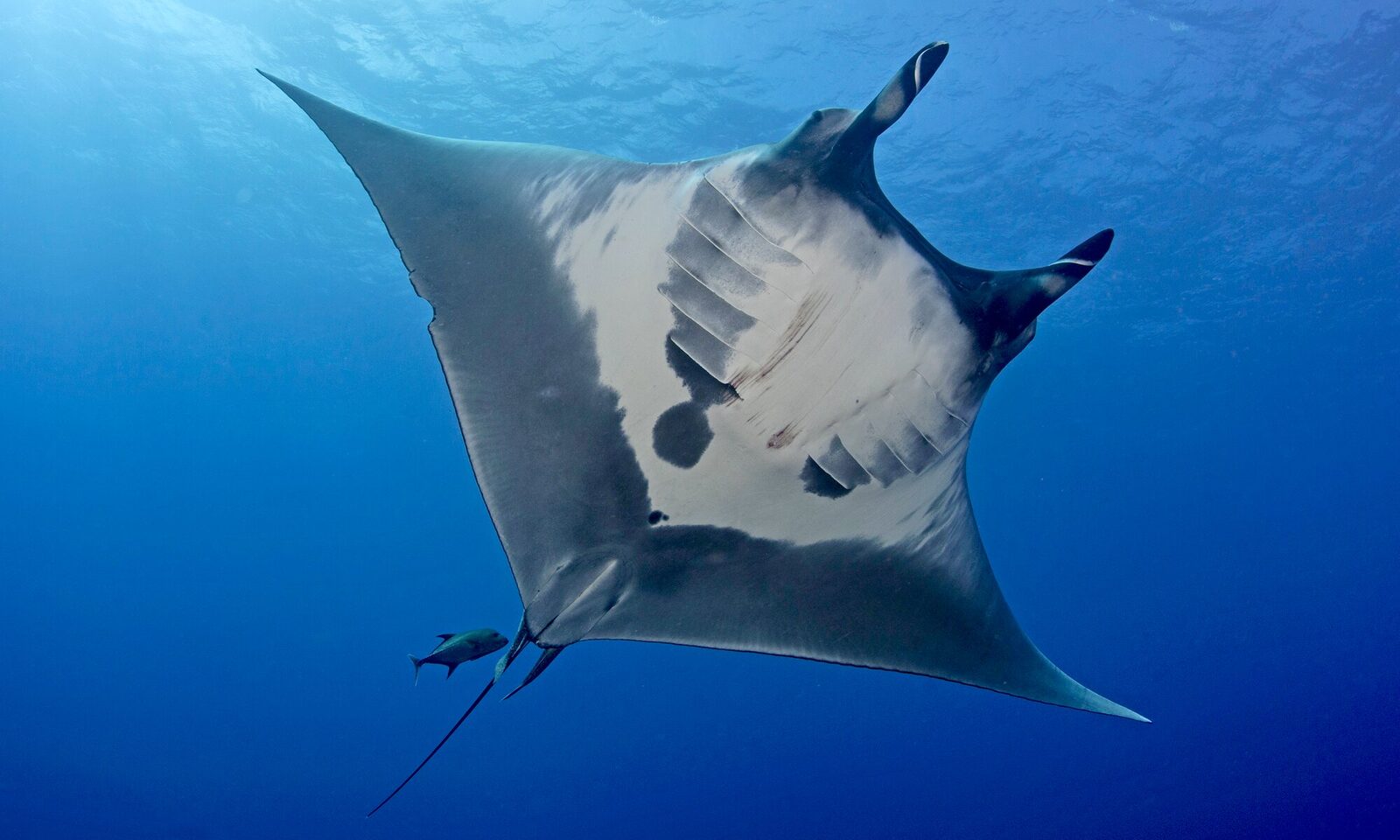
Photo-identification relies on the spot pattern on each manta’s underside, which stays the same throughout its life. Between 2005 and 2018, community scientists, dive guides, and research teams photographed 2,803 different giant mantas at the two sites, and Isla de la Plata accounted for 97.4% of the sightings. Other photo-identification catalogs for the species rarely exceed 1,000 individuals. Mark-resight models, which estimate population size from how often known individuals are seen again, estimated that 22,316 mantas used the two sites between 2009 and 2018. The 2022 paper notes that this is an order of magnitude more than the only other estimates for the species, about 600 in Mozambique and 1,875 in Raja Ampat, Indonesia.
Yet only 12.9% of the identified mantas were ever seen again, and only 5.6% in more than one year, which suggests that most visit the sites briefly rather than residing there. The longest record was a female first photographed in July 2005 and seen again in August 2018. Because these mantas range along the coasts of southern Ecuador and northern Peru, far beyond the two survey sites, surveys at two sites can only give a lower bound for the regional population, which is likely the largest in the world. One manta first identified at Isla de la Plata in 2009 was indeed photographed off northern Peru in 2015, 268 km (167 miles) away. (Photo: Jose Alejandro Alvarez.)
A male-biased aggregation
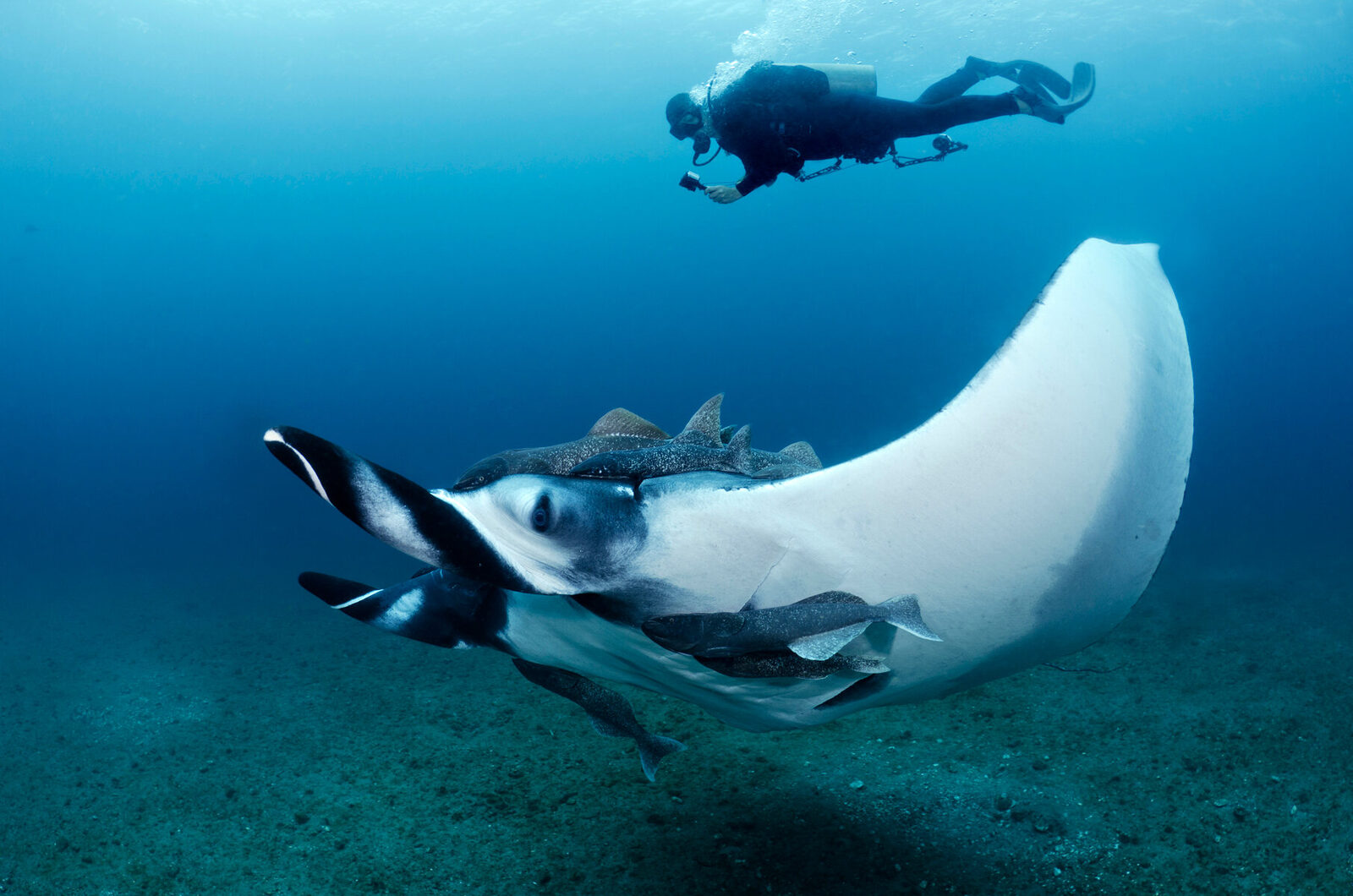
Several well-studied aggregations of reef and oceanic mantas, in Indonesia, eastern Australia, and Mozambique, are dominated by females. In contrast, the mantas photographed at Isla de la Plata and Bajo Copé were significantly biased toward males, at 1.67 males for every female, and 83.5% of the identified males were mature. The models nonetheless estimated similar numbers of females (11,022) and males (11,294) among the mantas using the two sites, which suggests that males are more faithful to these sites, or that the sexes use the region differently. Most of the mantas (65.1%) had the common chevron coloration, with a V-shaped gray band on the underside, while 18.7% were pale (leucistic) and 16.2% almost entirely black (melanistic).
The estimated number of mantas present peaked in 2012, the year with the coolest sea surface temperatures and the highest chlorophyll concentrations of the study, likely a sign of strong upwelling, the rise of cool, nutrient-rich water toward the surface. Sea temperature and chlorophyll predicted the modeled changes better than the El Niño–Southern Oscillation index, although the study did not rule out an El Niño influence.
Feeding in the deep
Giant mantas at Isla de la Plata are usually seen cleaning or cruising, and rarely feeding. To investigate their diet, Dr. Burgess analyzed small muscle samples from 75 mantas collected at Isla de la Plata and Bajo Copé between 2012 and 2014. Stable isotopes, naturally occurring forms of carbon and nitrogen that reflect what an animal has eaten, placed the mantas at a trophic position (level in the food web) of about 3.4, and mixing models estimated that, on average, surface zooplankton supplied 27% of their diet and mesopelagic sources 73%. Their fatty acid profile, low in polyunsaturated fatty acids and rich in compounds typical of deep-sea organisms, pointed to the same mesopelagic origin. However, many mesopelagic animals migrate toward the surface at night, so the depth at which the mantas actually feed remains unresolved.
Isla de la Plata lies less than 40 km (25 miles) from the edge of the continental shelf, beyond which the seafloor descends to about 3,000 m (9,800 ft). The mantas may therefore feed in deep water nearby, possibly at night, and visit the island’s cleaning stations by day, where small fishes remove their parasites and they may also recover from cold, deep-water feeding.
Fishing gear and protection
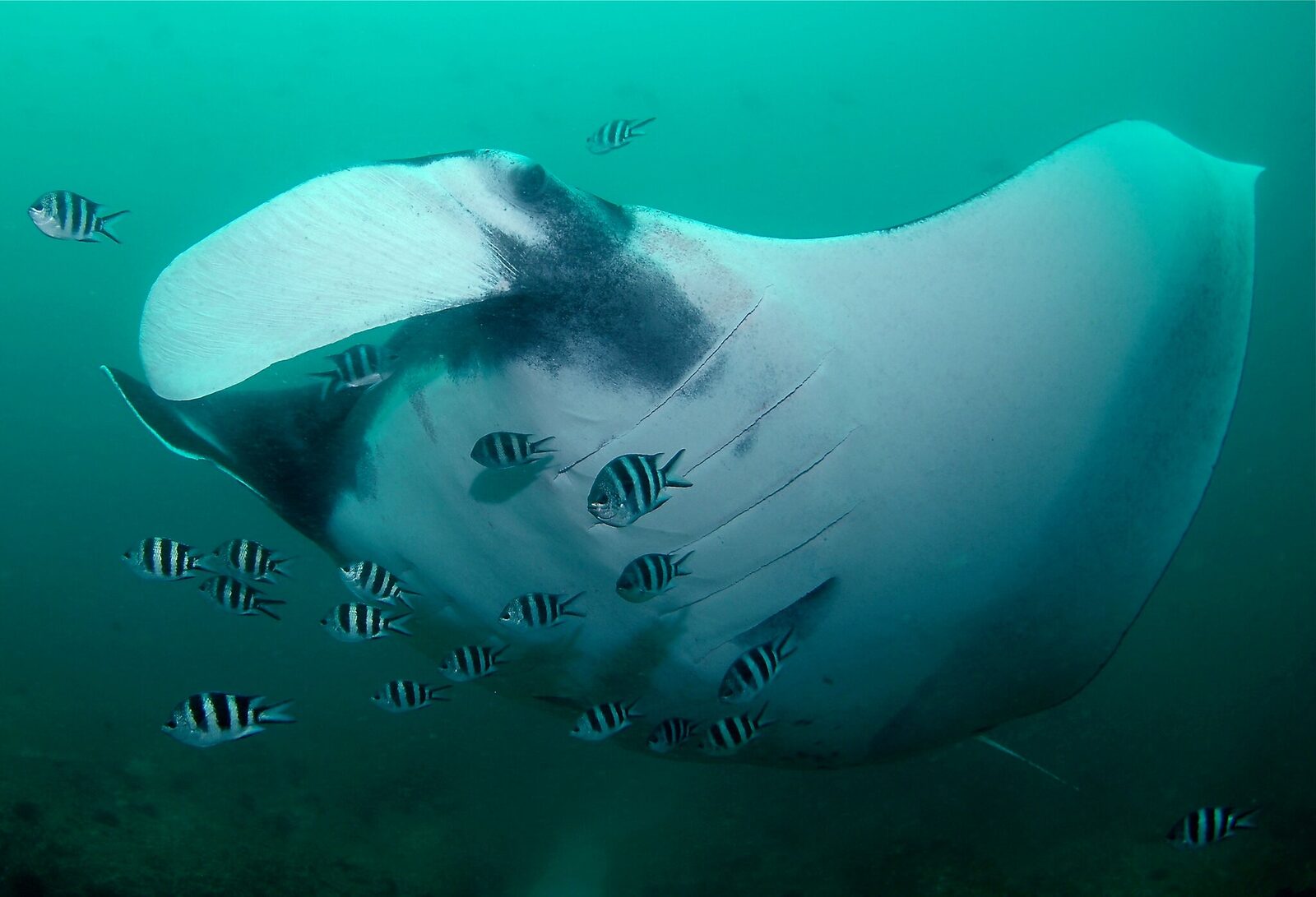
Injuries were recorded for 563 of the identified mantas. Of these, 71 were seen entangled in fishing lines, hooks, or nets, and another 277 carried injuries or scars likely caused by fishing gear, together 61.8% of the injured mantas. During fieldwork, our team spent many dives cutting lines and nets from entangled mantas. The species remains at risk of bycatch in purse-seine, longline, and gillnet fisheries along this coast, and it is listed as Endangered on the IUCN Red List.
Ecuador has prohibited the capture of manta and devil rays since 2010, and Peru has prohibited targeted fishing for giant mantas since 2016. Because giant mantas travel widely and regularly enter international waters, we worked with the Government of Ecuador to champion their listing on the Convention on Migratory Species in 2011. Their inclusion on Appendices I and II encourages countries to cooperate on their conservation across the species’ range.

Open questions
- How far the population ranges: one manta was matched between Isla de la Plata and northern Peru, and satellite tracks from a separate study link these waters with the Galápagos Islands.
- Where, and at what depth, the mantas feed: tags that record depth and movement, and animal-borne cameras, could test whether they feed at depth or nearer the surface at night.
- How fishing injuries affect survival, which will need standardized injury records.
- How changes in upwelling and productivity, including those expected with climate change, will affect the mantas’ use of these sites.
MMF Project Team
 Dr. Andrea Marshall
Supporters & Partners



Research papers
- 2022Demographics and dynamics of the world’s largest known population of oceanic manta rays Mobula birostris in coastal Ecuador
- 2018Novel signature fatty acid profile of the giant manta ray suggests reliance on an uncharacterised mesopelagic food source low in polyunsaturated fatty acids
- 2017Use of epidermal mucus in elasmobranch stable isotope studies: a pilot study using the giant manta ray (Manta birostris)
- 2016Manta birostris, predator of the deep? Insight into the diet of the giant manta ray through stable isotope analysis
 Atlantic Mobula Rays
 Florida Manta Project
 Hawaii Oceanic Manta Project
 Madagascar Manta and Devil Rays