
SAVING OCEAN GIANTS.
Scalloped hammerhead
Sphyrna lewini
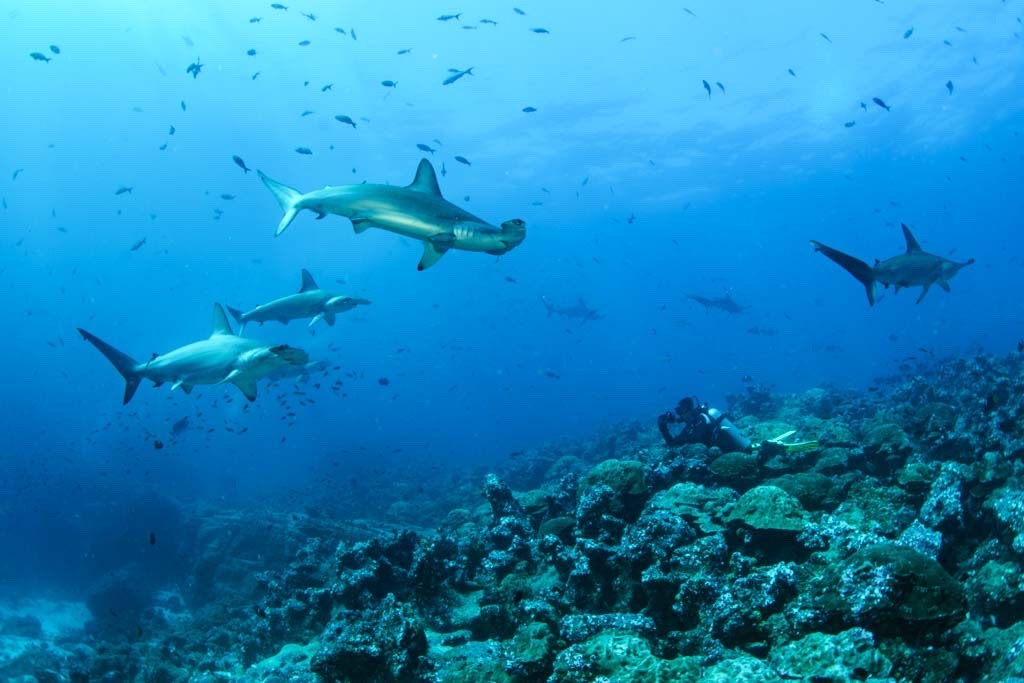
Critically EndangeredThe schooling hammerhead: a warm-water shark that aggregates in the hundreds at islands such as the Galápagos by day and makes deep dives at night, probably to feed.
Key facts
- Scalloped hammerheads grow to about 4 meters (13 feet) long; the 2019 Red List assessment gives a maximum of 4.2 meters (14 feet).
- The front edge of the head has two rounded lobes separated by a notch at the center, which sets the scalloped hammerhead apart from the great and smooth hammerheads.
- By day they school at offshore islands and seamounts. Surveys at Darwin Island in the Galápagos estimated resident populations of about 500, 670, and 400 scalloped hammerheads in September 2011, September 2012, and October 2013.
- At night many leave the schools, probably to feed. The species also dives far deeper than its daytime schools suggest: in 2020 a tagged female off Hawaii reached 1,240 meters (4,068 feet), the deepest dive recorded for the species.
- Tagged scalloped hammerheads travel between the Galápagos, Cocos Island, and Malpelo, protected islands up to about 1,200 kilometers (750 miles) apart.
- Females give birth to live young after an estimated pregnancy of 10 to 11 months. In the Eastern Pacific, pups measure 47 to 55 centimeters (19 to 22 inches) at birth.
- In 2022, Dr. Alex Hearn's team reported the first putative scalloped hammerhead nursery at an oceanic island in the Eastern Tropical Pacific, a mangrove bay on San Cristóbal in the Galápagos.
- At Cocos Island, Costa Rica, the estimated relative abundance of scalloped hammerheads, from dive guides' records, fell by 75% between 1993 and 2019.
- In 2014 the scalloped hammerhead became the first shark protected under the US Endangered Species Act. A 2021 global analysis found hammerhead populations in the Northwest Atlantic rebuilding under strictly enforced US quotas.
- The IUCN Red List classifies the scalloped hammerhead as Critically Endangered (2019). International trade has required CITES permits since September 2014, and the species was listed on Appendix II of the Convention on Migratory Species in 2014.
Meet the scalloped hammerhead
The scalloped hammerhead (Sphyrna lewini) is one of about ten species of hammerhead shark, and of the three large species it is by far the most studied. It is a large coastal and semi-oceanic shark found in warm-temperate and tropical seas around the world, and it is the hammerhead that forms the famous daytime schools at offshore islands and seamounts. The behavior of the large hammerheads ranges from nomadic and solitary in the great hammerhead to social and aggregative in the scalloped. The schooling that divers travel to see is therefore a trait of this species, not of hammerheads in general.
The three large species are told apart by the front edge of the cephalofoil, the hammer-shaped head. The great hammerhead’s is straight and the smooth hammerhead’s forms a single rounded lobe, whereas the scalloped hammerhead’s has two rounded lobes separated at the midline. Where scalloped and smooth hammerheads share the same water, researchers look first for that prominent central indentation, which smooth hammerheads lack. The other identification clues are in our guide to the types of hammerhead shark, and the long debate over what the head is for has its own chapter, why hammerheads have a hammer.
Adults reach about 4 meters (13 feet) in total length, and the 2019 Red List assessment gives a maximum of 4.2 meters (14 feet). The head does not keep pace with the body as the shark grows. A study of museum specimens found that head area grows proportionally more slowly than the body (negative allometry), while the fins grow relatively longer. The authors link these changes to the move from shallow coastal water into the open ocean, which young scalloped hammerheads make at around 1 meter (3 feet) in length. Records and growth are covered in how big hammerhead sharks get.
Where scalloped hammerheads live
Scalloped hammerheads are circumglobal in warm-temperate and tropical seas, from the surface and intertidal zone into deep water. Their habitat changes with age: smaller sharks are generally found in near-shore habitats, and larger ones in deeper, open water. The species forms seasonal aggregations at oceanic seamounts, particularly in the Pacific, and adults show high site fidelity to seamounts and to islands such as the Galápagos, Malpelo, and Cocos.
In the Eastern Tropical Pacific, the schools form at offshore islands: Darwin and Wolf in the far north of the Galápagos, Cocos Island off Costa Rica, Malpelo off Colombia, and the Revillagigedo Archipelago off Mexico. In Galápagos dive surveys, hammerheads and Galápagos sharks were by far the most commonly encountered sharks, with hammerheads schooling in large numbers at upstream current sites at Darwin and Wolf. At Revillagigedo, tracking of 11 adults identified San Benedicto Island as an important aggregation site for the species.
The species’ range may be changing. Drone surveys off Western Australia documented a recurring aggregation of young scalloped hammerheads 50 kilometers (31 miles) south of Perth. The authors consider it likely to be a relatively recent phenomenon that may indicate a poleward shift or extension in distribution, although they stress that this needs further investigation. Scalloped hammerheads also range far deeper than their shallow daytime schools suggest. In 2020, a tagged female off Hawaii Island dived to 1,240 meters (4,068 feet), the deepest dive yet recorded for the species.
Schools in the Eastern Tropical Pacific
Much of what is known about these schools comes from the long-term tracking of Dr. Alex Hearn of the Universidad San Francisco de Quito and his colleagues, MMF’s research partners in the Galápagos. Between 2006 and 2009, Hearn’s team tagged more than 100 hammerheads at Darwin and Wolf, most of them females, because it is the females that form the large schools. The schools proved to be highly site-specific. At Wolf Island, the tagged sharks concentrated at the island’s southeastern corner and showed a significant preference for daylight hours. Seven sharks tracked there used a daytime core area averaging just 0.25 square kilometers (about 60 acres) on the up-current side of the island. At dusk, many left: the tags recorded frequent nocturnal absences of several hours, presumed to be foraging trips.
Research in the Gulf of California proposed an explanation for why the schools are mostly female. There, female scalloped hammerheads move offshore at a smaller size than males and form schools made up mainly of intermediate-sized females. Offshore, young females fed more on open-water prey than males of the same size. The study contended that this lets them grow quickly to the larger body needed to carry pups, so that females mature at a larger size than males but at a similar age.
At Darwin Island, a 2025 study with Hearn among its authors combined acoustic tags with underwater counts to estimate how many scalloped hammerheads were resident. During field trips in September 2011, September 2012, and October 2013, it estimated resident populations of about 500, 670, and 400 scalloped hammerheads. The low rate at which tagged sharks were resighted suggests that many more, mostly females, pass through. At Cocos Island, dive guides have counted up to 1,000 scalloped hammerheads on a single dive. When the Galápagos schools peak is less settled. Hearn’s team recorded its highest diver counts around Wolf in January 2008, whereas the review of the reserve’s sharks and rays that he led reported greater abundance in the cooler months, from May through October. The studies agree only that numbers dip from about March to May, when the number of tagged sharks detected at the islands drops every year. The schooling and migration chapter goes further into how the schools form.
Movements between islands
Darwin and Wolf are 38 kilometers (24 miles) apart, and the sharks commute between them: 12 of the first 14 sharks tagged at Wolf moved to Darwin within six months. Some go much farther. Of 134 sharks tagged at Darwin and Wolf, three reached Cocos Island and one Malpelo, islands 700 and 1,200 kilometers (435 and 750 miles) away. These long trips were most common in the warm season. Tracking at Malpelo, with Hearn among the authors, recorded one shark that swam from Malpelo to Cocos, then to the Galápagos and around the archipelago, at least 1,941 kilometers (1,206 miles) in all. Movement between the islands nonetheless appears to be relatively infrequent. At Cocos, a study with Hearn as second author found that hammerheads from the Galápagos and Malpelo arrived mostly in April and May. The authors suggest that the sharks may use Cocos as a navigational waypoint or stopover during seasonal migrations toward the coasts of Central and South America.
A juvenile female tagged in the Gulf of California covered approximately 3,350 kilometers (2,080 miles) in 10.5 months before being recaptured close to where she was tagged. Over that time she moved from shallow coastal water to deeper offshore water as she grew. At the scale of whole oceans, the 2019 Red List assessment stated that males move across ocean basins, while females only move regionally. A newer genetic study sampled 541 scalloped hammerheads at 12 locations across the Indo-Pacific, from the Seychelles to the Gulf of California. Its genetic results showed little gene flow across the Indian Ocean, implying that neither sex migrates effectively across the Indian Ocean. The authors concluded that the earlier picture of male-biased dispersal across the Indian and Pacific Oceans will need to be updated.
These connections matter for protection, because sharks that stay at one island by day still range widely by night and between seasons. A 2022 review of the region’s tracking work, with Hearn among its authors, drew on studies completed over 20 years. It concluded that they had justified the expansion of the Cocos Island National Park and the Galápagos Marine Reserve and supported their boundaries as they then stood.
Feeding and deep dives
Scalloped hammerheads feed on a mixture of fish, crustaceans, and cephalopods, with squid as a primary prey item. Diet studies of hammerheads landed in mainland Ecuador suggest that the region’s sharks feed mainly on oceanic squid, such as jumbo squid (Dosidicus gigas). At Wolf, a female that Hearn’s team followed by boat moved offshore each night to an area 5.6 kilometers (3.5 miles) east of the island, returning before dawn. She dived to 100–300 meters (330–980 feet) on the way out and back.
Sharks tracked offshore from Wolf also made “yo-yo” dives through the thermocline, the layer where water temperature drops sharply with depth, deep enough to reach jumbo squid in the low-oxygen zone. These dives may give the sharks access to squid, although the Wolf team judged its evidence for deep foraging limited and inconclusive. Tags elsewhere have recorded far deeper dives, up to the species record of 1,240 meters (4,068 feet) off Hawaii. The authors of that study could not tell why the shark made the dive, suggesting that it may have encountered a rich prey source or a potential predator on the way down. The feeding chapter sets out the tracking and diet evidence in detail.
Reproduction and nurseries
Scalloped hammerheads give birth to live young. In the central-eastern Pacific, a study of landings at Manta, Ecuador, found that males mature at a median 178.1 centimeters (5.8 feet) total length and females at 219.4 centimeters (7.2 feet). Its data agreed with a pregnancy of 10 to 11 months, from September to June or July, and it put the size at birth at 47 to 55 centimeters (19 to 22 inches). Lifespans are long: studies have estimated maximum ages of 30.5 years in the Northwest Atlantic and Gulf of Mexico and 35 years in Indonesia, both assuming that one growth band forms each year.
Pups are born in shallow coastal nurseries. In Kāne’ohe Bay, Hawaii, researchers estimated that about 7,700 scalloped hammerheads are born each year. Only a small fraction remain for a year. The authors estimated first-year losses of 85 to 93%, from death and emigration combined, and concluded that malnutrition and starvation make a major contribution to that mortality.
In 2022, Hearn’s team at the Universidad San Francisco de Quito reported a putative, or suspected, scalloped hammerhead nursery at Puerto Grande, a mangrove-fringed bay on San Cristóbal Island in the Galápagos. It was the first oceanic-island nursery location for the species in the Eastern Tropical Pacific. Pups were caught every time the team set a beach seine there, and four fitted with acoustic tags stayed in the bay for 13 to 93 days. Our chapter on baby hammerhead sharks covers nurseries across the species’ range.
Population trends
The 2019 Red List assessment found that the scalloped hammerhead has undergone steep declines in all oceans, with estimated median reductions of 76.9 to 97.3% over three generations (72.3 years). Cocos Island holds a long-term record from the Eastern Tropical Pacific: 46 dive guides logged 34,342 dives between 1993 and 2019. Over those 27 years, the estimated relative abundance of scalloped hammerheads declined by 75%.
Ocean temperature shapes those counts as well. Predicted counts were 105.6% higher during strong La Niña conditions than during strong El Niño conditions. The authors read the temperature effects as likely reflecting distributional change rather than overall population declines, and the decade-scale decline as a sign of ongoing fisheries exploitation. Our page on climate change uses Cocos as a case study.
Against those declines, the Northwest Atlantic and Gulf of Mexico stand out. The 2019 Red List assessment found some signs of stabilization and possible recovery in response to management only in those waters. The 2021 global analysis of oceanic sharks that we contributed to likewise found hammerhead shark populations rebuilding in the Northwest Atlantic, owing to strictly enforced quotas throughout their US range.
MMF and scalloped hammerheads
MMF scientists meet scalloped hammerhead schools at Darwin Island, where Dr. Simon Pierce leads MMF’s part in the Galápagos Whale Shark Project. Our partners at the Universidad San Francisco de Quito, led by Dr. Hearn, run the regional silky shark tracking study across the Galápagos and the other offshore islands of the Eastern Tropical Pacific, with Dr. Chris Rohner leading MMF’s contribution. The same partners completed a yellowfin tuna tracking study in the Galápagos Marine Reserve. MMF’s work in the Galápagos also helped secure the Hermandad Marine Reserve, an expansion covering 60,000 km² (23,000 square miles) declared in 2022.
Our own research includes scalloped hammerheads. Pierce and Rohner co-authored a 2022 global analysis of 989 tags on 38 species of sharks and rays, which found scalloped hammerheads capable of deep dives to meso- and bathypelagic depths. These are the zones below 200 and 1,000 meters (660 and 3,300 feet), yet the tagged sharks consistently used relatively shallow habitats. We also co-authored a 2025 analysis of shark protection in the Central and South American Pacific. It found that the scalloped hammerhead and the whale shark are the species most frequently named as conservation values (species a protected area is managed to conserve) in the region’s marine protected area management plans. However, Important Shark and Ray Areas, which map critical habitat for sharks and rays, are poorly covered: only 15.6% of their combined area overlapped marine protected areas, and 7.3% overlapped no-take areas. The authors conclude that these shortfalls undermine shark conservation efforts across the region.
Threats and protection
The scalloped hammerhead is caught globally as target and bycatch in longline, purse-seine, and gillnet fisheries, and is retained for its meat and fins. Its habits add to the risk. Daytime aggregations can indicate that certain populations are small, highly localized, and in shallow water, which makes hammerheads highly vulnerable to capture. The nightly trips away from protected islands could also take sharks beyond the 22-kilometer (14-mile) radius that the marine protected area around Cocos had in 2019, into reach of longlines that fish from dusk to dawn. Capture is often fatal: in the US Atlantic pelagic longline fishery, the estimated mean survival of scalloped hammerheads at haulback was 45.9%, although survival was higher on deeper hooks.
The fin trade drives much of that catch. Scalloped hammerhead made up an estimated 2.0% of Hong Kong’s retail fin trimmings in 2014–2015, ranking third among all species. A separate DNA pilot study of 72 scalloped hammerhead fin trimmings from Hong Kong’s retail market traced an estimated 61.4% to the Eastern Pacific, the region of the Galápagos and Cocos schools. In August 2017, after the Galápagos National Park Directorate’s monitoring center alerted Ecuador’s Navy, the refrigerated cargo ship Fu Yuan Yu Leng 999 was detained inside the Galápagos Marine Reserve carrying 7,639 sharks. A team including Hearn identified 929 of the carcasses, and 122 of them (13.1%) were scalloped hammerheads. The provincial court of Galápagos ruled in favor of the Galápagos National Park Directorate, imposing prison terms on 20 crew members, confiscating the vessel, and setting a fine of US$6.1 million.
Protection has grown since 2013. The scalloped hammerhead was added to Appendix II of the Convention on International Trade in Endangered Species (CITES) in 2013, with the listing in force from September 2014. It was added to Appendix II of the Convention on Migratory Species in 2014. The same year it became the first shark protected under the US Endangered Species Act, with its Eastern Pacific population listed as Endangered. In August 2013, Ecuador banned its industrial fleet from retaining scalloped or smooth hammerheads and limited small-scale artisanal fishers to retaining five immature hammerheads per trip as incidental catch. Mexico’s Revillagigedo National Park, declared in 2017, was described in the 2022 tracking review as the largest no-take area in the waters surrounding the American continent. The Cocos tracking study co-authored by Hearn argues for going further, protecting the sharks’ migratory corridors and nursery areas across the region.
The next gains lie in national fishing rules: a 2022 review found landings of scalloped hammerheads prohibited nationally in only 7 of the 119 countries in the species’ range. More on these threats is in why hammerhead sharks are endangered and on our overfishing page, and you can support our shark research in the Galápagos.