
BryantTurffs.jpg)
Scientists have identified 259 Important Shark and Ray Areas across North American and Caribbean waters. MMF’s Florida team contributed to four of them that were recognized for the Atlantic manta ray, a species formally named only last year.
What the new map means
On September 24, 2026, the IUCN Species Survival Commission’s Shark Specialist Group announced an update to its global map of Important Shark and Ray Areas (ISRAs). It adds 191 ISRAs in the North American and Caribbean Atlantic and 68 in the North American Pacific.
ISRAs are habitats that are especially important to sharks, rays, and chimaeras (deep-water relatives of sharks and rays). They include places where these animals feed, give birth, rest, gather, or travel, and each one is assessed against the same global scientific criteria. An ISRA is not a protected area and creates no new rules. Instead, it gives governments, fisheries managers, and marine planners independent evidence they can use when deciding how these waters are managed.
Another 51 sites were listed as Areas of Interest: places that were assessed, but where more information is needed before they can qualify. The findings are set out in two regional reports, one for the Pacific published on July 1 and one for the Atlantic published on September 24. Together they drew on contributions from nearly 500 specialists, 393 in the Atlantic region and 101 in the Pacific.
Four areas for the Atlantic manta ray
MMF Senior Scientist and US Country Manager Jessica Pate and Bryant Turffs, of our Florida Manta Project, contributed to four areas recognized for the Atlantic manta ray (Mobula yarae).
Boynton Beach, Florida
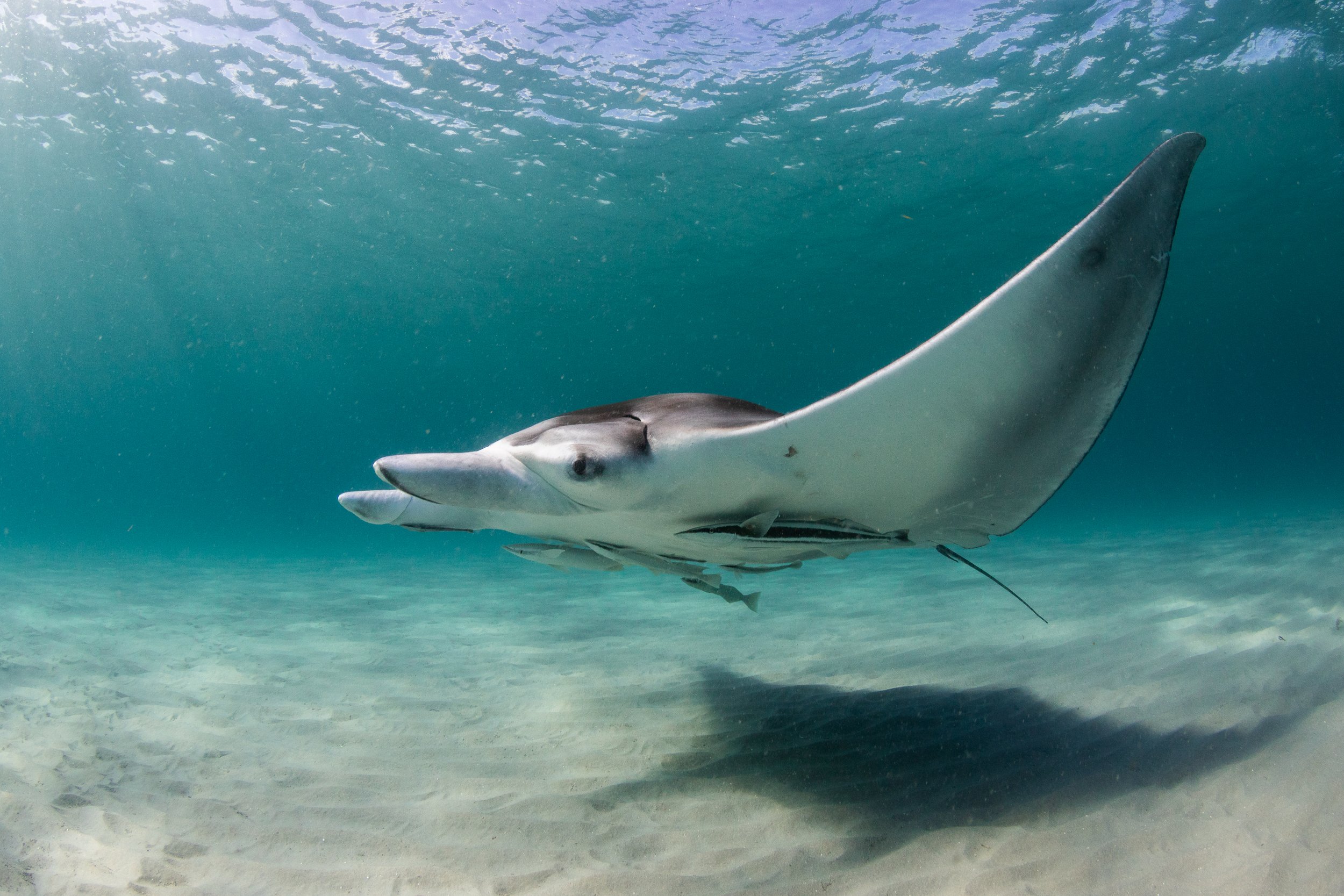
A juvenile Atlantic manta ray in the shallow nearshore waters of south Florida. Photo: Bryant Turffs
Nearshore waters, Boynton Inlet, and part of the Intracoastal Waterway were recognized as reproductive and resting habitat for Atlantic manta rays. Our first study of Florida’s manta rays surveyed the coast between Jupiter Inlet and Boynton Beach Inlet. Almost every ray it found was a juvenile, and some returned to the same shallow sites over several years, which is evidence of a nursery along this coast. The area was also recognized for the threatened Atlantic guitarfish (Pseudobatos lentiginosus), which we began studying in south Florida in 2020.
Cape Canaveral and East-Central Florida
Both areas lie on Florida’s central Atlantic coast and were recognized as feeding habitat for Atlantic manta rays. Since 2021 we have been studying the adult mantas that gather off central Florida each spring, using aerial surveys, boats, drones, and satellite tags.
Mississippi River Mouth
The shallow waters off the Mississippi River delta in the northern Gulf of Mexico were recognized as feeding habitat for Atlantic manta rays. The river delivers nutrients, and converging currents concentrate the plankton the mantas feed on.
Other MMF contributions
Jessica also contributed to three more ISRAs (Montauk, Southeast Florida, and the Southern Cape Cod to Florida Corridor) and to an Area of Interest around Little Tobago and Goat Island in Trinidad and Tobago. MMF Principal Scientist Dr. Chris Rohner is a co-author of both regional reports through his work with the ISRA project.
Why it matters for a newly named species
The Atlantic manta ray was formally described in July 2025 by an international team led by Nayara Bucair, with Jessica and MMF co-founder Dr. Andrea Marshall among the authors. We are still learning where females give birth, how far the nursery habitat extends, and how populations along the coast are connected. Recognizing the places where these rays feed, rest, and reproduce gives managers evidence to act on while that research continues.
“These areas tell us where sharks, rays, and chimaeras are carrying out the most important parts of their lives,” said Dr. Rima Jabado, Chair of the IUCN SSC Shark Specialist Group. “The next step is making sure this information is incorporated into the decisions that determine what happens in those waters.”
Explore the new areas in the ISRA eAtlas or read the announcement. Both regional reports are free to download: North American and Caribbean Atlantic and North American Pacific.
To support new research on manta rays, adopt a Florida manta ray.