
Madagascar · Global Whale Shark Program · Since 2016
Madagascar Whale Shark Project
Young whale sharks aggregate off Nosy Be from about September to December, and the Madagascar Whale Shark Project has studied and protected them since 2016.
Led by Madagascar Whale Shark Project, with MMF
The Madagascar Whale Shark Project is a collaborative project focusing on whale sharks (Rhincodon typus) and other megafauna species in northwestern Madagascar, centered on the island of Nosy Be. It is led by its founder, MMF research associate Stella Diamant, and MMF works with the project on its whale shark research.
The project began in 2016, working with citizen scientists within the marine tourism industry, and has since expanded into an integrated research, education, and conservation project spanning multiple species in this global biodiversity hotspot. Its whale shark work covers population ecology, tagging and tracking, and ecotourism, all aimed at understanding and protecting the whale sharks of Nosy Be. MMF’s Dr. Simon Pierce and Dr. Chris Rohner collaborate with Stella and the project team on this research.
.jpg)
Support our whale shark research
Whale sharks that cross borders need protection that does too. Your gift supports MMF's whale shark research, including our work with partners like the Madagascar Whale Shark Project.
Whale sharks of Nosy Be
Founded in Nosy Be
Stella Diamant, a biologist with an MSc from Imperial College London, established the Madagascar Whale Shark Project in 2016 following her own encounter with a whale shark in Nosy Be. As project lead, she focuses on collecting ecological data, advocating for sustainable management, and promoting education within local communities and among the wider public. (Photo: Madagascar Whale Shark Project.)
The project’s key successes to date:
- Identified 546 whale sharks off Nosy Be by the end of the 2025 season, contributing to our understanding of their population.
- Secured recognition of Nosy Be as a Key Biodiversity Area, and helped make the case for the Tandavandriva marine corridor, which links two existing protected areas and received temporary protection in March 2026.
- Enshrined the whale shark tourism code of conduct in Malagasy law, making it the standard operating procedure within the local ecotourism industry.
- Showed that whale shark tourism was worth an estimated $1.5 million to the Nosy Be economy over the three-month 2019 season.
- Established Nosy Be as an IUCN Important Shark and Ray Area.
Population structure and residency
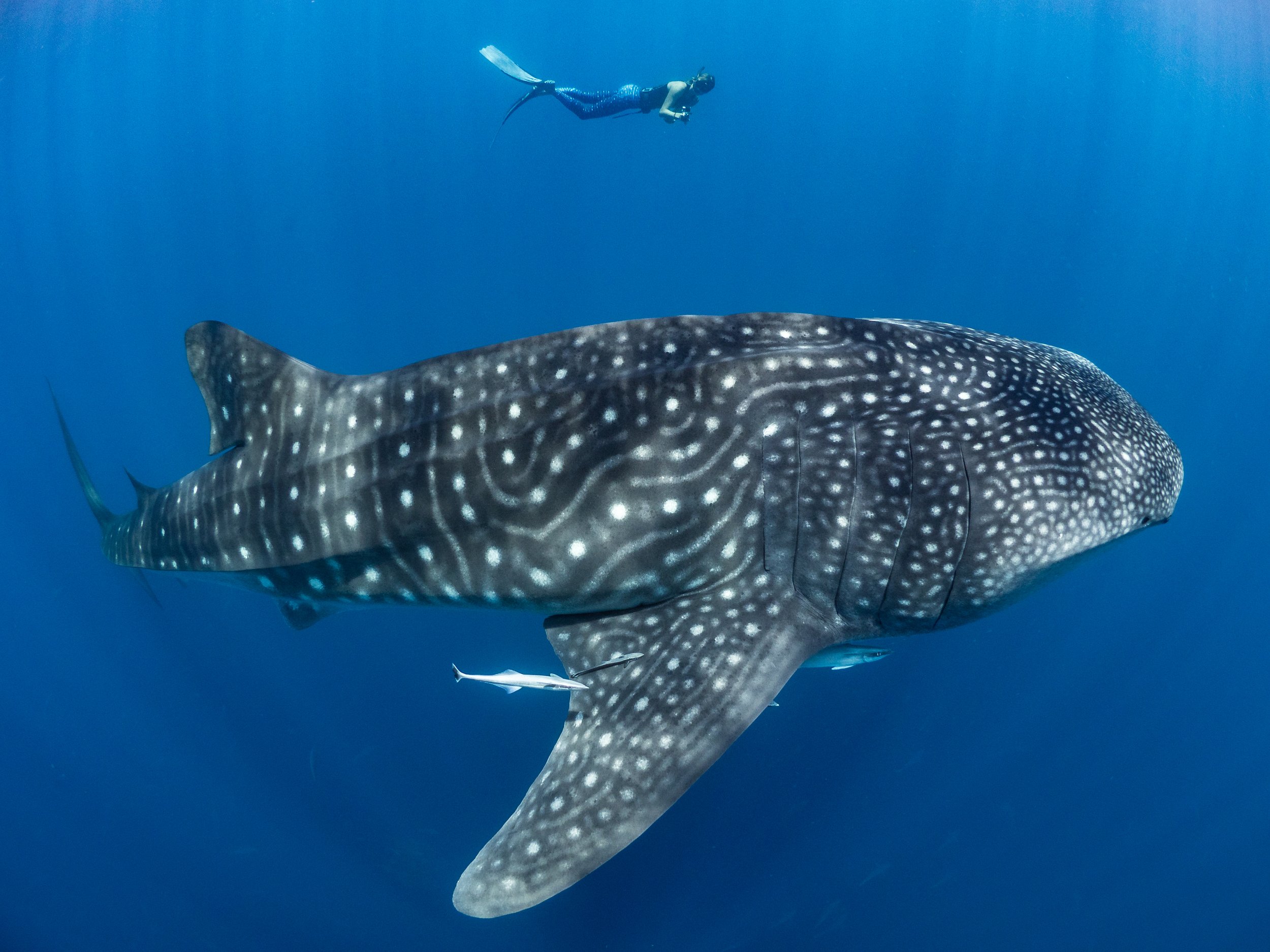
Photo-identification had recorded 546 whale sharks off Nosy Be by the end of the 2025 season, with some individuals returning for about a decade; two sharks, Hugo and Alphonse, have been seen every year since 2015. Every shark identified here has been immature, around eight in ten of them male, and they range from 3 to 8 m (10 to 26 ft) in length. The sharks arrive from about September to December to feed, usually at the surface alongside feeding tuna and seabirds. Most are feeding on small baitfish; in some seasons, however, the team has instead found them feeding on dense surface swarms of krill, a reminder that what draws whale sharks to a place can shift from year to year.
Tagging and tracking
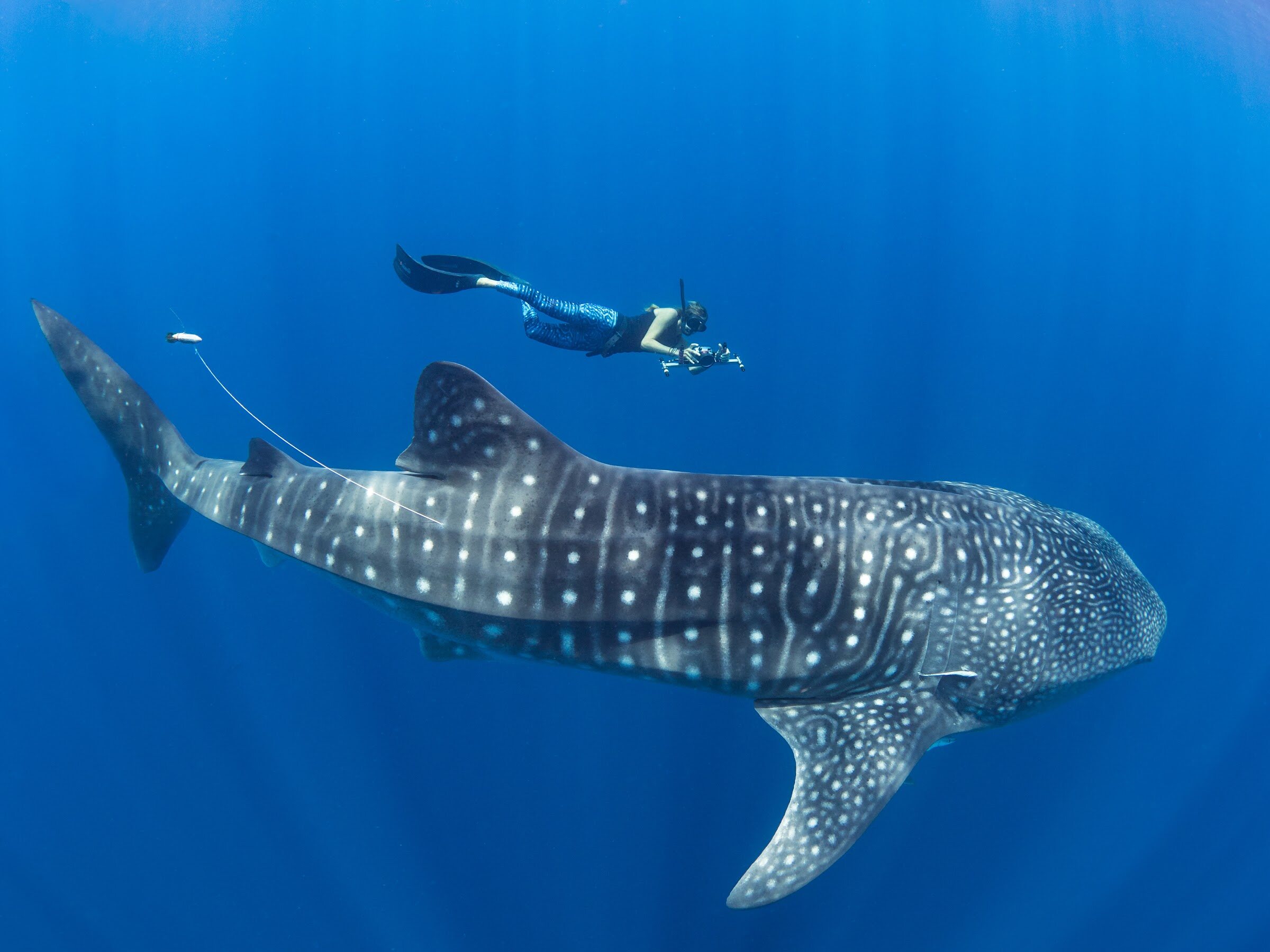
Satellite tracking has shown that some sharks undertake substantial movements away from Nosy Be: one traveled to southern Madagascar before returning, a round trip of more than 4,000 km (2,500 miles). Several tagged sharks spent considerable time at the surface further south along the Madagascar coast, indicating a second hotspot for the species.
That work also identified a high-use area around Nosy Be itself, which is now covered by a network of underwater acoustic receivers (twenty stations as of the 2025 season) that detect tagged sharks around the clock. The array has confirmed that whale sharks use Nosy Be year-round, often at night or offshore where they would not be seen from a boat, and that most of those detections fall inside the boundaries of the Tandavandriva marine corridor. These findings are now being used in marine spatial planning.
A code of conduct, now in law
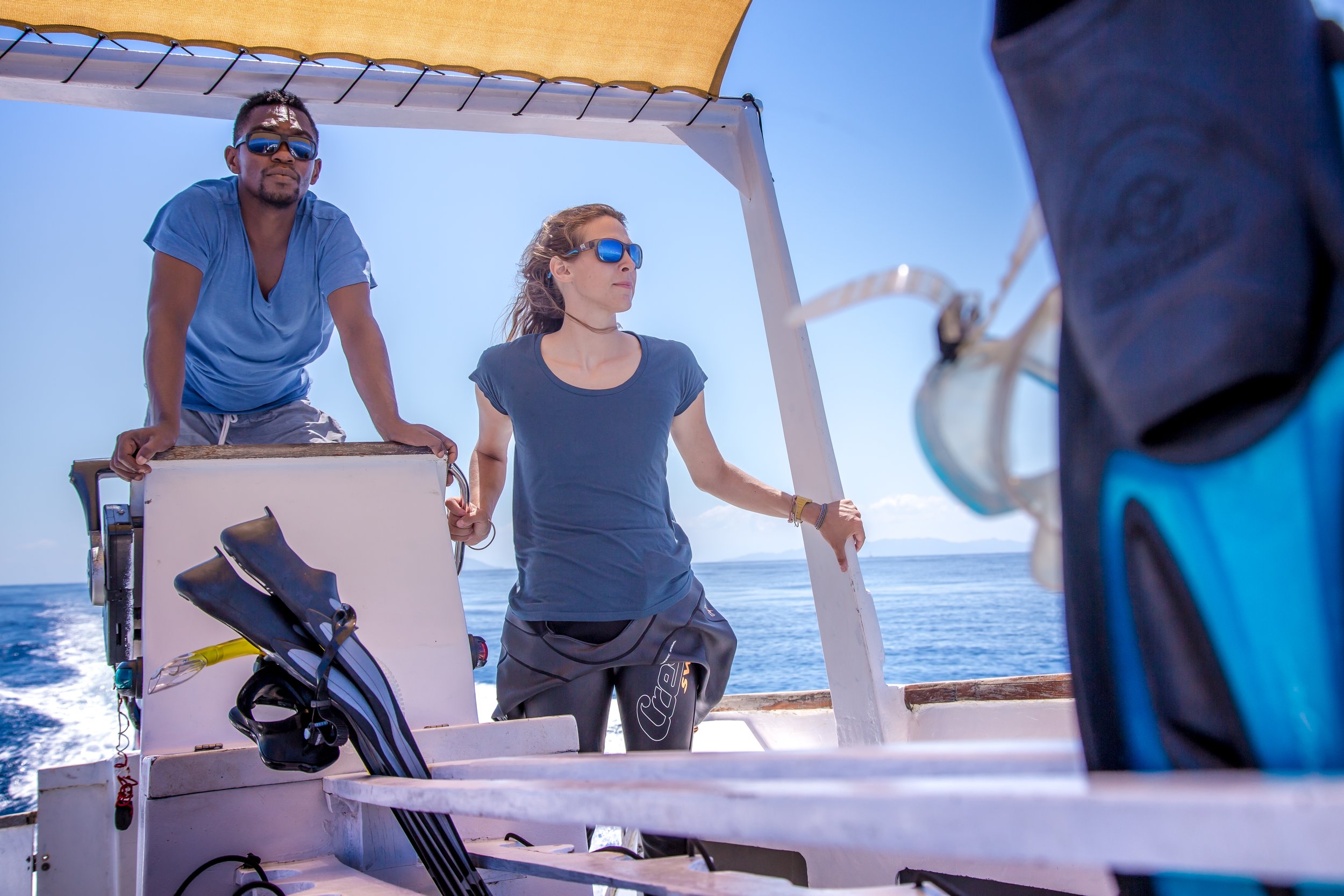
A code of conduct has been developed and implemented within the whale shark tourism industry since 2017, and in December 2023 it was formalized in Malagasy law by inter-ministerial decree, applying to operators working with whale sharks, marine mammals, and sea turtles alike. More than 300 tourism professionals have been trained, including through a three-module course delivered in 2024 that certified 68 operators.
Enforcement remains a challenge, however: boats still work with whale sharks without following the code, putting both the animals and the swimmers in the water with them at risk. (Photo: Madagascar Whale Shark Project.)
.jpg)
Ocean Ambassadors in Nosy Be
For the 2026 season, nine new Ocean Ambassadors from Nosy Be communities and partner projects are joining the Madagascar Whale Shark Project’s program. After two weeks of training in marine biodiversity, environmental education, regulations, and field responsibilities, they combine outreach on land and at sea with data collection on the impacts of tourism. Brian, who carried out master’s research with the project during the previous season, has joined the team full-time to coordinate this work.
Connecting the western Indian Ocean
In 2019, a juvenile male whale shark was photographed off Nosy Be and added to the catalog as Mistral. In August 2025, he was photographed again off Mahé, in the Seychelles, more than 1,200 km (750 miles) away and now around 6 m (20 ft) long. Matched from his spot pattern through a collaboration between the Madagascar Whale Shark Project and the Marine Conservation Society Seychelles, the record is the first confirmed movement of a whale shark between the two countries, and it was published in the journal Oryx.
With support from MMF, Stella visited the Marine Conservation Society Seychelles in 2026 to share data-collection protocols, train volunteers, and contribute to whale shark monitoring in the Seychelles.
Single records like this carry more weight than their number suggests. Whale sharks that move between countries can only be protected by countries that coordinate, yet Madagascar’s whale sharks are still being counted, tagged, and protected largely as though they were Madagascar’s alone. Nosy Be is recognized as an IUCN Important Shark and Ray Area, alongside oceanic manta rays and devil rays that use the same waters. The next step for this work is to extend that recognition into enforceable, connected protection across the western Indian Ocean.
The project on film
A short film presenting the Madagascar Whale Shark Project and its work in Nosy Be.
MMF Project Team
 Stella Diamant
 Dr. Simon Pierce
 Dr. Chris Rohner
 Dr. Clare Prebble
Collaborators and Partners
Recent research
- 2022Improving sightings-derived residency estimation for whale shark aggregations: A novel metric applied to a global data set
- Global collision-risk hotspots of marine traffic and the world’s largest fish, the whale shark
- 2021Regional variation in anthropogenic threats to Indian Ocean whale sharks
- Population structure, residency, and abundance of whale sharks in the coastal waters off Nosy Be, north-western Madagascar
- Economic value and public perceptions of whale shark tourism in Nosy Be, Madagascar
- 2018Movements and habitat use of satellite-tagged whale sharks off western Madagascar
In the news
Coverage of this work.
 Coral Sea Whale Shark Project
 Galapagos Whale Shark Project
 Microplastics & Megafauna
 Mozambique Whale Shark Project