
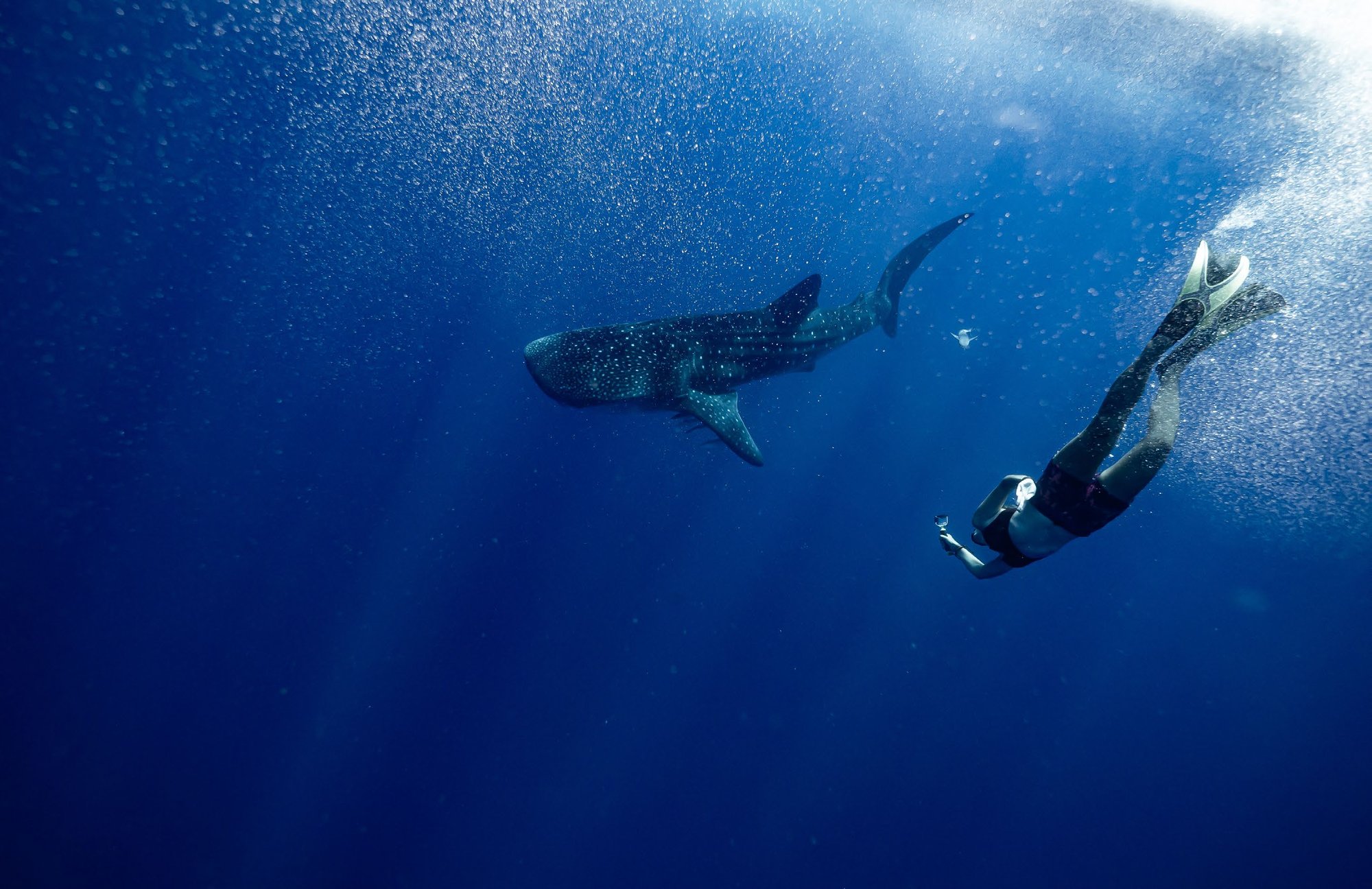
A Madagascar Whale Shark Project volunteer photo-identifying a whale shark.
Stella Diamant is the founder of the Madagascar Whale Shark Project, which has become a major research, education, and conservation program based on Nosy Be in northwestern Madagascar. Stella joined us for a season at Mafia Island in Tanzania back in 2015, and we’ve been collaborating with her and the MWSP team ever since. I talked to her while she was traveling through Mexico. – Simon Pierce
I’ll start at the beginning. You’re from Belgium; what got you over to Madagascar?
Initially, it was completely by chance. I first went to Madagascar as part of a volunteer program run by WWF in 2011. They have a program that offers you an experience as a volunteer on one of their projects. It was just after I finished my bachelor’s in biological sciences, and I sent in an application because I wanted some field experience in conservation.
I never really thought I would end up in Madagascar, but I did. I was 21 then, and it was a very intense experience. Far away and remote. I was blown away by how kind the people were and, equally, how beautiful the country was. There was so much to do, so much work needed, especially in marine conservation. That’s also when I realized that marine conservation is a field.
After that, I went on to do my master’s in ecology and conservation. I always wanted to go back and participate in developing marine conservation over there. So it was always on the back of my mind, and then in between two jobs – I worked in marine pollution at the time, studying marine plastics – there was a brief break between contracts.
I decided to go back to Madagascar and see if there was something I could do, or participate in. Completely by chance, I ended up on a touristic boat trip in the area where I work now. That’s where I saw my first whale shark ever. I was amazed by how beautiful they are, and also that no one was really doing anything with them. So I started asking questions and sending emails and that’s, I think, when we first got in touch.
Yeah. It really surprises people that there isn’t more known about even these iconic species, or amazing places like Madagascar. When you started there, it really wasn’t on the radar as a whale shark hotspot, was it?
No. Well, I looked into it and I didn’t find much. Rachel Graham from MarAlliance had done research a few years earlier, and there was a short paper summarizing anecdotal reports from Madagascar. I remember contacting other people in whale shark science, who said, ‘Well, if there were whale sharks, we’d know about it.’
Locally, there were a few operators running tours, and actually the operator we work with now, Baleines Rand’eau, has been active since about the same time. It wasn’t really consistent sightings or anything though. Thanks to the science, we know now there are more than 400 whale sharks at Nosy Be, but initially they all thought they were seeing the same sharks over and over. They were trying to recognize them by scars, but that was difficult with so many sharks.
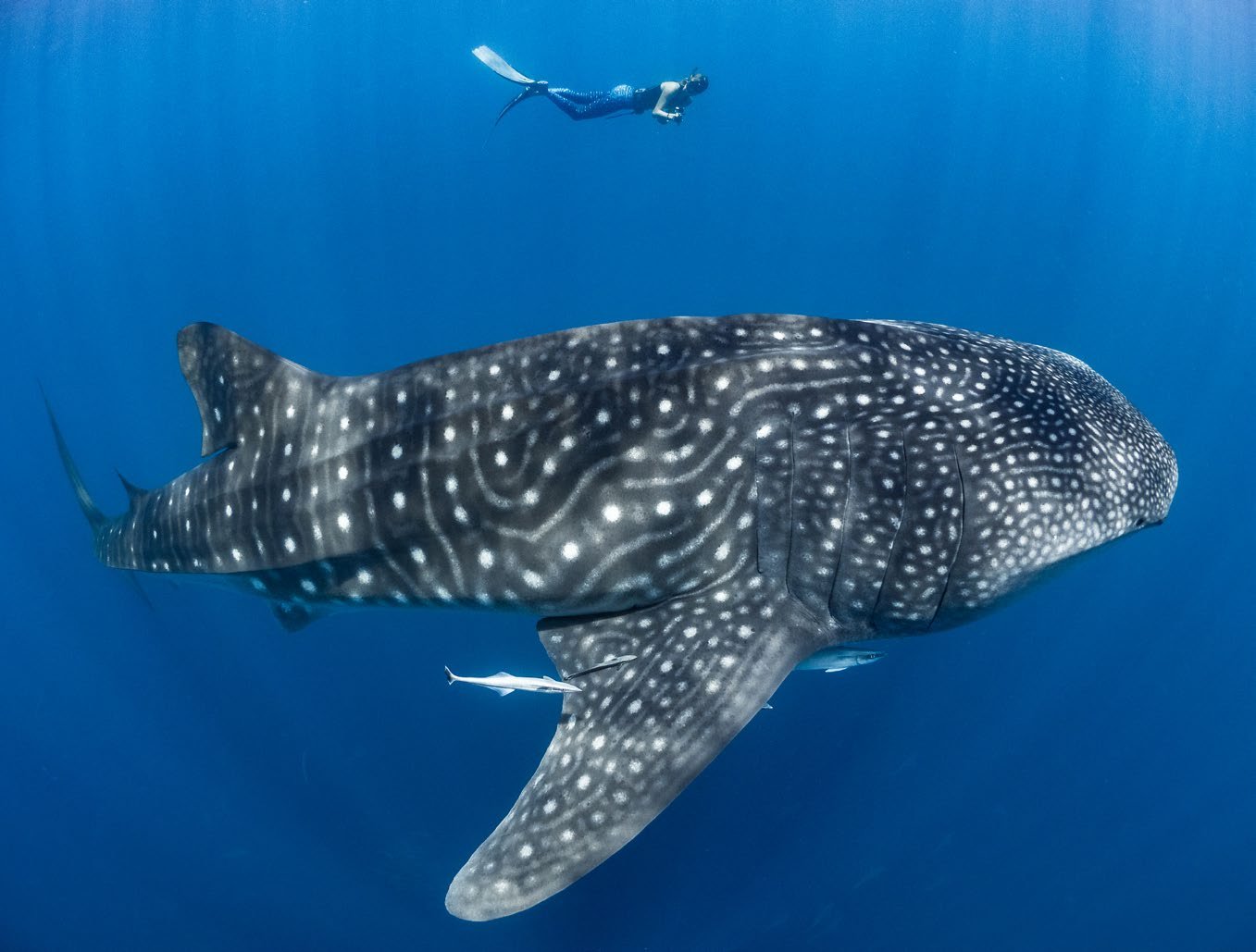
Stella and whale shark off Nosy Be.
I was super surprised myself. I was a Facebook friend of Jacques Vieira, who was working over there as a diver, and he’d sent me occasional pictures. It must have been pretty amazing when you first realized that there were actually a lot of sharks.
Yeah. So initially in 2015, while I was on Mafia Island with you guys, the Baleines Rand’eau team was collecting whale shark data for us opportunistically. We actually presented that data in Qatar at the International Whale Shark Conference in 2016. In just one season, they got more than 100 sightings. They were quite surprised themselves.
I think that result was what triggered my interest even more, to actually obtain funding to go there for a full season myself, to start a dedicated effort to collect standardized data.
You’ve put in a huge amount of field effort over there, going out pretty much every day for months at a time, right?
I was counting the other day. I think I’ve done maybe 700 trips now. So 700 days.
A couple of years’ worth of whale sharking.
It’s always different, and that’s what I love about this job and this career. You never know what is going to happen at sea, which shark you’re going to see. So often we get incredible days out, with amazing surprises and other animals, it’s always exciting. You never get bored by it.
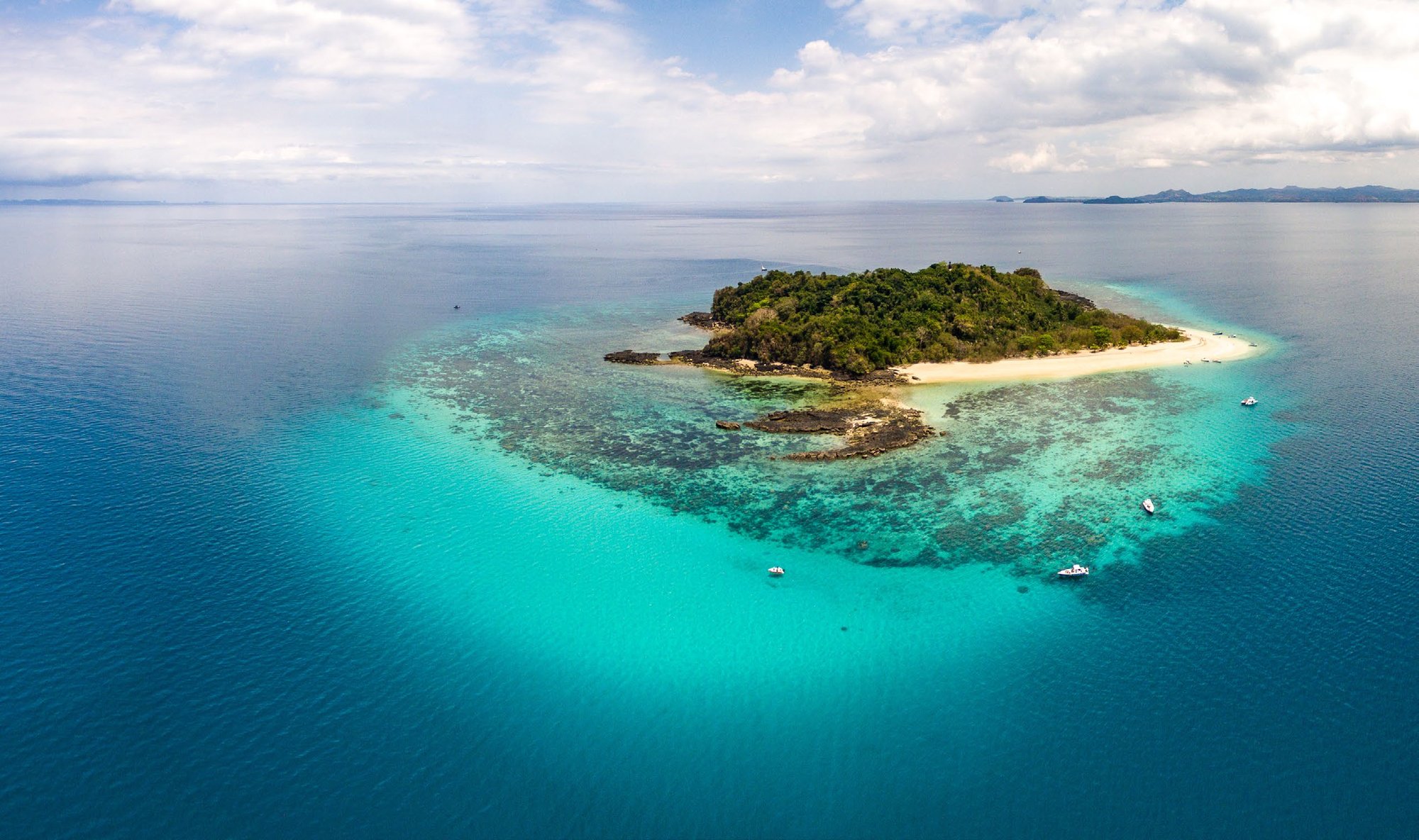
Aerial view of Nosy Tanikely, with Nosy Be in the background.
No, definitely not. So, how do you go about researching the whale sharks over there?
The main thing we do, which is pretty standard across the world now, is photo-identification. These days, we use volunteers a lot; we spend a few days training them, and then deploy them daily on different tourism boats. That’s what we’ve been doing over the last few years, and it’s working really well. Even though the boats communicate with each other, they usually follow different routes, and can all see different whale sharks.
For the first two years, I was pretty much on my own. I was collecting good data, but it was still only one boat’s worth of tracks. Now we get data from seven boats some days, so we get a lot more coverage of a big search area. We’ve recently started working with other operators too, so most of the guides now know how to take photo-IDs, and the divers will also take photos when they’re out.
We also satellite-tracked a few whale sharks back in 2016, and have collected biopsy samples that, thanks to COVID, are still stuck in Madagascar in a fridge somewhere. We’re also planning to deploy an acoustic array to look at the fine-scale distribution of whale sharks.
So that’s the bulk of what we do. We recently published a paper that summarized the past five years of photo-ID work, from 2015 to 2019. We identified more than 400 whale sharks over that time. I never thought we’d reach that number. I’m really proud that, using non-invasive science, we could get there.
The satellite tracks ended up being really cool too.
Really cool. One shark swam 7,000 km in total, and we saw him again afterwards. He went all the way down to the southern tip of Madagascar, then the tag stopped transmitting, and he came back to Nosy Be a year later.
You’ve identified over 400 sharks, but a lot of those, you’ve only really seen in one season, right?
Yeah. I think it’s about a third of the sharks we’ve seen in more than one season. Most sharks are just passing through. In the 2021 season though, we’d seen most of the sharks before. So I think we’re slowly getting to know most of the sharks.
With the satellite tracks, as you mentioned, I think it was six out of the eight sharks that turned up again in more recent seasons, right? So it’s a super important area to these whale sharks.
They keep coming back, even after swimming far away. So there must be a good reason for them to come back. I think we’ve decided it’s the food.
Indeed. Madagascar’s quite unique in terms of what the sharks are doing.
I’m realizing that more and more as I talk to other researchers. It’s really unique. We don’t actually look for sharks – we look for bait balls at the surface, these boils of activity. You’ll see all these birds, specifically terns, diving down to catch baitfish. Then, at the same time, there’s a lot of bonitos, small tuna, coming up from underneath to trap the little baitfish against the surface.
Amongst all this really intense activity, usually right in the middle of it, there’ll be a whale shark vertical feeding. Usually just one, rarely a few more. The sharks are scattered around the bay, all with their individual little baitfish restaurant. We can easily spot them from afar thanks to the birds flying around and the splashing of the tunas. I know there’s similar baitball activity in Djibouti and Honduras, and there was a recent paper from Ningaloo, but it’s still very unique.
The other thing is the blue water. I didn’t realize how special that was until recently, but it’s incredibly blue water. It’s really nice to see whale sharks in blue water.
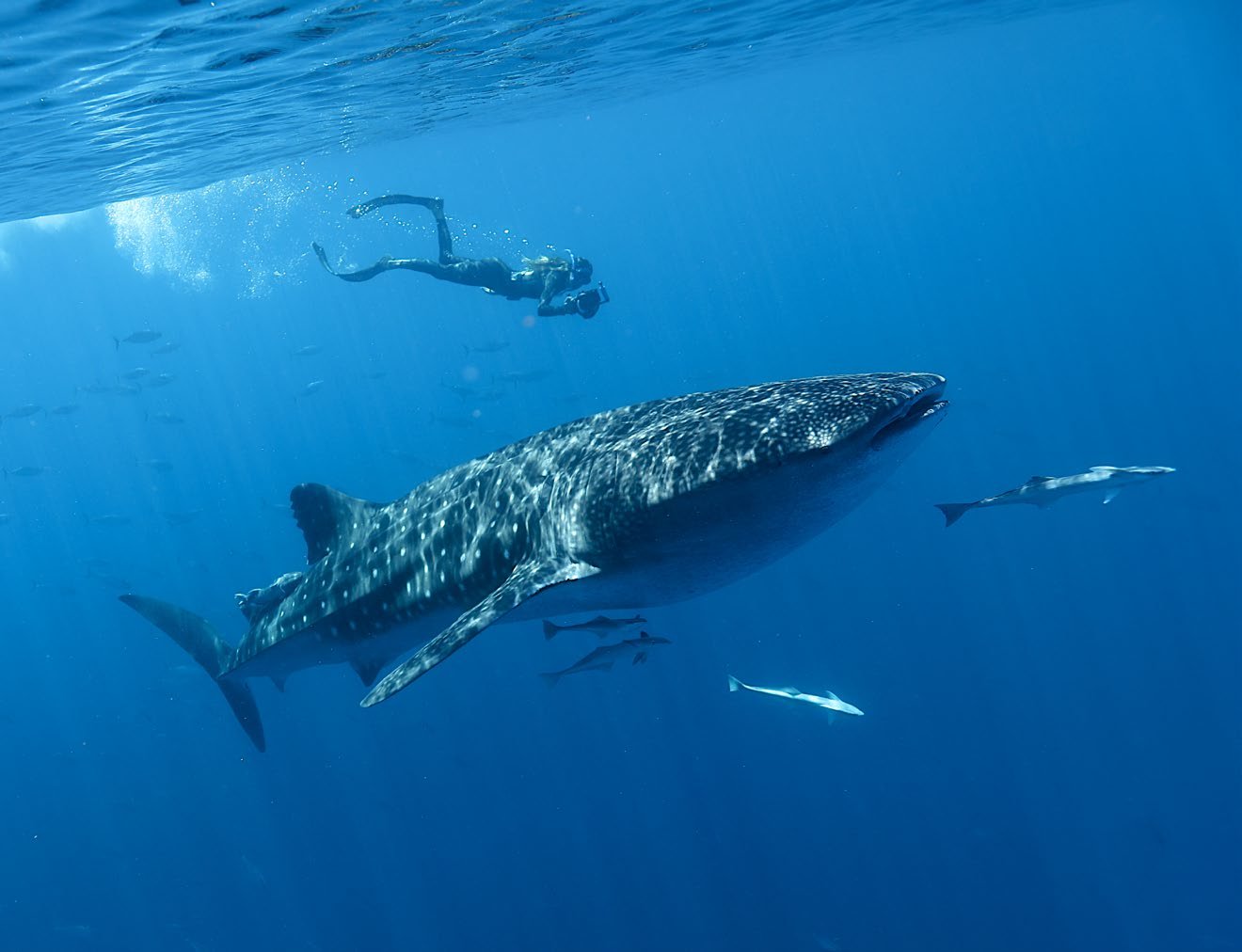
Stella photo-identifying a whale shark.
I think we mentioned it in the paper last year, an idea that Steve Fox from Utila in Honduras first put into my head – that the whale sharks might hear the tuna jumping and bird activity and come up to the surface. That’s always stuck with me as a really interesting idea.
Yeah. I remember you telling me this. I’m pretty convinced, but the thing is sometimes the bait balls are really small, or there aren’t many birds, and you still see a whale shark in there. One year I decided to try to measure the bait ball activity and, with the volunteers, recorded the number of birds and the size of the bait ball. We were thinking, ‘There must be some correlation if the bait ball is huge and there are all these birds.’ Sometimes it’s so big, so wide, it’s like crossing a football pitch, but there aren’t more whale sharks in there. So I’m curious. I think there’s something else we’re not understanding. Maybe there’s something to do with productivity, and the moon cycle, something else that’s maybe not so obvious. So that’d be a cool thing to study next.
It’s a really good example of how whale shark presence is closely linked to other species as well. I was going to mention protection; can you talk about the lack of protection for whale sharks over there?
Our study on whale sharks is pretty much the first long-term field study on any shark species in Madagascar. I wasn’t really aware of that until speaking with Rhett Bennett, from WCS, who we work with. There aren’t any shark or ray species protected in Madagascar, mainly due to the lack of baseline data. So, now that we have all of this data, we’re contributing to getting some sort of protected status for the whale sharks. We’re collaborating now with a few local partners to get that to happen, but Madagascar is a complicated country where there are a lot of other issues. There’s a big famine going on currently, and so it isn’t a priority. But yeah, currently, whale sharks are not protected at all.
It’s a tricky one though, because people are not fishing the whale sharks, so why should they be listed? There is a kind of self-regulation happening now where, because people now see how much they’re worth to tourism, they possibly don’t fish them for that reason. Also, from what I’ve heard, it’s because meat isn’t very good, it’s a lot of work to bring whale sharks back, and there isn’t really demand for whale shark fins currently.
So they’re mainly caught as bycatch, if they get stuck in nets set for other animals. I think what really needs to happen is some sort of control over what’s being fished, and some control of the gear and the methods being used, so that it’s less detrimental for all the shark species, including the whale sharks. That’s a more subtle goal, though.
It’s a great point, and I guess a core philosophy we both share is that it’s important to do what’s most effective, not just what sounds good. Sometimes the simple-sounding action isn’t the most effective conservation strategy.
Turtles are officially protected in Madagascar, so people don’t fish them, but they still die because they get stuck in nets. People we work with, especially recently during the pandemic, have seen lots of dead turtles, floating around. They’re listed, but is protection making any difference?
Protection does nothing without enforcement. Just from a broad perspective, regarding protection laws, if people aren’t catching any protected species then there’s no reason to change their gear. If they are catching listed protected species, then there can be more justification for gear restrictions where they’re needed, which can help to reduce whale shark catch, but also the bycatch of other, unprotected but endangered species that are being affected by the same techniques. Habitat protection is helped by the presence of these big iconic animals too.
Yeah. And the thing is, there used to be so many sharks in Madagascar. It’s been such a shark hotspot, especially in the Mozambique Channel. When you speak to people, especially in the south, everyone was catching sharks. They’ve been completely depleted now but, because of the lack of tourism, people are fishing even more sharks and rays and anything else they can find, just to survive. So that’s definitely a big issue. Even if it’s not directly affecting whale sharks, it’s affecting the habitat and the ecosystem, which are all linked, right?
Sure. Some people are thinking that the pandemic and the lack of tourism are helping ecosystems to recover. You’re thinking that the opposite is going on in Madagascar at the moment?
I’m a bit torn between the two. There’s been less whale shark tourism. They’ve probably been able to feed more, without disturbance, which is great. They’ve probably been hit by boats less. So it might be good for them. I know from local sources and friends, though, that there’s been a lot more poaching going on, and more sharks and fish getting caught. People are just really desperate for cash, and they can get quick cash from selling shark fins to Comoros and to China. That’s a market that’s just been rising, despite the pandemic. So, that is worrying.
It does make me wonder, really, how sustainable and reliable tourism is. I remember us sitting on the boat with a journalist friend telling him that tourism would save whale sharks. I really believed that, but then I see what’s happening now when tourism suddenly stops. It’s a tricky one.
Yeah. It’s hard. Effectively, tourism has been subsidizing the costs of research and protecting the sharks as well. There’s no other mechanism in place to get that stuff done. Obviously, a big part of my attention is always on sustainable financing for nonprofits. The pandemic has brought it home that if you’re reliant on ecotourism, as good as the industry can be, when it stops, everyone’s in trouble.
It’s been a big wake-up call for us, for me especially. If there was no pandemic, I’d be earning a little living, but it would be stable. We’d have enough money coming into to have a stable research program but, now, everything’s upside down. We need to think of other creative ways to get funding in, without relying on tourism, so it’s a big change from what we were doing before.
A resilient approach. Yeah. So, coming back to the Nosy Be area itself, obviously the whale sharks have been a big focus for your work – but they’re only one of the giant, iconic animals that are found in that region.
Yeah. It’s an amazing area. We see many dolphin species, many turtle species. Once we saw a leatherback turtle, which was pretty cool. I was lucky to see it, but we also see many mobula rays, quite frequently, and sometimes giant manta rays. We’re putting together a paper on the manta rays, and it would be the first paper on manta rays in Madagascar, so that’s exciting. Then there are the humpback whales coming through, and they overlap with the start of the whale shark season. Then, there’s a really cool species called the Omura’s whale, which is still very mysterious. Madagascar is one of the only places where they’re often seen, and they’re just amazing.
Given that it is such an important area for marine species, is there an effort underway to look at managing the area and protecting it?
There’s definitely interest. Thanks to WCS, who we’re working with, there’s been discussion and an actual agreement to expand two existing marine protected areas, north and south of Nosy Be, into one bigger MPA that would encompass some of the whale shark habitat. That would be a huge win, but there are still open questions – will it be a no-fishing zone? Will there be boat speed regulations? I’m not sure about the answers there. I’ve provided data to support that process, and the acoustic array we’ll deploy this year will provide a lot of answers on the residency of the sharks.
Actually, with the satellite tracking, you identified another place where they were spending a lot of time at the surface.
Yeah. That’s been really exciting, and I think even more exciting is the fact that it’s really remote and difficult to get to.
It’s good that you’re excited by this stuff.
Oh yeah. I’m still so excited about it. Yeah, there is a second place – near Pointe d’Analalava – where the whale sharks, at least the whale sharks from Nosy Be, go and feed – but we don’t know if it’s all the same sharks. Maybe there are some sharks that only use that area and don’t come to Nosy Be. We’ve seen from the satellite tracks that they do surface feed, and we’ve seen bait balls there, so it might be similar to Nosy Be. I’m hoping to deploy some acoustic receivers down there, so that if we tag some whale sharks in Nosy Be, and they go there, we can pick it up.
It’s a really beautiful place. It’s only 180 km by sea, so you’d think on a road it would be a few hours. No, it’s two days on the roads, if you don’t stop. I’ve been there twice now. Once, I hitchhiked overland to get there, then hitchhiked out on a boat but, after all that, we didn’t have enough fuel to actually reach the area I was interested in. The second time it was more of a planned expedition to find the sharks, but we didn’t see any. So I’m still very intrigued by the area.
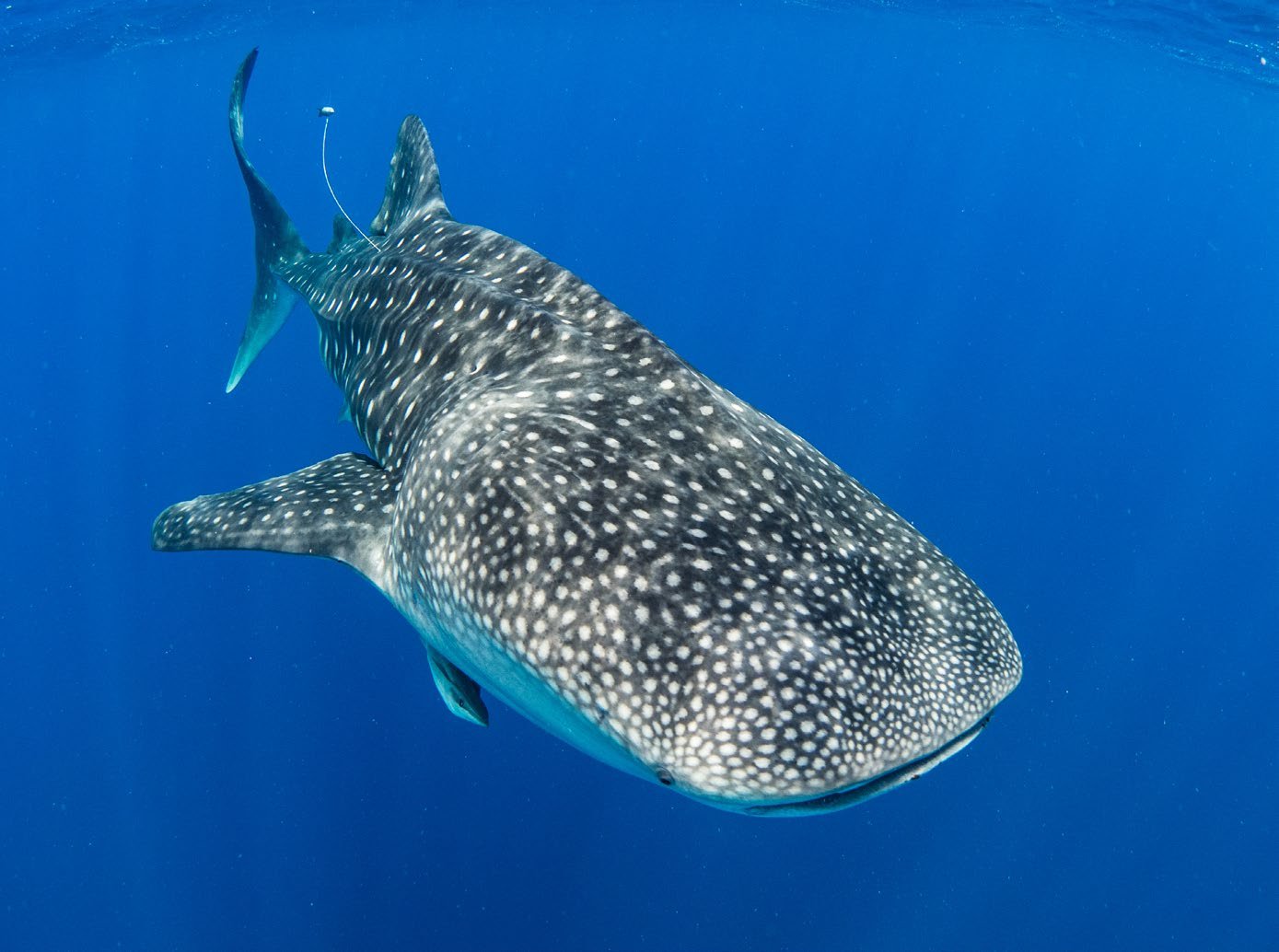
A satellite-tagged whale shark off Nosy Be.
I thought that result was a really good testament to why satellite tracking can be useful, because it’s identified a place that we didn’t know whale sharks were hanging out. But they clearly are, based on the eight satellite-tagged sharks – several of them spent quite a lot of time in that area.
Yeah. When I was there, I spoke with some local fishermen who sometimes see them, but no one really knew what was going on. Unless we do photo-ID, we’re not really going to know how many whale sharks are there. I’m quite curious as to whether it’s a big hotspot, or just a small one, or if the sharks are just there for a few days a year. It’s the same with the Mitsio Archipelago, further north of us, in that the tagged sharks also spent time up there. There’s a big hotel there with a dive center, but they never really see whale sharks. So there’s still a lot we need to understand.
We’ve talked about tourism in passing. One of the aspects of your work that has really impressed me is the way that you interact with the tourism operators around Nosy Be. Very quickly, it’s gone from basically unmanaged tourism, to successful ecotourism. I know there are some issues, but compared to a lot of places around the world, I think it works pretty well. Can you explain what you’ve done to help that situation along?
So initially, in 2016, we had that first operator saying, ‘We want to include a code of conduct. We want to add one to this place,’ but the other operators were like, ‘No, we don’t agree.’ You remember this response? It was quite shocking, and I remember feeling quite sad like, ‘Oh, how are we going to do this?’
There were two papers that helped. One from Jackie Ziegler in Mexico saying, ‘We spoke with tourists after the tour, and these are the things that they liked the most, and that mattered to them most,’ and one of them was spending as much time as possible with the shark, for example. And then your paper, from you and Peter Haskell in Mozambique, looked at whale shark avoidance behaviors and laid out, ‘Whale sharks will respond to this and this, and this’.
Basically for me, that gave us a recipe for success. If you can meet the needs of the tourists coming to swim with whale sharks, and you can guarantee they’re going to receive what they paid for, that in turn benefits the operator and their reputation. And at the same time, if you follow what’s been shown in the science – we know certain things make whale sharks react negatively, so we avoid them.
For me, that was quite clear. Then it was just a matter of, ‘How do we share this information in a user-friendly way with people?’ That was a real exercise and it took a bit of trying. We printed a very simple code of conduct, and we distributed that around, but it was still difficult and there was still this little petty fighting between the operators at sea.
So then I decided to go and meet all of them individually. That’s been a long-term effort. It means spending a lot of time repeating the same speech and trying to convince people with the same arguments. But it kind of worked. Slowly, people were trusting me more, and we’ve had this huge advantage in Madagascar of having been quite late to the whale shark tourism party. We could already see that ‘Oh, these people followed a code of conduct, and it worked. These people didn’t, and it’s a mess.’ With these two papers, I thought we had all the information we needed, so the question then was mostly, ‘How do we empower people to make it happen?’
The answer seems to be, simply, ‘Invest time with them.’ If they ask for you to come on the boat, you go on the boat. If they ask you to come to the other side of the island to give a speech, you do it. It’s been kind of exhausting for me, but it’s slowly paying off. The last two training sessions we did were in collaboration with Cetamada, a humpback whale research and education NGO on the east side of Madagascar. I knew of them since my first visit to Madagascar, and they got funding to train guides for humpback whale watching. It was a natural progression to include whale sharks in that.
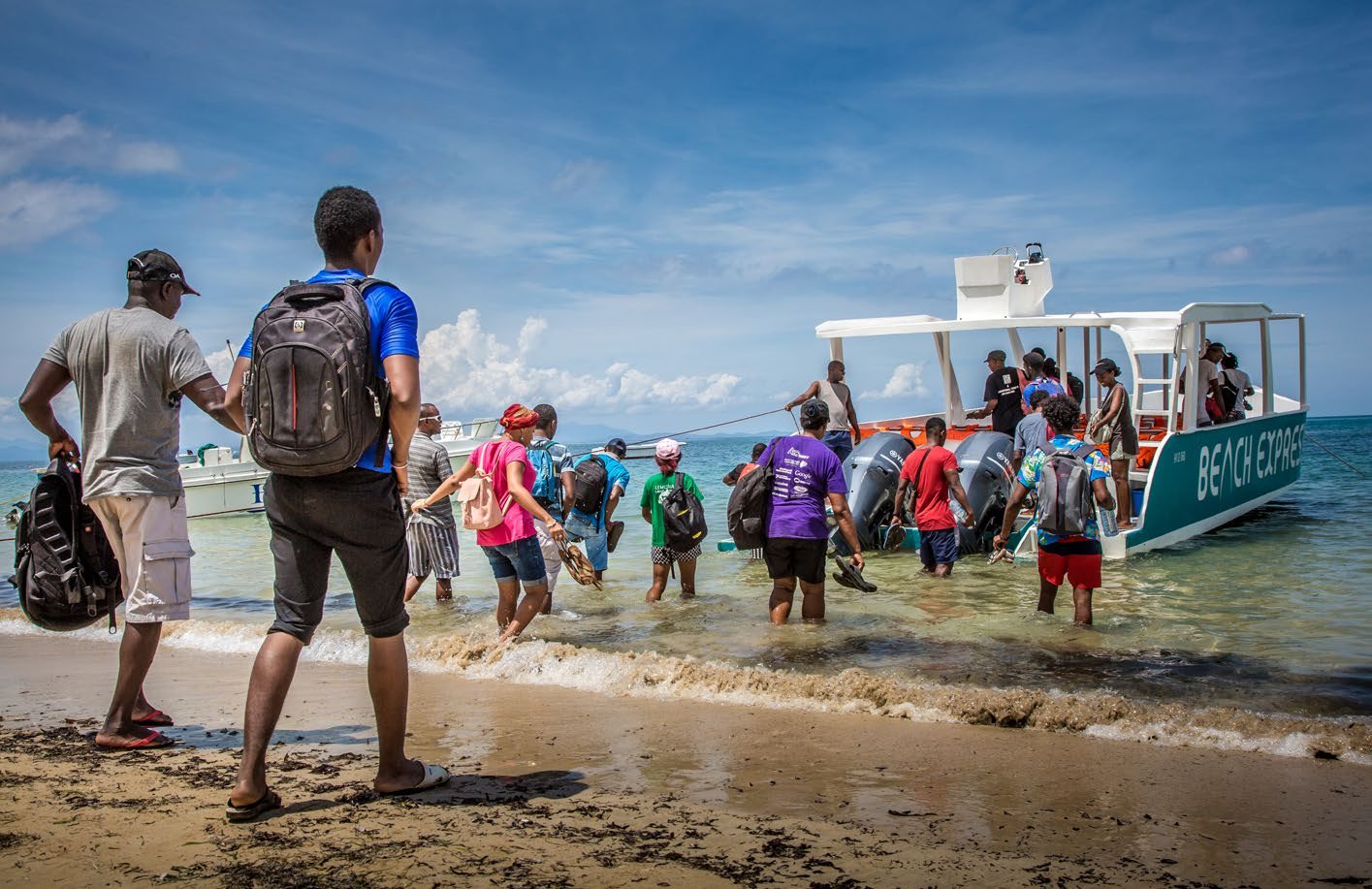
Heading out for a day of whale shark tourism.
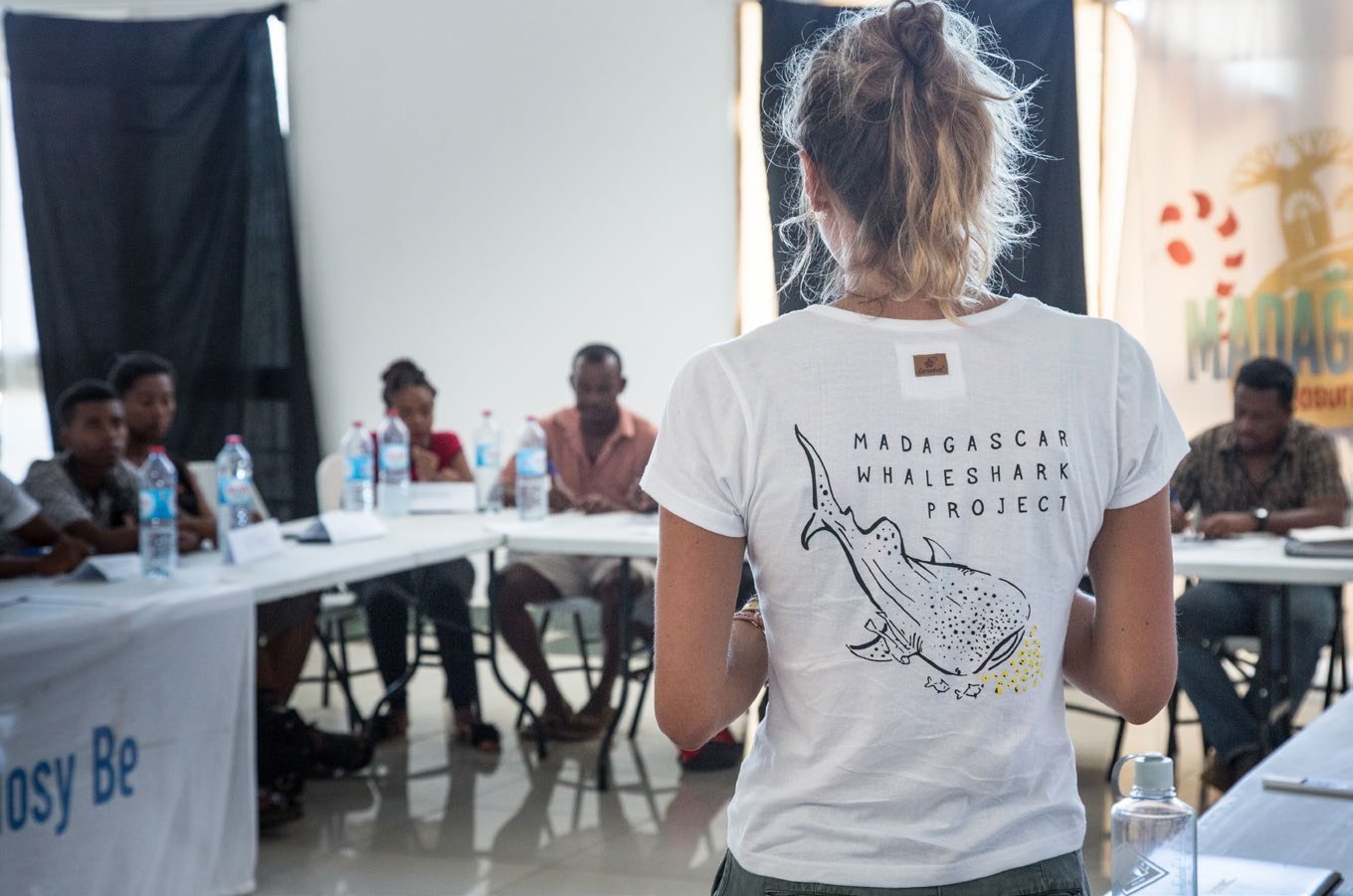
They came to Nosy Be and rented a big room for the Malagasy operators. Cetamada spoke about humpback whales for a day, and I spoke about whale sharks for a day. Then we went to sea and showed how, in practice, you approach both whale sharks and humpback whales. People were paid for their time, they were given lunch; there was nothing to be lost for them. So I think that’s definitely the way forward, to empower people and actually make them want to come, even if it means buying them lunch.
It’s definitely something I’m going to do more of, and it’s been really great because we really see the difference out at sea. I’ve been quite surprised, I have to say, because initially, I was very conscious that I’m a white woman giving orders to local men. They know a lot more about the sea than me, but because I’m a scientist, and I can kind of explain the science in an easy way, then it made it really approachable for them. There is a fine line between that and giving out information in a patronizing way. We’ve had a few more issues with other expats from Europe. But slowly it’s improving.
Coming back to what we were saying about laws and enforcement, after delivering that training with Cetamada, they wanted to renew their law against swimming with humpbacks and how to approach humpbacks properly. We’re adding an appendix to that law about the whale shark code of conduct, so I’m proud of that. Soon enough it’s going to be an official law in Madagascar.
There probably isn’t going to be any enforcement, though, so I think the great level of self-regulation now going on in Nosy Be is the most important thing – if someone isn’t following the rules, then most of the people are going to scream at them. If all the actors are empowered enough about what’s right, then it self regulates, I think, as long as it remains this small.
Before COVID, there was a lot more tourism happening each year. Actually, I think from 2015 to 2019, the number of international tourists coming in had doubled, and thanks to the economic study on whale shark tourism we did with Jackie Ziegler, we know that it’s bringing in a lot of money for Madagascar. There’s definitely more attention on Nosy Be, and more people wanting to visit.
Yeah, that’s the thing – during a good whale shark season, everything can be easy. Everyone has their own private shark. On the slow days, though, where I’ve seen 50 boats trying to get in with two whale sharks in other places, that’s where the value of regulation can come through. Ultimately, in Madagascar, I think that so much of the success with whale shark tourism there is down to your hard work, over multiple seasons, with that constant engagement – just wearing people down really, as they realize that you’re not going anywhere!
Yeah. Although I’m going to need some help now, because it’s getting to be too much work for one person. I need to find another person as stubborn as me.
Really, I think it’s so important that we scientists share what we know with the community. Initially, I thought, ‘Oh, they don’t really care’. But the captains know the whale sharks now. They recognize individuals. I think there’s a lot to do, everywhere in the world, to empower local people to care – it comes with getting to know the sharks, helping them meet the sharks. It might seem trivial, because we see them all the time, but they really appreciate it.
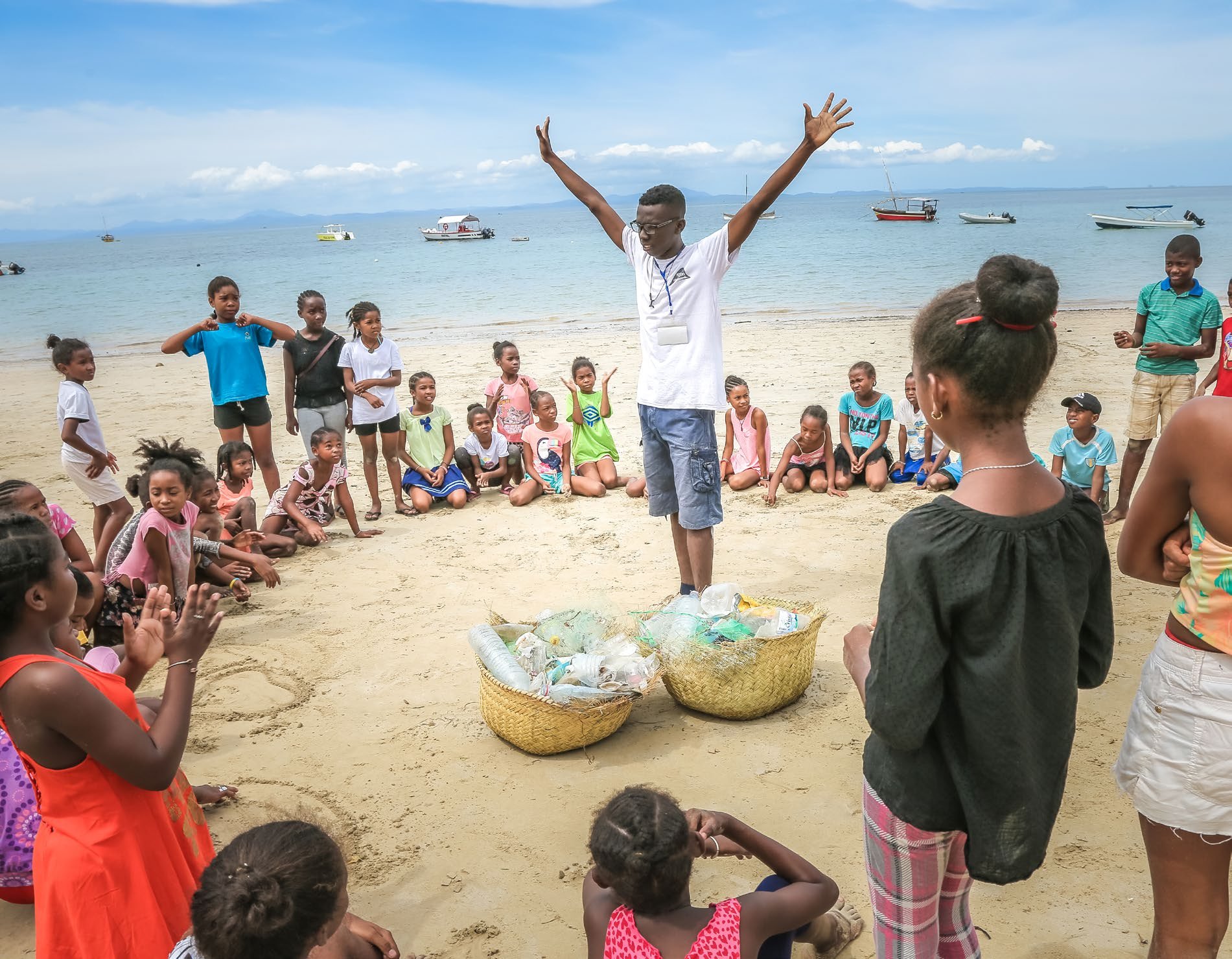
The MWSP education team working with children on Nosy Be.
Locally, is the view on whale sharks fairly positive? I know you’ve been doing a lot of marine conservation education in the community as well.
Yeah, so thanks to MMF for your support, because I came to Tofo in 2018 and saw how the education program was run there, and then we adapted that for Madagascar. We have a second education person now, as of a few months ago, so, we have two staff members and 16 classes we work with.
There’s definitely a lot of demand for growth, especially from the kids, and from the teachers on educating kids about plastic, marine life, and what’s out there – and taking them to see things. Of course, that transmits to parents directly.
That’s a part I love, because you see results really fast. The kids did a video clip, with a song about plastic, a rap song – it’s really catchy. Once I grabbed a shared tuk-tuk and there were kids in it and they were singing the song and I thought, ‘Oh, that’s why it all matters, because – eventually – it has real impact.’
There’s more that we aren’t doing, that I would love to do, and I’m not sure exactly how to do it yet. Especially speaking with the fishermen, and interacting with the adult population that are not involved in tourism, because we’re not in touch with them now.
Most people are fine with whale sharks. They’re associated with other fish, like the tuna we discussed earlier, and of course, the tourism industry brings in money. So adults like them, and the kids love them because they know all the cool facts about whale sharks now.
That’s awesome. Anything else you want to wrap up with?
It’s been a ride. I never thought it would go this far, but it has, so I guess it shows that anything is possible. One of the things I try to do now is to share my journey and motivate other people, especially women, because we don’t need a PhD. We don’t need certain education. We just need grit and motivation, I think, and there’s so much to be done still.
I think grit really sums up one of your primary personality traits. I know it’s been a long ride, as you say.
Thank you. Yeah. It’s been surprising. I remember getting in touch with you. You were refreshing in the way you approached things, because you didn’t ask me about my papers or about my education. You just said, ‘Oh, this sounds like a good idea, and it matches with what we’re trying to do at MMF’.
I wish more people in the science world were like this, because things aren’t great. There’s a climate crisis, there are species going extinct. We need people with grit more than exactly the right education, or with the highest number of papers. I think there’s a real kind of can-do experience that is a bit lacking in developing young conservationists. I encourage people to be more open to young people that are working to start something.
Definitely. Well, that’s been awesome. Thank you so much for chatting to us today.
Happy to. It’s nice to look back after all these years!
Whale shark approaching a tourism vessel off Nosy Be.
This conversation was originally published in Ocean Giants, MMF’s magazine, Issue #05 (Summer 2022). Download the full issue as a PDF. Read more about this work on our Madagascar whale shark research page.