
Qatar · Global Whale Shark Program · Since 2011
Qatar Whale Shark Project
Every summer, more than a hundred whale sharks at a time aggregate in an offshore oil field in Qatar to feed on the eggs of spawning tuna.
Led by Qatar Whale Shark Research Project, with MMF
Every summer, whale sharks (Rhincodon typus) aggregate in the middle of an offshore oil field in Qatar to feed on the eggs of spawning tuna. Since 2011, we have worked with Qatari partners to document the identity, residency, and movements of these sharks.
The Al Shaheen oil field lies about 90 km (56 miles) off Qatar’s northeast coast, in the central Arabian Gulf, where the sea is 50–70 m (160–230 ft) deep. Workers on its platforms had reported large groups of whale sharks since 2007. The Qatar Whale Shark Research Project began in 2011 as a partnership between Qatar’s environment ministry, the field’s operator, and a small group of scientists, led by Dr. David Robinson, who founded the Sharkwatch Arabia citizen-science network in 2010. Working alongside Mohammed Jaidah of the ministry and the operator’s research staff, the team conducted boat surveys, photo-identification, and satellite tagging, and operated an acoustic tracking array, with support from the Qatar Coast Guard. MMF’s Dr. Simon Pierce and Dr. Chris Rohner have co-authored the project’s research since its first paper in 2013.
What the project has done
- Described the Al Shaheen aggregation for the first time from the 2011 season, showing that the sharks aggregate there to feed on tuna eggs, published in PLOS ONE in 2013.
- Photo-identified 422 whale sharks across the Arabian Gulf and Gulf of Oman between 2011 and 2014, 341 of them at Al Shaheen, published in 2016.
- Tracked 59 satellite tags fitted to whale sharks at Al Shaheen between 2011 and 2014, mapping the sharks’ movements after they leave the field, published in 2017.
- Operated an array of 21 acoustic receivers around the field from 2012 to 2016, monitoring 117 tagged sharks through about 105,000 detections, published in Frontiers in Marine Science in 2025.
- Contributed data on Qatar’s sharks to regional and global studies of whale shark movements, diet, residency, ship-strike risk, and climate change.
Support whale shark research in the Arabian Seas
The whale sharks of Al Shaheen range across the Arabian Gulf and beyond. Your gift supports our whale shark research in Qatar, Oman, and across the region.
Research findings
Feeding on tuna eggs
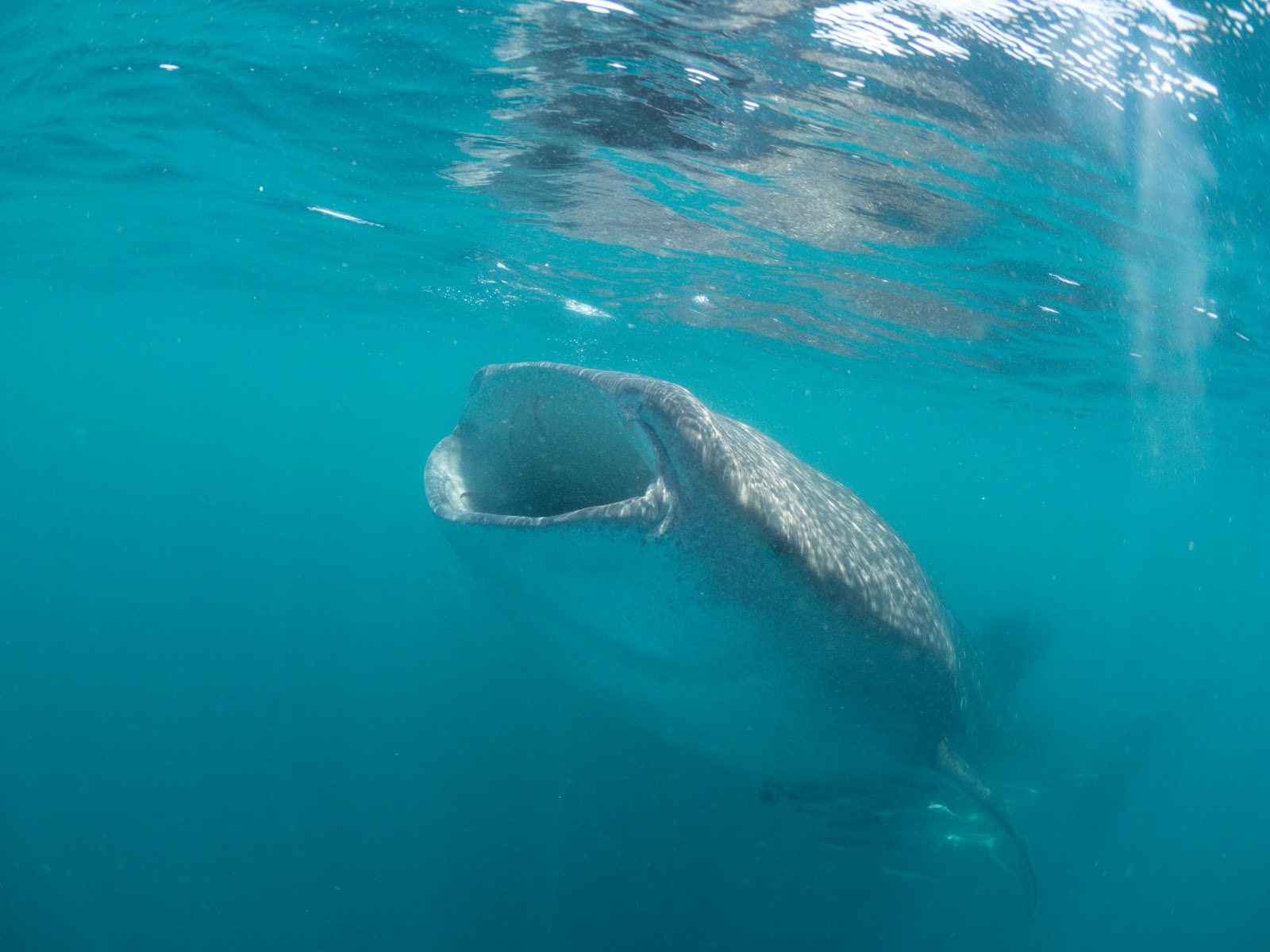
Whale sharks are present at Al Shaheen from April to September, peaking from May to August, and up to 100 have been seen feeding together in a single square kilometer (0.4 square miles). Fish eggs dominated plankton samples taken among the feeding sharks, accounting for 66–77% of the net contents, and DNA barcoding identified them as the eggs of mackerel tuna (Euthynnus affinis). Acoustic tracking revealed a daily cycle: the sharks feed on the drifting eggs from about 7 am until midday, carried downstream by the current as they feed, then swim back upstream at night. Most detections came from one small area of the field, indicating that the sharks are targeting a tuna spawning site rather than the platforms themselves. The Gulf has more than 800 oil and gas platforms, yet none of the others hosts a regular whale shark aggregation.
Feeding in hot water
The Arabian Gulf is shallow and becomes exceptionally warm in summer. In August 2011, the top 10 m (33 ft) of water at Al Shaheen remained above 33 °C (91 °F) for the entire month, yet the sharks continued to feed. Tagged sharks spent about two-thirds of their time in water of 24–30 °C (75–86 °F), moving deeper and into cooler water at night. These conditions make the Gulf’s sharks important for understanding how whale sharks will cope as the oceans warm: in a 2024 global study, the highest temperature encountered by any tracked whale shark, 33.4 °C (92.1 °F), was in the Gulf.
Size, sex, and maturity
Photo-identification, based on each shark’s unique spot pattern, recorded 341 individuals at Al Shaheen between 2011 and 2014. They ranged from 4 to 10 m (13 to 33 ft) long, averaging about 6.9 m (22.6 ft), and 69% of those whose sex could be determined were male. Most males were mature, which made Al Shaheen the first whale shark aggregation known to be dominated by adult males, in contrast to most aggregations elsewhere, which consist mainly of young males. Two females of about 9 m (30 ft) appeared pregnant, the first time this had been recorded in the Indian Ocean region.
Residency and return
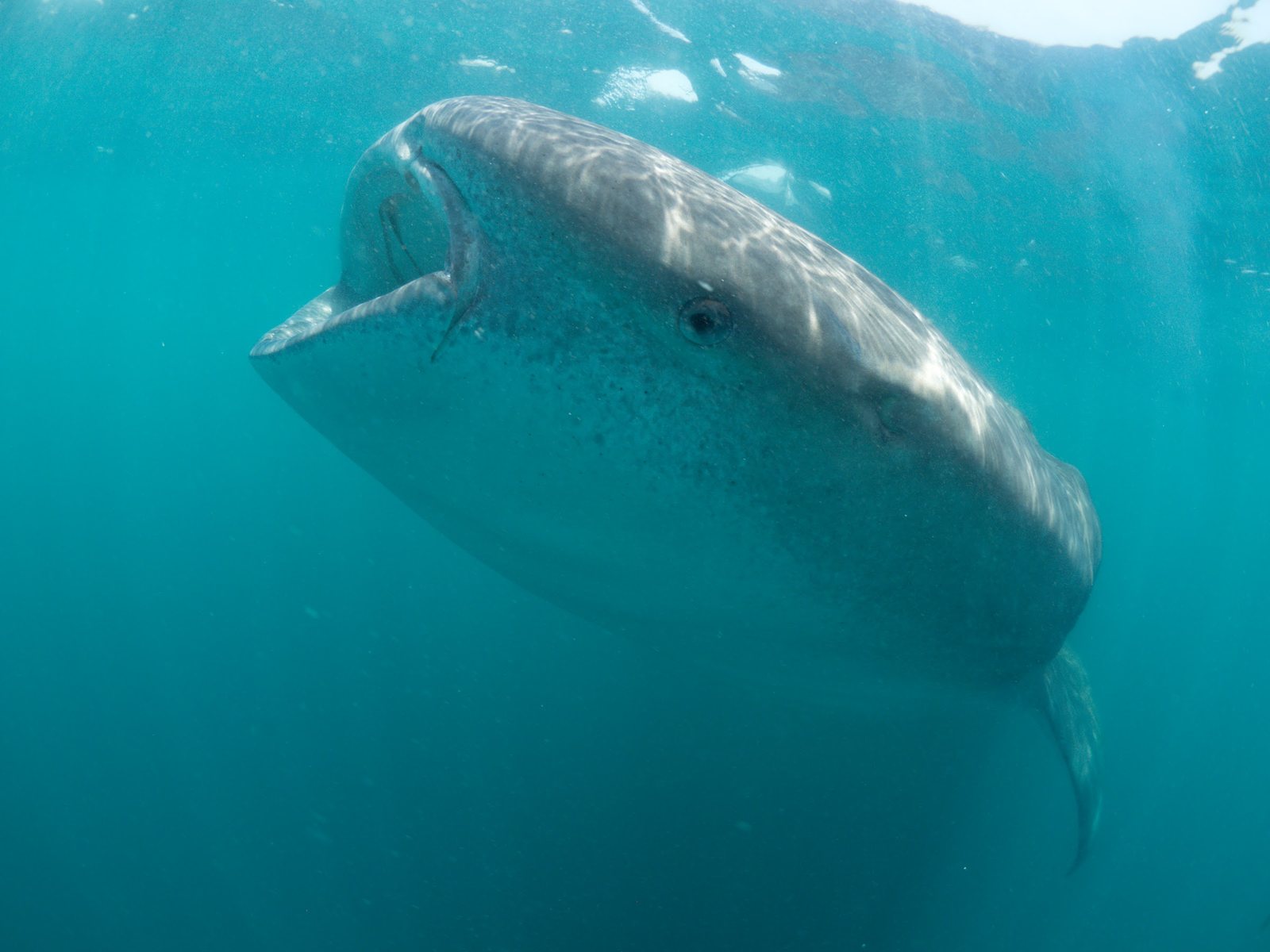
An estimated 124 sharks were present in the field on any one day during the season. Acoustic tags recorded continuous stays of up to 77 days, with half of the tagged sharks remaining for two weeks or more. Residency at Al Shaheen is longer than at other well-studied sites, including Ningaloo Reef in Australia and St Helena in the Atlantic, and the largest sharks, 8 m (26 ft) and over, were the most resident of all. Many sharks also return: of those fitted with satellite tags and also photographed, 58% returned in later years.
Movements beyond Qatar
At the end of the season, the sharks disperse into deeper water across the Gulf for the winter, and every shark still carrying a tag after the season moved into the waters of Saudi Arabia, Iran, the United Arab Emirates, or Oman. Nine left the Gulf through the Strait of Hormuz, and one large female, thought to be pregnant, crossed five maritime boundaries in 37 days to reach waters near Socotra, about 2,644 km (1,643 miles) away. The tracks also point to a likely second feeding site in Saudi waters, about 126 km (78 miles) from Al Shaheen. Photo-identification links Al Shaheen with the Musandam Peninsula and the Daymaniyat Islands in Oman, up to 828 km (514 miles) apart, but not with the whale sharks of Mozambique or Tanzania. Effective protection for these sharks will therefore require countries across the region to work together.
A sanctuary by accident
Fishing has been prohibited around the Al Shaheen platforms for decades, and boats must remain 500 m (1,600 ft) away from them. As a result, the field functions as an unintended sanctuary for the whale sharks, and probably benefits the tuna that spawn there too. Al Shaheen is now recognized as an Important Shark and Ray Area. The sanctuary does not, however, remove the threat of vessel strikes: three of the 14 sharks checked for injuries in 2011 carried boat-strike scars, and a 2024 global study named Al Shaheen among the places where measures to reduce collisions between ships and whale sharks would do the most good, an opportunity to make the sanctuary safer still.
MMF Project Team
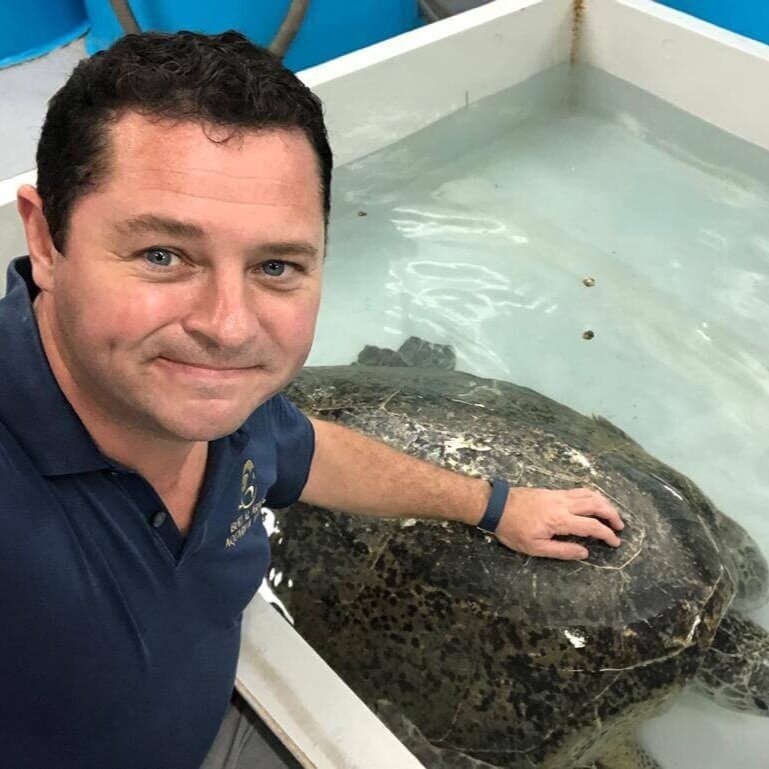 Dr. David Robinson
 Dr. Chris Rohner
 Dr. Simon Pierce
Collaborators and Partners

Recent research
- 2025Whale shark residency and small-scale movements around oil and gas platforms in Qatar
- 2018Limited latitudinal ranging of juvenile whale sharks in the Western Indian Ocean suggests the existence of regional management units
- 2017Some like it hot: Repeat migration and residency of whale sharks within an extreme natural environment
- 2016Population structure, abundance and movement of whale sharks in the Arabian Gulf and Gulf of Oman
- 2013Whale sharks, Rhincodon typus, aggregate around offshore platforms in Qatari waters of the Arabian Gulf to feed on fish spawn
 Coral Sea Whale Shark Project
 Galapagos Whale Shark Project
 Madagascar Whale Shark Project
 Microplastics & Megafauna